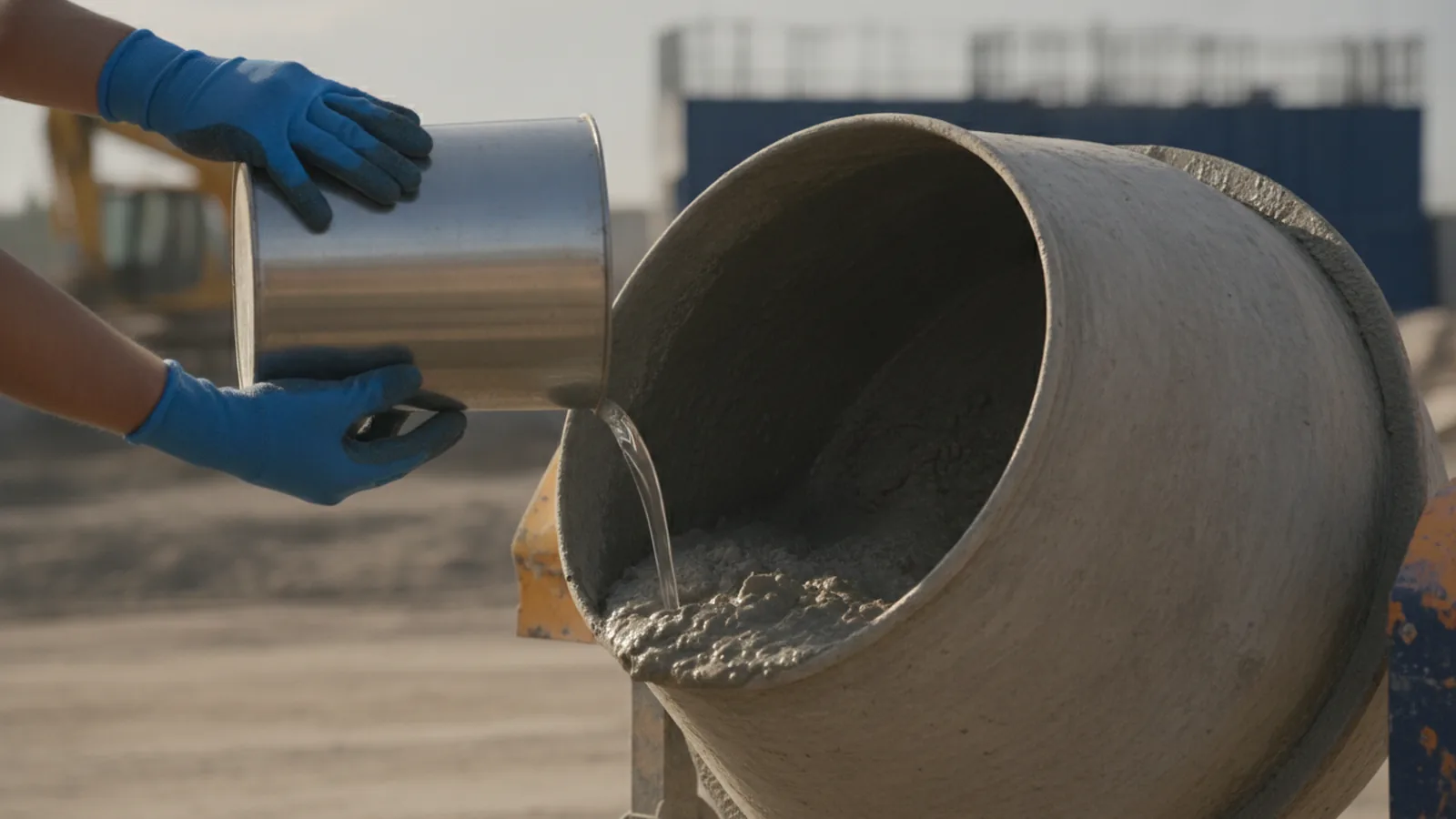
What Is an Admixture in Concrete? Types, Uses and Dosage
Fifteen admixture classes with the actual chemistry in each, plus a pigment-to-colour table for coloured concrete. No dosage figures.
Key takeaways
- Water-reducing admixtures can cut water demand by up to 30%, in plasticiser, mid-range and superplasticiser tiers.
- Pigment table: iron oxide gives red, brown, black or yellow; chrome oxide green; cobalt blue; titanium white.
- Anti-washout admixtures use modified cellulose ethers to stop segregation when concrete is placed underwater.
The short version
Admixtures are ingredients added to concrete to modify its properties. They can improve workability, strength, durability, and resistance to environmental factors. Admixtures include water-reducers, accelerators, retarders, air-entraining agents, and more.
Types of Concrete Admixtures and Their Uses
Concrete admixtures are added to a mix in order to improve various properties of the concrete, including strength, workability and longevity. Different admixtures serve different purposes; some are used to increase durability or reduce shrinkage while others impart workability, retard set or delay setting time.
When creating concrete, it is important to consider the use of admixtures. One type of admixture is a coloring agent, which can be used to change the color of the concrete. However, it is essential to conduct trial batches when using coloring admixtures as the amount added will affect the final color of the concrete.
- Water Reducing Admixtures Concrete admixtures, including water reducing admixtures, are materials added to concrete during the mixing process in order to alter its properties. Water reducing admixtures can be used to reduce the water demand by up to 30% while also improving strength and durability. There are three main types of water reducing admixtures: plasticizers, mid-range plasticizers, and super plasticizers. Common examples include calcium, sodium and ammonium lignosulphonates, acrylic polymer based products, poly carboxylate-based substances and multicarbovylaturated ethers.
- Retarding Admixtures Retarding admixtures, sometimes known as retarders, are concrete additives that are used to delay the setting time of freshly mixed concrete or mortar. By delaying the process of hardening, these admixtures provide more time to work with and shape the material to achieve desired results. Commonly used retarding admixtures include calcium sulphate or gypsum, starch, cellulose products, common sugar, and salts of acids. They are especially useful in high temperature zones where concrete will set quickly and can lead to discontinuities in a structure or poor bonding between surfaces.
- Accelerating Admixtures Accelerating admixtures, also known as accelerators, are added to concrete mixtures to reduce the initial setting time of the concrete. By hastening the initial hardening of concrete, accelerating admixtures allow for early formwork removal, shorter curing times and emergency repairs in colder climates. Commonly used accelerating admixtures include calcium chloride, triethanolamine, calcium formate, silica fume and finely divided silica gel.
- Air Entraining Admixtures Air entrainment admixtures are used to make concrete more resilient in the face of freezing and thawing. When included in the mixture, these add-ins create numerous air bubbles that don’t stick together, which boosts concrete’s properties. Air entraining also tweaks workability, staves off segregation and bleeding, lowers unit weight and modulus of elasticity, and bolsters its chemical resistance.
- Pozzolanic Admixtures Pozzolanic admixtures are essential for creating a strong and durable concrete mix, which is key for water-retaining structures like dams and reservoirs. They effectively reduce heat and shrinkage during hydration, reduce risks of alkali-aggregate reaction, leaching and sulfate attack. Both natural and artificial materials can be used as pozzolanic admixtures, such as clay, shale, volcanic tuffs, pumicite, fly ash, silica fume, blast furnace slag, rice husk ash, surkhi.
- Damp-proofing Admixtures Damp-proofing admixtures are particularly important for construction methods that involve contact with underground or highly humid environments. These types of admixtures are typically composed of chemicals such as aluminum sulfate, zinc sulfate, aluminum chloride, calcium chloride, and silicate of soda which act as pore fillers.
- Gas Forming Admixtures Gas forming admixtures are invaluable for creating concrete mixes of the highest quality. They work by releasing gas inside the mixture, allowing for enhanced workability. This is particularly useful for constructing lightweight concretes as it can reduce their densities without compromising strength. Aluminum powder, zinc powder and hydrogen peroxide are usually used as gas forming admixtures.
- Air Detraining Admixtures Air detraining admixtures are often added to concrete during mixing to minimize the number of air bubbles. Such bubbles can reduce the overall strength and durability of concrete. Tributyl phosphate, silicone, and glycol are all common air detraining admixture materials.
- Alkali Aggregate Expansion Inhibiting Admixtures The use of alkali aggregate expansion inhibiting admixtures is an effective way of preventing the formation of gel-like substances in concrete caused when alkalis in the cement react with certain types of aggregates. Commonly used types include lithium compounds and pozzolanic materials.
- Anti-Washout Admixtures Anti-washout admixtures can be used in circumstances where concrete is poured underwater as they inhibit concrete segregation due to water erosion. Generally speaking, anti-washout admixtures consist of modified cellulose ethers and other natural polymers which increase the viscosity of the mix.
- Grouting Admixtures Grouting admixtures are used to modify the properties of a grout solution — a fluid blend of cement and other materials used to fill spaces between precast units or poured masonry. Commonly used grouting admixtures include bentonite, silica fume, and superplasticizers.
- Corrosion Inhibiting Admixtures Corrosion inhibiting admixtures are designed to prevent or reduce corrosion of steel reinforcement contained within the concrete. The two most commonly used types are calcium nitrite and organic corrosion inhibitors.
- Bonding Admixtures Bonding admixtures serve to improve the bond strength between old and new concrete layers. Bonding admixtures can include acrylics, epoxies, and polyurethanes, which create a chemical bond when applied to an existing layer of concrete before the addition of a new layer.
- Fungicidal, Germicidal, Insecticidal Admixtures These are used in concrete structures that may be exposed to damp or humid environments which increase the risk of biological attack by fungi, bacteria, and insects. Some of the most commonly used admixtures are copper compounds, zinc compounds and organochlorines.
- Coloring Admixtures Coloring admixtures are specialized ingredients used to add a desirable color to concrete. These admixtures do not impact the strength or performance of concrete. Common types include red oxide, yellow oxide, and specialty pigments for unique hues. Coloring AdmixtureColor Produced Iron oxideRed, brown, black, and yellow Chrome oxideGreen Cobalt oxideBlue Titanium oxideWhite Carbon blackBlack Organic dyesVarious colors
Related articles
Three more from the same corner of the catalogue.

Concrete Admixtures: Six Types and When to Use Each
Six admixture classes, their water-reduction ranges and retention times, plus a table matching each requirement to an IS 9103 type.
Concrete Admixtures 101: What Each Family Actually Does
Covers what plasticisers, PCE superplasticisers, retarders, accelerators and air-entrainers each do, plus why dose comes from trial mixes.
Seven Admixture Types and Where Each One Is Used
Seven admixture types, each with the project types it suits — dams, cold-weather pours, high-rise. Advantages listed, no dosage or chemistry.
Related products & solutions
The systems this article is about, with the published data behind them.
Downloadable resources
Current-revision documents, sent straight over.
Specifying this on a live project?
Send the substrate, the exposure and the area. We are an authorised distributor and applicator for nine manufacturer ranges, so the recommendation follows the condition rather than the stock.