Which waterproofing system does your structure actually need?
Written for engineers, contractors and owners specifying waterproofing in Indian conditions. It sets out the eight system families in use here, where each genuinely performs, where each fails on site, and how to match one to your structure.
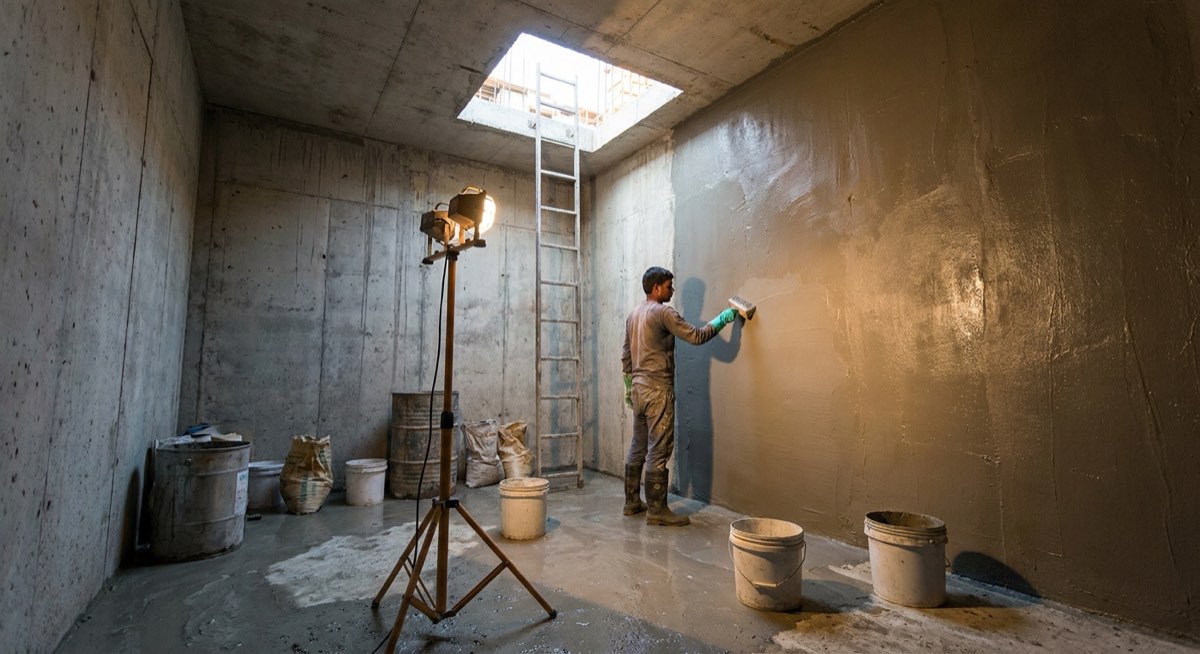
What this guide settles
Choose the system from where the water is, not from the product catalogue. Terraces that bake and move need an elastomeric liquid membrane with high elongation. Basements under a water table need pre-applied HDPE or a bituminous barrier on the positive face, backed by crystalline or admixture protection in the concrete. Wet areas need a thin polymer-cementitious coat under tile. Tanks need a potable-approved cementitious coating. Rigid coatings fail where structures move; flexible ones fail where they get punctured or over-thinned.
Where is the water?
Pick the condition that matches your project. The specification, the build-up and the products update as you choose.
Elastomeric liquid membrane over a screed laid to falls, with scrim-reinforced upstands and drain mouths.
The failure mode here is movement, not head. A terrace slab expands and contracts every day and cracks at parapet junctions first. Specify elongation over compressive strength, and bed reinforcing fabric at every upstand, drain mouth and construction joint. If the falls are wrong, no membrane saves it.
- Repair and grind slab; form 75 mm coved fillets at all parapet and kerb junctions
- Screed to falls, 1:80 minimum, draining to outlets with no back-fall or flat spots
- Prime, then two cross-applied coats of elastomeric membrane at 400-800 micron DFT
- Bed polyester scrim into first coat at upstands, drains, pipe collars and day joints
- Flood-test 48 hours before any tile, china mosaic or protective screed goes down
Positive-side barrier plus Type B protection in the concrete. Never a negative-side coating on its own.
Once backfilled you cannot re-treat the outside, so the barrier goes on the wet face and the concrete itself becomes the second line. Where there is no working space, cast against a pre-applied bonded HDPE sheet so groundwater cannot track between membrane and structure. Protect the membrane before backfill.
- Design mix with integral admixture or crystalline dose; verify RCPT to ASTM C1202
- Pre-applied HDPE laid adhesive-face-in, 75 mm laps taped before steel fixing
- Or where access exists, prime and apply a 1.5 to 2 mm self-adhesive SBS sheet, or a 3 to 4 mm torch-applied sheet, to the wet face
- Waterbar every construction joint; detail tie holes and pipe entries separately
- Geotextile or protection board before backfill; no angular stone against the membrane
- Keep dewatering running until slab and walls can resist uplift, then draw down slowly
Two-coat flexible polymer-cementitious coating, 300 mm up walls generally and 1.8 m in shower zones.
Water here is intermittent and low-head, so chemistry matters far less than continuity. Every leak starts at a floor trap, a pipe sleeve or the skirting junction, not in the middle of the floor. The membrane must be tile-adhesive compatible, which rules out bitumen and most polyurethane. Flood-test before tiling.
- Complete and pressure-test all plumbing; no chasing after the membrane goes on
- Cove all wall-floor junctions with polymer mortar fillet, 50 mm minimum radius
- Two coats flexible cementitious coating, 1 mm wet per coat, applied cross-wise
- Scrim-reinforce trap surrounds, pipe sleeves and internal corners in the first coat
- Cure 7 days minimum, then flood-test 24 hours to 25 mm depth before tile adhesive
Potable-approved flexible cementitious coating inside, with crystalline or admixture in the concrete.
Tanks are the one case where the coating must survive from both sides. When you drain an underground tank the head reverses and a poorly bonded membrane blisters straight off. Cementitious systems bond chemically and take negative pressure; organic membranes generally do not. Check the potable approval, not just the waterproofing data.
- Cut out honeycombing and tie holes; reinstate with non-shrink repair mortar
- Crystalline slurry or integral admixture as the in-concrete defence per IS 6494
- Two coats potable-approved flexible cementitious coating, 2 mm total dry build
- Cure 7 days minimum, then flush, disinfect and hold a 7-day drop test
- Treat the external face of UG tanks separately against groundwater and backfill
High-elongation membrane buried under protection and drainage, with the deck falling and drained above it.
This is the highest-consequence case on any site. The membrane sits under screed, planters or a wearing course, so a leak cannot be traced to its source and repair means demolition. Specify a system tested to ASTM C836, protect it physically, and drain at membrane level as well as at the surface.
- Cast the structural slab to falls where possible rather than correcting it all in screed
- Prime, then spray polyurea or PU deck membrane at 1.5-2.0 mm continuous DFT
- Turn membrane up 150 mm minimum at upstands and dress into every drain flange
- Flood-test 72 hours and record it before any protection layer is placed
- Geotextile plus drainage board, then screed, planter build-up or trafficked wear course
Breathable elastomeric coating, not a vapour-tight membrane, and seal the joints before you coat.
Facades leak through cracks, window perimeters and mortar joints, not through sound plaster. A vapour-tight coating traps interstitial moisture and blisters off in the first hot spell. Use a breathable elastomeric or hydrophobic system that lets the wall dry outwards while shedding rain, and treat the sealant joints as part of the waterproofing.
- Rake out and re-point cracked joints; cut and fill live cracks before any coating
- Reseal all window and door perimeters with a movement-accommodating sealant
- Prime, then two coats breathable elastomeric coating at 300-400 micron DFT
- Check water vapour transmission above 150 g/m2/day, EN 1062-1 class V1, so the wall can still dry outwards
- Detail drip grooves and coping overhangs; most facade leaks start at the top
Selections are indicative. Send us the substrate, exposure and area and Space Arc Engineering will confirm the specification.
What this looks like in practice
The work Space Arc Engineering supplies and applies, matched to the systems and steps described above.
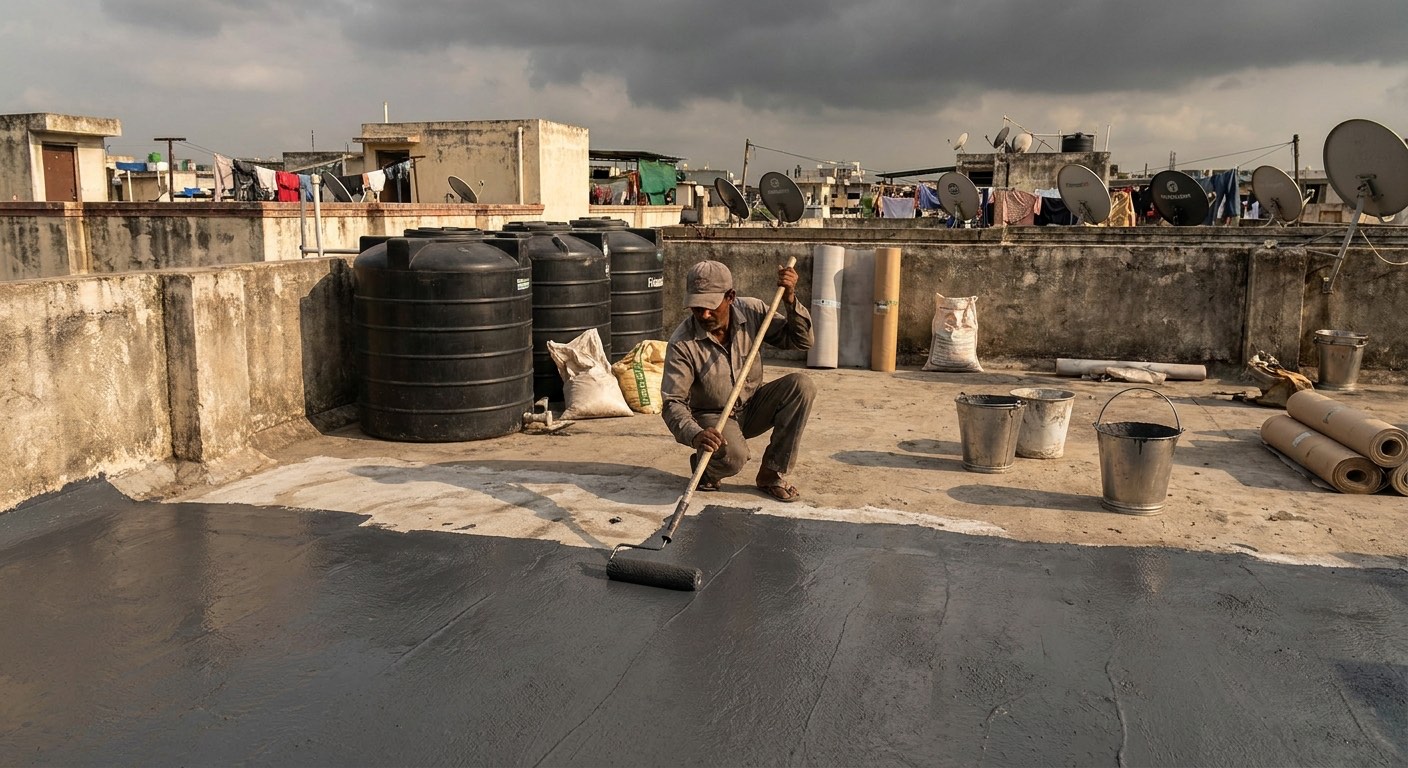
Acrylic and SBR elastomeric coatings
Water-based dispersions of acrylic or styrene-butadiene polymer, sometimes fibre-filled, that dry by evaporation and coalescence into a continuous elastic film. There is no chemical cure and therefore no pot life, so ordinary site labour can apply them with a brush. Exposed terraces, chajjas, parapets and sloping roofs on residential work. High solar reflectance drops slab surface temperature, elongation absorbs daily thermal movement, and a failed patch can be overcoated the same week without demolition.
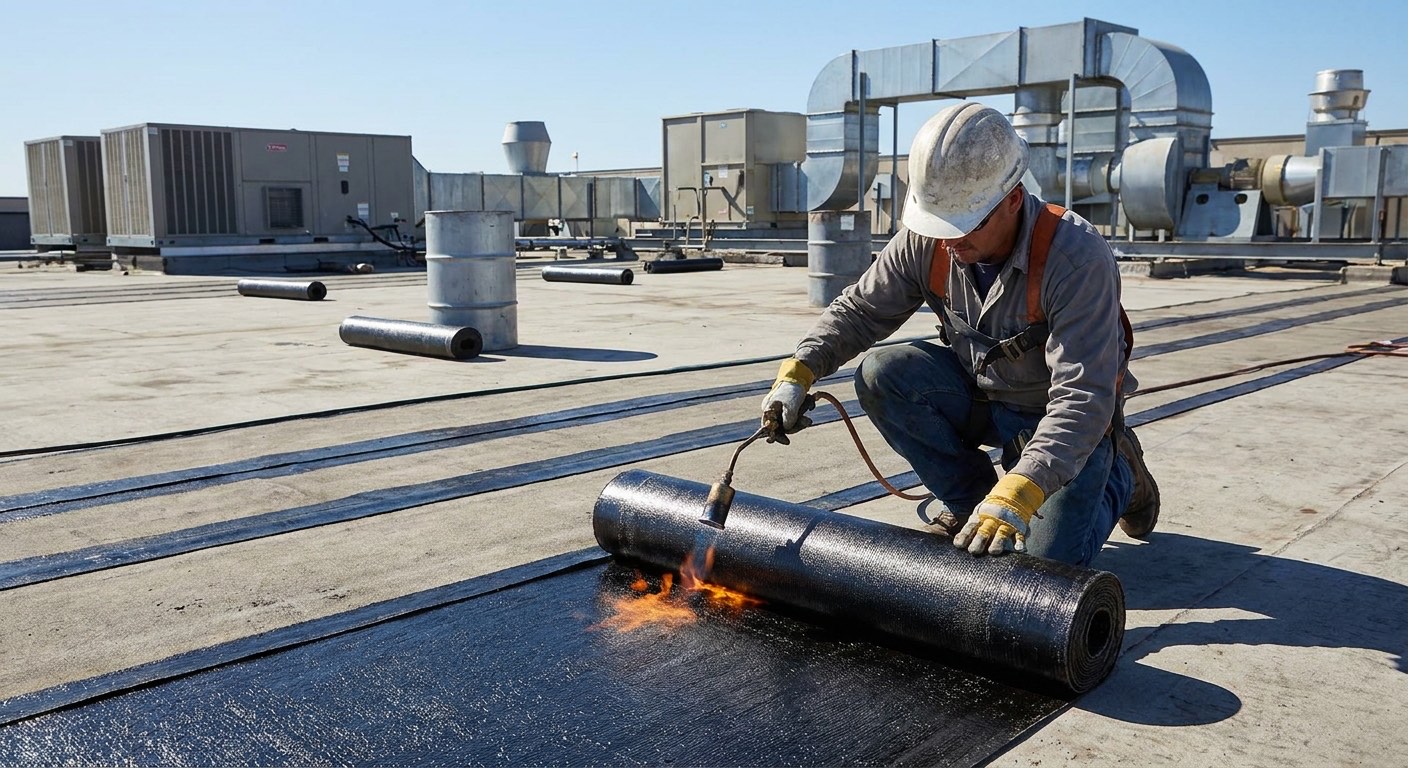
Preformed bituminous sheet membranes
Factory-made rolls of SBS or APP modified bitumen on a polyester or glass carrier, either torch-fused at 3 to 4 mm or cold self-adhesive at 1.5 to 2 mm with a release film. Factory manufacture guarantees the thickness that a site-applied liquid never quite does. Below-ground rafts, retaining walls, cut-and-cover tunnels and podium decks where consistent thickness and high head resistance matter. Self-adhesive grades remove flame risk in congested excavations, which matters on urban NCR sites with combustible shuttering nearby.
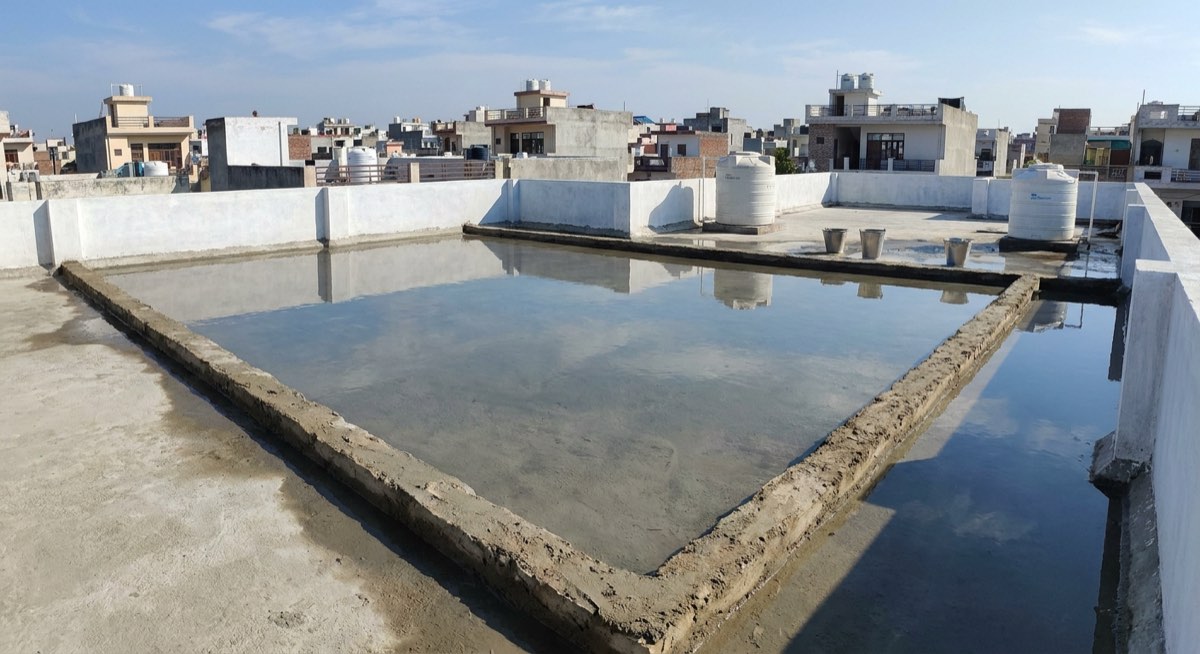
Flood-test and record the result
Pond the area to at least 25 mm for 24 hours on wet areas, 48 hours on terraces and 72 hours on podiums, with the soffit inspected throughout. Tanks get a drop test after filling. Nothing covers the membrane until the test has passed.
Systems compared, including where each one fails
Every system here is one Space Arc Engineering both supplies and applies, so the limitations listed are the ones we see on site rather than the ones in a brochure.
Polymer-modified cementitious coatings
Portland cement, graded fillers and a polymer, either acrylic dispersion or redispersible powder, gauged into a slurry. The polymer film bridges the cement matrix, giving a coating that bonds chemically into the concrete pore structure and holds against positive and negative head.
Anything permanently damp and enclosed: water tanks, lift pits, wet-area screeds, internal basement tanking. It takes negative pressure, needs no primer on saturated-surface-dry concrete, and accepts tile adhesive or plaster directly over it.
Exposed terraces. Even flexible grades bridge only fractions of a millimetre, and Indian roof slabs cycle roughly 25 to 60 degrees C daily in summer. Rigid grades crack over any moving joint inside one season.
Typical spec. Two coats at right angles on saturated-surface-dry substrate, 1 to 1.5 mm wet per coat, roughly 2.5 to 4 kg/m2 total for a 2 mm dry build. Damp cure 3 to 7 days. Allow 7 days before tiling, and 7 days cure before filling a tank.
Integral admixtures and crystalline systems
Two ways of making the concrete itself the barrier. Admixtures are plasticiser or lignosulphonate blends that densify the paste and cut permeability. Crystalline products carry reactive chemicals that meet free lime and moisture and grow insoluble crystals inside capillaries and hairline cracks.
Water-retaining and buried concrete where a surface membrane can never be inspected or repaired: rafts, retaining walls, tanks, sewage structures. Crystalline resists negative head and partially reseals cracks that reopen years after casting.
Neither seals a construction joint, a tie hole, a honeycomb pocket or a crack wider than roughly 0.4 mm. Sold as a standalone answer they underperform badly. They are a second line of defence, not a membrane.
Typical spec. Admixture dosed at the manufacturer’s rate, typically 125 to 200 ml per 50 kg of cement for a liquid integral compound, which is roughly 0.25 to 0.4 percent by weight of cement, fixed on a trial mix and not judged on site by eye. Crystalline slurry 0.8 to 1.5 kg/m2 per coat in two coats, or dry-shake at about 1 kg/m2 onto green slab. Fog cure 48 hours minimum.
Acrylic and SBR elastomeric coatings
Water-based dispersions of acrylic or styrene-butadiene polymer, sometimes fibre-filled, that dry by evaporation and coalescence into a continuous elastic film. There is no chemical cure and therefore no pot life, so ordinary site labour can apply them with a brush.
Exposed terraces, chajjas, parapets and sloping roofs on residential work. High solar reflectance drops slab surface temperature, elongation absorbs daily thermal movement, and a failed patch can be overcoated the same week without demolition.
Not for standing water or hydrostatic head. The film softens under prolonged ponding, thins to almost nothing over a sharp arris, and chalks under UV within about five to eight years. It is a maintenance system, not a permanent one.
Typical spec. Primer plus two to three coats at right angles, roughly 1.0 to 1.5 kg/m2 total for 400 to 800 micron DFT, with 60 to 100 gsm polyester or glass scrim bedded at all junctions. Overcoat 4 to 6 hours apart, never within 12 hours of forecast rain.
Liquid-applied polyurethane systems
One-part moisture-cured or two-part reaction-cured polyurethane that builds a seamless elastomeric skin, usually over a reactive primer. Aliphatic topcoats give UV stability; aromatic grades must be buried or overcoated. Deck grades carry broadcast aggregate for skid resistance.
Trafficked surfaces where waterproofing and wear have to be one layer: car park decks, ramps, podiums over habitable space, service corridors. High elongation with real abrasion resistance is a combination no cementitious system offers.
Moisture and reaction chemistry do not mix. Applied over a slab still holding construction water, or in high monsoon humidity, it foams, pinholes and blisters. It also needs a genuinely dry, primed substrate, which is hard to guarantee on an Indian site in July.
Typical spec. Primer at 0.2 to 0.3 L/m2, then two membrane coats at 0.8 to 1.0 L/m2 each to 1.5 to 2 mm total DFT, plus a wear course at 0.1 to 0.2 L/m2 with 0.4 to 0.8 kg/m2 anti-slip grain. Foot traffic about 24 hours, vehicles 3 to 5 days depending on temperature.
Spray-applied pure polyurea
Two 100 percent solids components, an isocyanate and an amine resin, impinged at 120 to 150 bar and 70 to 80 degrees C in a plural-component gun. The addition reaction is instant and moisture-independent, gelling in seconds into a thick seamless elastomer.
Large uninterrupted decks, podiums, tank linings and STP structures where speed and thickness matter. It cures regardless of humidity, builds 2 mm in one pass, and returns a deck to service the same day. Elongation above 300 percent handles substrate movement.
It is unforgiving of everything except itself. Substrate defects telegraph straight through, adhesion depends entirely on priming and profile, and there is no working time to correct a run. Aromatic grades chalk badly in Indian UV unless topcoated.
Typical spec. Prime and detail all joints first, then spray in cross-hatch passes to 1.5 to 2.0 mm minimum DFT at roughly 1.2 kg/m2 per mm. Gel 5 to 10 seconds, walkable in minutes, full service around 7 days. Certified applicator and calibrated rig are mandatory, not optional.
Preformed bituminous sheet membranes
Factory-made rolls of SBS or APP modified bitumen on a polyester or glass carrier, either torch-fused at 3 to 4 mm or cold self-adhesive at 1.5 to 2 mm with a release film. Factory manufacture guarantees the thickness that a site-applied liquid never quite does.
Below-ground rafts, retaining walls, cut-and-cover tunnels and podium decks where consistent thickness and high head resistance matter. Self-adhesive grades remove flame risk in congested excavations, which matters on urban NCR sites with combustible shuttering nearby.
The sheet is only as good as the lap. Side and end laps, internal corners and pipe penetrations are where these systems leak, and a poorly rolled lap in a 45 degrees C shade temperature will creep open. Bitumen also softens badly if left exposed on a terrace.
Typical spec. Prime with compatible tack coat at 3 to 6 m2/litre, lay a 3 to 4 mm torch-applied or 1.5 to 2 mm self-adhesive sheet with 75 mm side laps and 150 mm staggered end laps, roll every lap. Turn up 150 mm minimum at upstands. Protect with board or geotextile before backfill; never leave exposed to UV.
Pre-applied bonded HDPE membranes
A three-layer sheet, HDPE carrier film plus a pressure-sensitive adhesive layer plus a trafficable protective coating, laid adhesive-face-up before the pour. Fresh concrete cast against it develops a mechanical and adhesive bond into the coating, so membrane and structure act as one.
Blindside and zero-clearance basements where there is no external working space, and any structure where you cannot risk water tracking laterally between membrane and concrete. Peel adhesion to concrete above 880 N/m to ASTM D903 modified means a local puncture stays local instead of flooding the whole raft.
Nothing recovers a badly sequenced pour. Sheets get walked on by steel-fixers, taped laps get lifted, and if concrete is not placed within the exposure window the adhesive contaminates with dust and never bonds. It also demands a stable, dry, well-blinded substrate.
Typical spec. Lay on prepared blinding or shuttering, adhesive face toward the pour, 1.2 to 1.5 mm sheet with 75 mm laps taped and sealed. Repair punctures with patch tape before steel fixing. Cast structural concrete directly against it; hydrostatic head resistance above 70 m.
Resin injection (remedial only)
Low-viscosity epoxy or polyurethane resin pumped into a drilled port pattern under pressure. Epoxy structurally rebonds dry cracks. Hydrophobic and hydrophilic PU resins react with water in the crack, foaming or gelling to seal an actively leaking path.
Live water ingress through cracks, cold joints and tie holes in basements, tunnels and lift pits, where you cannot get to the positive face. PU foam resins will stop a running leak in an occupied basement without excavating anything.
It is a repair, not a waterproofing system, and it is routinely sold as one. Injection seals the path you found, not the ten you did not. On a moving crack, rigid epoxy simply cracks again beside the repair within a season.
Typical spec. Drill 12 to 14 mm ports at 45 degrees, spaced roughly at half the member thickness, alternating either side of the crack. Flush with water, inject bottom upward at 60 to 150 bar until resin shows at the next port, then seal the crack face. Remove packers and make good after cure.
Why this fails on Indian sites
Most failures are not product failures. These are the ones Space Arc Engineering’s applicators get called in to put right, usually years after the original job.
The falls were never built
- What you see
- A newly waterproofed terrace ponds for days after rain, and leaks reappear in the same rooms within one or two monsoons despite a brand-new membrane.
- Root cause
- The membrane went straight onto a flat or back-falling slab. Standing water finds every pinhole, softens water-based films, and loads the weakest 2 percent of the area continuously instead of draining away in minutes.
- How to prevent it
- Level the slab and set out the falls before a single litre of material is ordered. Minimum 1:80 to outlets, checked with a string line and a flood test, with the screed corrected before the membrane, not after.
The system was specified but the details were not
- What you see
- The open field of the slab or wall is bone dry, yet water appears at the parapet junction, the drain mouth, a pipe sleeve or a column kicker.
- Root cause
- Junctions are where movement concentrates and where a brush-applied film always ends up thinnest. Without a coved fillet and bedded scrim, the membrane sits over a sharp internal angle at half its intended thickness and splits there first.
- How to prevent it
- Write the detailing as a separate hold point in the specification: cove every internal angle, scrim-reinforce every junction and penetration, and get details signed off before the field coats start.
Applied on a slab at 45 degrees C
- What you see
- Pinholes, blisters and patches of poor adhesion appear within weeks. The membrane looks correct on day one and lifts in sheets after the first monsoon.
- Root cause
- An exposed Indian roof slab regularly exceeds 50 degrees C surface temperature by midday. Water-based films skin before they coalesce, reactive systems flash-cure, and moisture trapped in the substrate vaporises and pushes the coating off.
- How to prevent it
- Restrict application to early morning or evening and measure substrate temperature, not air temperature. Set a written upper limit around 40 degrees C surface, and check substrate moisture before any reactive system.
Negative-side coating used as the primary barrier
- What you see
- An internally coated basement wall blisters and delaminates in sheets, often after the first monsoon when the water table rises.
- Root cause
- On the negative face, adhesion alone resists the full hydrostatic head. Water pressure works into every pore and lifts the coating. The waterproofing is fighting the structure instead of being pressed against it.
- How to prevent it
- Put the barrier on the positive face wherever it can be reached, and back it with Type B protection in the concrete itself. Reserve negative-side coatings for existing structures, and choose cementitious chemistry rated for reverse pressure.
Coverage rate cut on site
- What you see
- The system performs for two or three years, then fails generally rather than at any one detail. A cut sample shows dry film thickness at roughly half the specified figure.
- Root cause
- Material was issued by area covered rather than by weight consumed. Spreading a 25 kg pack over 15 m2 instead of 10 m2 saves visible money on the day and quietly removes a third of the barrier.
- How to prevent it
- Reconcile consumption bay by bay against the specified kg/m2 and record it. Use a wet-film comb gauge during application, and take a small number of DFT checks on the cured film before covering it.
Crystalline or admixture sold as the whole answer
- What you see
- A tank or basement built with an admixture and a crystalline dose still weeps steadily at construction joints, tie holes and around pipe entries.
- Root cause
- In-concrete systems reduce permeability through the body of sound concrete. They cannot bridge a 5 mm cold joint, a form-tie void or a honeycomb pocket, which is exactly where water actually travels.
- How to prevent it
- Treat crystalline and admixtures as the second line of defence they are. Specify waterbars at every construction joint, proper tie-hole reinstatement and a surface system, and price the combination rather than the cheapest single line item.
The correct sequence, in order
Skipping a step here is what turns a specified system into a warranty claim. Space Arc supervises these hold points on the projects it applies.
- 1
Establish where the water is actually coming from
Separate groundwater, rain ingress, plumbing leakage and condensation before choosing anything. A slab that is wet from a leaking chase does not need a new terrace membrane. Trace the source, then decide which face the barrier belongs on.
Hold point: Written diagnosis and a decision on positive-side versus negative-side treatment, signed before procurement. - 2
Fix the substrate and the falls
Cut out honeycombing, spalled concrete and loose screed. Reinstate with polymer-modified repair mortar, grind off laitance and curing compound, and lay or correct the screed to falls. Every subsequent layer inherits whatever geometry you leave here.
Hold point: Falls verified by string line or level to at least 1:80, and the substrate confirmed sound, dry enough and free of laitance. - 3
Detail the junctions before the field
Form coved fillets at internal angles, dress drain flanges, sleeve pipe penetrations and treat construction joints with waterbar or joint sealant. Then apply the first membrane coat locally and bed reinforcing scrim into it while wet, at every one of these locations.
Hold point: All details completed and inspected, with scrim visibly embedded rather than laid on top, before general application starts. - 4
Prime, then apply the system at the specified rate
Use the primer the manufacturer names, not a diluted topcoat. Apply membrane coats at right angles to each other and measure consumption per bay against the specified kg/m2 or litre/m2. Respect the overcoat window, both minimum and maximum.
Hold point: Material consumption reconciled bay by bay and recorded, plus wet-film gauge checks during application. - 5
Cure it the way the chemistry requires
Cementitious systems need continuous damp curing for 3 to 7 days and shade from direct sun. Reactive systems need protection from rain and dew until they are through-cured. This is the step most often shortened when the programme slips, and it is the most expensive to skip.
Hold point: Cure period completed in full and logged before the next trade is allowed onto the surface. - 6
Flood-test and record the result
Pond the area to at least 25 mm for 24 hours on wet areas, 48 hours on terraces and 72 hours on podiums, with the soffit inspected throughout. Tanks get a drop test after filling. Nothing covers the membrane until the test has passed.
Hold point: Signed and dated flood-test record with soffit inspection notes, held before any protection or finish is placed. - 7
Protect the membrane before follow-on trades
Lay geotextile, protection board or a screed over the membrane the same week it passes the test. Most membranes are damaged not by water but by scaffolding, rebar offcuts, planter excavation and reinforcement dragged across an unprotected surface.
Hold point: Protection layer in place and access controlled before scaffolding, planters or backfill are permitted on the deck.
Comparison table
| System family | Crack bridging | Head resistance | Typical exposed life in India | Applied by |
|---|---|---|---|---|
| Rigid cementitious coating | Static shrinkage only, under 0.2 mm | Positive 5-7 bar, negative around 3 bar | Buried or immersed, 15-20 years | Site mason, brush or trowel |
| Flexible cementitious coating | 0.5-0.9 mm at 2 mm dry build | Positive 5-7 bar, negative around 3 bar | Buried or immersed, 15-20 years | Site mason, brush or roller |
| Crystalline and admixture | Self-heals cracks up to roughly 0.4 mm | Positive and negative, acts within the concrete | Life of the structure | Slurry coat, dry-shake or batch dosing |
| Acrylic or SBR elastomeric | 1-2 mm at 600 micron with scrim | Non-hydrostatic only, sheds water | Fully exposed, 5-8 years | Brush, roller or airless spray |
| Liquid-applied polyurethane | High elongation, above 100 percent, deck grades above 300 percent | Non-hydrostatic when exposed; positive face when buried | Exposed 8-12 years with an aliphatic topcoat | Roller, squeegee or airless spray on a dry primed substrate |
| SBS or APP sheet membrane | 2-3 mm at 3-4 mm sheet thickness | Up to about 70 m head | Buried, 20-25 years | Torch fusion or cold self-adhesive |
| Pre-applied bonded HDPE | Bonded to concrete, resists lateral tracking | Above 70 m head | Life of the structure, permanently buried | Sheet laid before the pour, taped laps |
| Pure polyurea | Above 300 percent elongation | High, fully seamless, no laps | 10-15 years exposed with aliphatic topcoat | Certified crew, heated plural-component rig |
The standards this work is specified against
Quote these in your tender documents. They are what a third-party inspector will check against, and Space Arc Engineering can supply the batch and compliance paperwork to match.
The umbrella Indian code for this discipline. Covers design detail, surface preparation and drainage, which is precisely the ground where most Indian waterproofing arguments are actually won or lost.
Defines what an integral waterproofing compound must deliver, assessed by water percolation through standard mortar cylinders with and without the compound. Use it to challenge admixture claims made without test data.
The reference for tanks and pools, covering both outward loss and inward infiltration. Relevant to every underground sump, fire tank and STP structure in an Indian residential or commercial development.
Still the governing Indian code for felt and bituminous sheet roofing. Sets out laying operations, laps and finishing, and remains the baseline against which modern SBS and APP sheet specifications are read.
The test regime for buried liquid membranes on podiums, plaza decks and parking structures. Its low-temperature crack-bridging and adhesion-in-peel-after-water-immersion clauses are the ones worth quoting in a podium specification.
The recognised benchmark for bathroom and wet-area membranes that must sit under tile adhesive. Useful because it tests the membrane and the bond together rather than the membrane in isolation.
Products we recommend and stock
Every product below is one Space Arc Engineering stocks as an authorised distributor. Fosroc’s real strength here is depth below ground and in water-retaining structures. The Conplast admixtures, Brushbond ICW crystalline slurry, Nitocote CM cementitious range, Proofex sheet membranes and pre-applied HDPE all come from one house, so a basement can be specified as a single compatible Type A plus Type B build-up rather than assembled from three suppliers. For fully exposed residential terraces on tight budgets, a straightforward acrylic system from any competent brand will often do the same job for less.
Distributor and applicator, not just a supplier
Waterproofing is the one discipline where the specification and the application cannot be separated. Being an authorised distributor means the primer, membrane and geotextile come from a single compatible system with current batch documentation. Being an applicator means the same people who quote the material also cove the fillets, bed the scrim, reconcile consumption per bay and run the flood test. When a terrace leaks, there is no argument about whether it was the product or the trowel, because both sit with one accountable party in Ghaziabad.
- Authorised distributor for Fosroc, Sika, Dr. Fixit, MC-Bauchemie, UltraTech, Master Builders Solutions, STP and D-Seal
- In-house application crews across Delhi NCR, with pan-India project supply
- Specification support before you tender, and site supervision during execution
- Genuine, batch-traceable material direct from authorised channels

Waterproofing systems – frequently asked questions
Which waterproofing is best for a terrace in India?
Can I waterproof a basement from the inside?
How long does waterproofing last in India?
Is crystalline waterproofing better than a membrane?
Why does my terrace still leak after waterproofing?
Can waterproofing be applied during the monsoon?
What waterproofing is safe for a drinking water tank?
How much waterproofing material do I need per square metre?
Related guides
How to Waterproof a Terrace or Roof (Step-by-Step)
A practical, cross-brand guide to waterproofing an RCC terrace or roof – from finding the leak and prepping the slab…
Crystalline vs Membrane Waterproofing: Which to Choose?
A practical, cross-brand comparison of crystalline (integral) and membrane (surface-applied) waterproofing – how each…
Best Waterproofing for Bathrooms & Wet Areas
A practical, cross-brand guide to waterproofing bathrooms and wet areas the right way: diagnosis, surface prep, the…
Not sure which specification your project needs?
Send us the substrate, the exposure and the area. Space Arc Engineering will come back with a specification, a bill of quantities and the datasheets to support it.