Construction chemicals: the eight families and how they fit together
Written for specifying engineers, contractors and building owners in India who need to place a product in the right family before comparing brands. It maps all eight systems, what each one actually does, and where each one fails.
What this guide settles
Construction chemicals are engineered formulations that change how concrete, mortar and substrates behave. On Indian sites they fall into eight families: concrete admixtures, waterproofing systems, repair mortars, industrial flooring, grouts and anchors, joint sealants, protective coatings and tile fixing. Admixtures act inside the mix, waterproofing works from either side, and the remaining families act on hardened surfaces or in joints. Selection follows exposure, substrate and movement, not price. IS 456 exposure class sets the concrete; the exposure then dictates which surface system is justified. Most site failures are substrate or curing failures, not product failures.
Which family does your problem belong to?
Pick the condition that matches your project. The specification, the build-up and the products update as you choose.
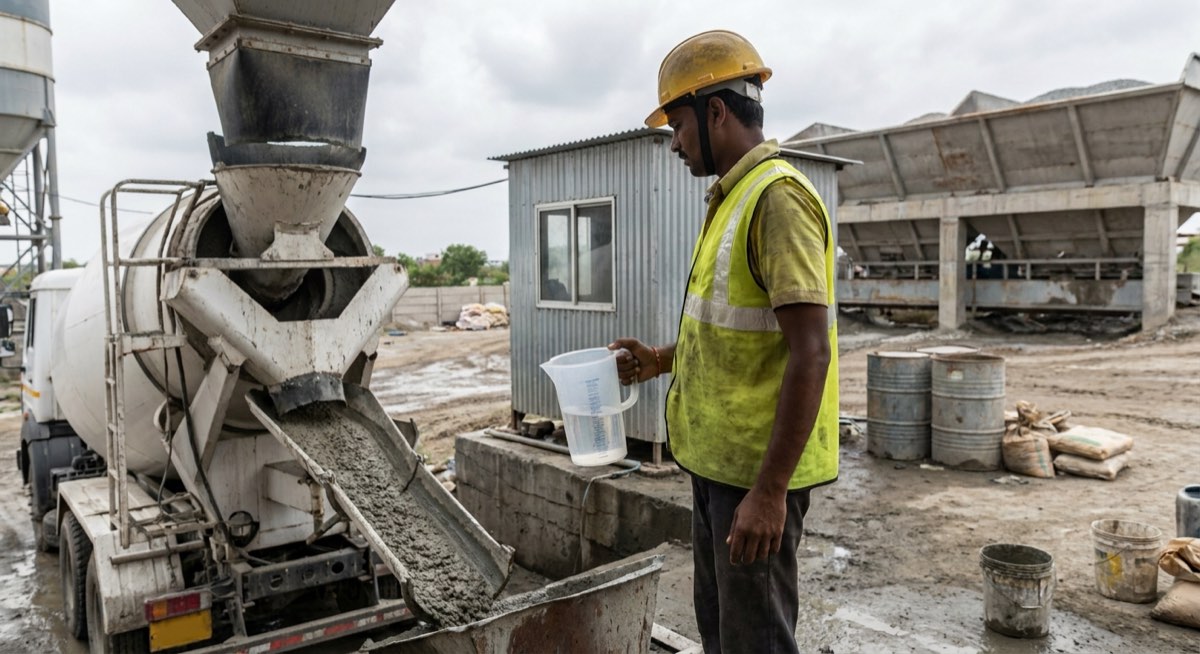
Fix the water/cement ratio first. This is the only family that works from inside the concrete.
Every other family on this page is a repair for something the mix could have prevented. A PCE superplasticiser that takes water/cement from 0.50 to 0.40 cuts permeability more than any coating adds. Set the IS 456 exposure class, then dose to hit it, then verify slump retention at site temperature.
- Set exposure class per IS 456 Table 5; this fixes max w/c and min grade
- Trial mix with the actual site aggregate at site temperature, not lab conditions
- PCE superplasticiser 0.4-1.2% by cement weight to reach workability at low w/c
- Add retarder or corrosion inhibitor only where pour time or chloride risk demands it
- Cure from the moment of finish; a curing compound or 7 days wet cure, not both skipped
Choose by whether the substrate will crack and whether the membrane will be exposed.
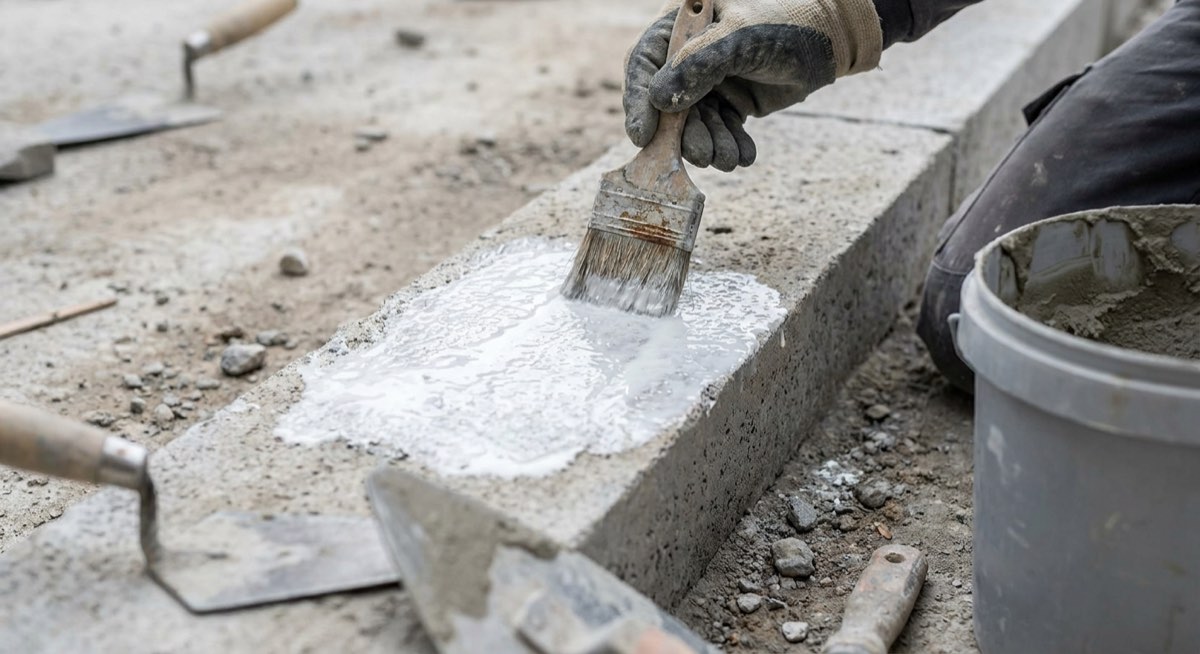
Rigid crystalline and cementitious systems suit stable, permanently confined concrete such as basement rafts and tanks. Anything that moves or bakes, above all a terrace, needs an elastomeric membrane. Read the waterproofing guide for full membrane selection and detailing; the products below span all three mechanisms, from the in-mix admixture to sheet tanking.
- Water-resisting admixture and low w/c in the structural pour, not just a surface fix
- Slope screed to 1:100 minimum with no ponding; test with a hose before membrane
- Fillet all wall junctions and sleeve every penetration before the first coat
- Two-coat elastomeric membrane, 1.2-1.5 mm DFT, reinforced at junctions and drains
- 48-72 hour flood test, then protection screed before any tiling or traffic
Repair the concrete and then protect it. A patch without a coating fails again.
Spalling is an electrochemical problem, not a cosmetic one. Break back behind the bar, clean the steel, rebuild with a shrinkage-compensated mortar of similar modulus, then apply an anti-carbonation or chemically resistant coating so the chloride or CO2 front does not simply restart. See the concrete repair and protective coatings guides.
- Survey with half-cell potential and cover meter; map the anodic zone, not the spall
- Break back 20-25 mm behind the bar and expose 50 mm of sound steel each side
- Clean steel to bright metal, then zinc-rich or cementitious steel primer
- Rebuild in 10-40 mm layers with shrinkage-compensated mortar; wet cure 3-7 days
- Apply anti-carbonation or chemical-resistant coating over the whole element
Select by moisture and thermal shock, then by chemical exposure. Thickness follows.
Epoxy is the default for chemical resistance and cleanability. Polyurethane concrete at 6-9 mm is the only sensible choice where steam cleaning or freezer thresholds cause thermal shock. Before either, confirm slab moisture and a functioning damp-proof membrane; that single check prevents most resin floor failures.
- Test slab relative humidity; below 75% for epoxy or use a moisture-tolerant primer
- Shot-blast to CSP 4-5; grinding alone rarely opens the surface enough
- Prime, then scratch coat to fill blowholes before the wearing layer
- Self-levelling epoxy 2-3 mm, or PU concrete 6-9 mm where thermal shock applies
- Cut and seal movement joints through the topping over every slab joint
Cementitious for bearing area under machines; chemical resin for post-installed bar.
Non-shrink cementitious grout suits large bearing areas and stays dimensionally stable under sustained load. Epoxy grout is for high chemical or dynamic loading in thinner sections. For anchors, the resin is rarely the variable that fails; brush-blow-brush hole cleaning and correct embedment depth decide the pull-out capacity. Read the grouting guide.
- Roughen and saturate the concrete base; remove standing water before pouring
- Formwork sealed and vented, with a 100-150 mm grout head on the pour side
- Mix to flow cone 20-30 seconds; pour from one side only, never vibrate
- Limit cementitious lift to 40-50 mm; use aggregate extension for deeper voids
- Cure damp under hessian 3 days, then trim shoulders to a 45 degree chamfer
Size the joint first, choose the chemistry second. Geometry decides the outcome.
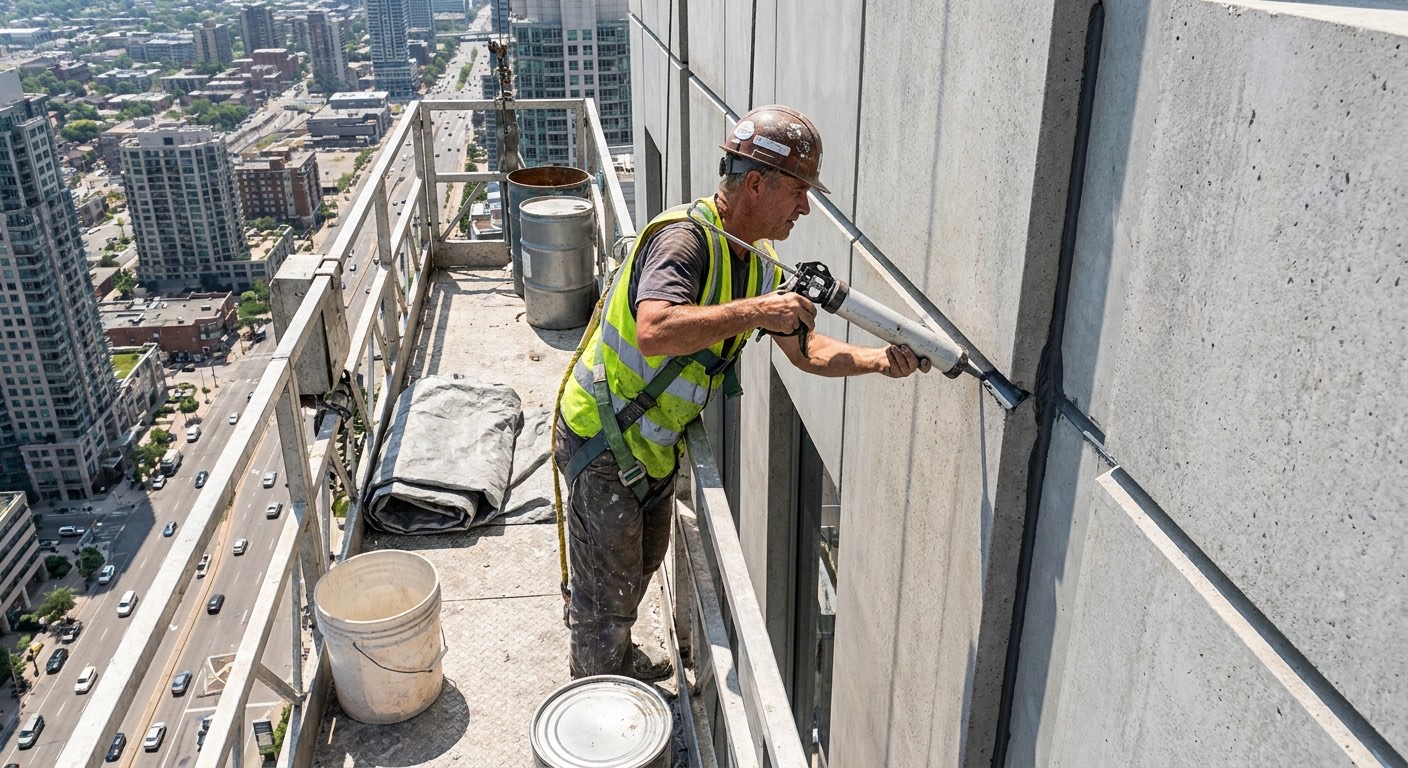
Polysulphide suits submerged and fuel-contact joints, polyurethane suits general external movement joints, silicone suits glazing and sanitary work, and MS polymer tolerates damp substrates. None of them survive a joint too narrow for the movement or bonded on three faces. See the sealants guide for chemistry selection.
- Calculate movement, then set joint width at four times that figure
- Grind or wire-brush joint faces free of laitance and release-agent residue
- Insert closed-cell backer rod compressed 25% to set depth and break the bond
- Prime both faces per the sealant type; most adhesion failures start here
- Gun and tool in one pass within open time; do not apply below dew point
Use a graded polymer-modified adhesive to IS 15477 and design movement joints in.
Sand-cement dabs leave large hollow voids under big tiles, which is where debonding and water tracking start. A notched-bed adhesive gives measurable adhesion and full contact. The failure to design for is thermal and shrinkage movement, not adhesive strength. Read the tile adhesive guide before fixing external or over-tile work.
- Let the screed cure and dry; a green screed transfers its shrinkage to the tile
- Remove curing-compound residue and laitance; confirm compatibility with adhesive
- Waterproof and flood-test wet areas before any tile is set
- Notched bed 3-6 mm, back-butter tiles above 600 x 600 mm, 95-100% coverage for external, wet-area and large-format work
- Movement joints at 20-25 square metre grid and at every internal corner
Selections are indicative. Send us the substrate, exposure and area and Space Arc Engineering will confirm the specification.
Systems compared, including where each one fails
Every system here is one Space Arc Engineering both supplies and applies, so the limitations listed are the ones we see on site rather than the ones in a brochure.
Concrete admixtures
Water-soluble organic chemistry dosed at 0.2-2.0% by cement weight. Polycarboxylate ethers disperse cement grains so the same workability needs less water; lignosulphonates, sugars and phosphonates delay hydration; calcium nitrite passivates steel electrochemically.
The cheapest durability you will ever buy. Cutting water/cement from 0.50 to 0.40 can reduce permeability by close to an order of magnitude, and permeability drives carbonation, chloride ingress and every waterproofing problem downstream.
Admixtures cannot fix bad aggregate grading, over-dosed retarders cause long set delays in a Delhi December, and PCE slump retention collapses when tanker turnaround exceeds the design window at 42 degrees C.
Typical spec. PCE superplasticiser at 0.4-1.2% by cement weight, trial-mixed at site temperature; retarder 0.2-0.5% for pours over two hours; verify slump retention at 30, 60 and 90 minutes before approving the dosage.
Waterproofing systems
Barriers that stop liquid water reaching concrete or reaching occupied space. Three mechanisms: pore-blocking admixtures and crystalline slurries inside the concrete, adhered membranes (cementitious, acrylic, polyurethane, polyurea, bitumen, HDPE sheet) on the surface, and loose-laid sheets with mechanical containment.
A correctly detailed membrane is the system that tolerates a live, moving crack; crystalline systems will re-seal hairline static cracks, but nothing rigid follows continuing movement. Elastomeric PU and polyurea bridge live cracks and survive terrace surface temperatures that swing sharply between afternoon and dawn.
Membranes fail at terminations, not in the field. Unturned upstands, unsleeved pipe penetrations, no fillet at the wall junction and no protection screed account for most terrace leaks that reappear in the second monsoon.
Typical spec. Exposed terrace: primer plus two coats elastomeric PU to 1.2-1.5 mm total DFT, reinforced at junctions with fabric, upstand carried 150-300 mm above finished level, water-tested 48-72 hours before overlay.
Concrete repair mortars
Polymer-modified cementitious or epoxy mortars formulated to replace lost concrete. Shrinkage-compensated binders, graded silica and acrylic or SBR polymer give them low free shrinkage, high bond and a modulus deliberately matched to the parent concrete rather than maximised.
Restoring cover to corroding reinforcement in beams, soffits and columns, where a hand-applied build of 10-40 mm per layer must hold overhead without formwork and gain strength fast enough to release props.
Patch repair does not stop corrosion. Repairing one delaminated zone shifts the potential of adjacent chloride-contaminated concrete and can drive new anodes at the patch edge, so the next spall appears 200 mm away. Embedded galvanic anodes at the perimeter are the usual counter-measure.
Typical spec. Break back 20-25 mm behind the bar, clean steel to bright metal, apply zinc-rich or cementitious primer, build repair mortar in 10-40 mm layers, wet-cure 3-7 days, then reinstate the surface protection.
Industrial flooring
Resin or cementitious toppings bonded to a concrete slab. Epoxies give hardness and chemical resistance at 0.3-3 mm; polyurethane concrete at 6-9 mm carries thermal shock; dry-shake metallic or non-metallic hardeners densify the wearing surface monolithically.
Self-levelling epoxy at 2-3 mm gives a jointless, cleanable, chemically resistant surface for pharma, food and electronics floors where dust generation and washdown chemicals both have to be controlled.
Resin floors are moisture-intolerant. Laying over a slab without a functioning damp-proof membrane, or over concrete above roughly 75% internal relative humidity, produces osmotic blistering and debonding within months.
Typical spec. Shot-blast to CSP 4-5, prime, apply self-levelling epoxy at 2-3 mm over a scratch coat, cure seven days at 25-30 degrees C before chemical exposure; confirm slab relative humidity below 75% first.
Grouts and anchors
Flowable cementitious or epoxy systems that transfer load into a void. Non-shrink cementitious grouts use controlled expansion to stay in bearing contact; epoxy and vinylester anchor resins bond threaded bar chemically into drilled holes.
Machine base plates, crane rails, bridge bearings and post-installed rebar, where full bearing contact and predictable early strength decide whether the plant can be commissioned on schedule.
Cementitious grout above 40-50 mm in one lift generates heat and cracks, and chemical anchors lose a large fraction of bond strength in wet or uncleaned holes. Hole cleaning, not resin choice, is the usual defect.
Typical spec. Cementitious base plate grout 25-50 mm thick, poured from one side with a head of 100-150 mm, flow cone 20-30 seconds, no vibration, cured damp under hessian for three days.
Joint sealants
Elastomers gunned into a designed gap. Polysulphide, polyurethane, silicone and MS polymer differ in movement capability (typically 12-50%), UV stability and adhesion. The sealant is the flexible part of a joint that the concrete itself cannot provide.
Anywhere two elements move independently: expansion joints, precast panel joints, glazing perimeters and floor saw cuts. A correctly sized joint absorbs movement that would otherwise crack the adjacent finish.
Three-sided adhesion. Without a bond-breaker or backer rod the sealant grips the joint base, cannot extend, and splits. Aspect ratio matters more than brand: a 20 mm joint filled 20 mm deep will fail.
Typical spec. Joint width four times the calculated movement, depth half the width and 6-12 mm minimum, closed-cell backer rod compressed 25%, faces cleaned of laitance and release-agent residue, primed, then tooled within open time.
Protective coatings
Thin films that control what reaches the concrete rather than what leaves it. Anti-carbonation acrylics restrict CO2 while staying vapour-permeable; epoxy and vinyl ester linings resist acids and effluent; polyurethane topcoats supply the UV stability epoxies lack.
Extending the life of exposed RCC in coastal and industrial air, and lining sewage structures in NCR treatment plants where biogenic H2S converts to sulphuric acid and attacks ordinary Portland concrete.
Coatings are only as good as the substrate. Applied over laitance, curing-compound residue or visibly damp concrete, even a correct system peels. Vapour-impermeable coatings on damp walls blister from behind.
Typical spec. Anti-carbonation system: abrade or blast, one primer coat, two topcoats to 150-250 microns total DFT, applied above dew point plus 3 degrees C, pull-off adhesion verified at 1.0-1.5 MPa minimum.
Tile fixing systems
Cement-based polymer-modified adhesives and grouts that replace sand-cement bedding. Redispersible polymer powder gives open time, slip resistance and tensile adhesion; epoxy grouts replace cement grout where the joint must resist acids or staining.
Large-format vitrified tiles, tile-on-tile overlays and external cladding, where a 3-6 mm notched bed gives measurable tensile adhesion instead of the widespread hollowness typical of thick sand-cement dabs.
Adhesive cannot compensate for a moving substrate. No movement joints in floors over 20-25 square metres, no de-bonding layer over a green screed, and tiles arch and tent in the first hot season.
Typical spec. Polymer-modified adhesive classified to IS 15477, notched trowel giving a 3-6 mm bed, back-buttering above 600 x 600 mm, 95-100% coverage for external, wet-area and large-format work (80% minimum internal dry) verified by lifting one tile per area, joints 3-5 mm, grouted after 24 hours.
Related guides
Waterproofing systems
Seven systems and where each one wins.
Concrete repair
Diagnose the distress before you specify a mortar.
Industrial flooring
Match the floor to the traffic and the chemistry.
Grouting & anchoring
Grouts, anchors and the admixtures behind the mix.
Sealants & joints
Joints move. Choose the chemistry that moves with them.
Protective coatings
Carbonation, chloride, chemicals and abrasion.
Tile adhesives
IS 15477 types, substrates and wet areas.
Comparison table
| Family | Acts on | Typical thickness or dosage | Indicative service life | Governing standard |
|---|---|---|---|---|
| Concrete admixtures | Inside the fresh mix | 0.2-2.0% by cement weight | Life of the structure | IS 9103 / EN 934-2 |
| Waterproofing membranes | Hardened concrete surface | 1.0-2.0 mm liquid DFT, 1.2-2.0 mm sheet | 8-20 years exposed, longer if protected | IS 2645 (integral compounds only) / ASTM C836 (liquid-applied) / IS 1322 (bitumen felt) |
| Repair mortars | Removed concrete section | 10-40 mm per layer | 15-25 years with surface protection | EN 1504-3 |
| Industrial flooring | Bonded to the slab | 0.3-3 mm epoxy, 6-9 mm PU concrete | 5-15 years by traffic class | EN 13813 (screed and floor topping materials) / ASTM C1583 (pull-off test method) |
| Grouts and anchors | Void under bearing or in hole | 25-50 mm bed, 10-20 mm annulus | Life of the structure if kept dry | ASTM C1107 / EN 1504-6 |
| Joint sealants | Designed gap between elements | Width 4x movement, depth half width | 5-15 years by chemistry and UV load | ASTM C920 |
| Protective coatings | Cover concrete surface | 150-400 microns DFT | 7-15 years before recoat | EN 1504-2 |
| Tile fixing | Between substrate and tile | 3-6 mm notched bed | 15-25 years if joints are designed | IS 15477 / EN 12004 |
Why this fails on Indian sites
Most failures are not product failures. These are the ones Space Arc Engineering’s applicators get called in to put right, usually years after the original job.
The spec names a product, not a system
- What you see
- Primer, membrane and topcoat arrive from three different brands, or the primer is omitted entirely to save cost.
- Root cause
- BOQ lines are written per product with independent rates, so the lowest bidder unbundles the system and substitutes the cheapest compatible-looking item for one layer.
- How to prevent it
- Specify by system with a single manufacturer’s build-up, name the primer as its own mandatory line item, and make any warranty conditional on all layers coming from one range.
Application inside the monsoon window
- What you see
- Membranes and coatings blister, whiten or peel within weeks; epoxy floors stay tacky and never reach full hardness.
- Root cause
- Work is pushed to just before the rains, when substrate moisture is high and relative humidity sits above the product limit. Solvent release and moisture-cure chemistry cannot develop properly.
- How to prevent it
- Make a substrate moisture reading and a dew-point check documented hold points. Plan external membrane and coating work for October to November and February to April in NCR, avoiding both the monsoon and the December-January fog period when overnight humidity saturates and temperatures fall below the minimum application and cure limits of most epoxy and polyurethane systems.
Curing treated as optional
- What you see
- Map cracking on slabs, dusting floors, and repair patches shrinking away from the arris within a month of placing.
- Root cause
- At 40 degrees C with wind and low humidity, evaporation exceeds the bleed rate within an hour of finishing. Nobody is paid separately for curing, so it is the first activity dropped.
- How to prevent it
- Price curing as its own BOQ item. Apply a curing compound at the stated coverage immediately after finishing, or pond and wet-hessian for seven days, and record which was done.
Substrate left as-cast
- What you see
- Coatings, screeds and tile beds debond cleanly, leaving a chalky or glossy layer still stuck to the concrete face.
- Root cause
- Laitance, mould-release residue and curing-compound film are all bond breakers. Grinding polishes the surface rather than opening it, and a smooth trowelled face reads as ready when it is not.
- How to prevent it
- Mechanically prepare to a defined surface profile, shot-blast or scabble rather than grind, and run a pull-off test on a trial area before the main application starts.
Grey-market and repacked material
- What you see
- Two drums of the same product behave differently; the site trial passes and the main consignment does not.
- Root cause
- Construction chemicals are bought on rate, not on chain of custody. Repacked, diluted or out-of-shelf-life stock reaches site through multi-tier trading with no traceable batch record.
- How to prevent it
- Buy against an authorised distributor invoice, reconcile batch numbers to the manufacturer’s despatch record, and retain one sealed sample of every batch until defect liability closes.
No hold points, so no evidence
- What you see
- A leak appears in year two and nobody can establish whether the design, the material or the workmanship failed.
- Root cause
- Sequential trades cover each other’s work within hours. Once a protection screed is cast, the membrane below can never be inspected again, and the argument becomes commercial rather than technical.
- How to prevent it
- Write inspection hold points into the method statement: substrate acceptance, primer coverage, wet film thickness, flood test result, each signed and photographed before cover-up.
The standards this work is specified against
Quote these in your tender documents. They are what a third-party inspector will check against, and Space Arc Engineering can supply the batch and compliance paperwork to match.
Table 5 fixes the maximum water/cement ratio, minimum grade and minimum cement content for each exposure class, and Clause 26.4 fixes cover. This is the starting point for every selection decision on this page.
The Indian specification for chemical admixtures, covering accelerating, retarding, water-reducing, superplasticising and air-entraining types, with the uniformity and performance requirements a supplied batch must satisfy.
Governs integral water-resisting compounds dosed into the mix, and only those. Use it when a specification calls for an integral admixture and you need a compliance basis rather than a marketing claim about permeability; applied membranes are covered by ASTM C836 and IS 1322 instead.
The reference most Indian specifications borrow for anti-carbonation and chemically resistant coatings, since no directly equivalent IS specification exists for surface protection systems.
Defines what non-shrink actually means for a cementitious base plate grout, including the requirement that height change below the placement height is avoided. Cite it rather than the word non-shrink alone.
Classifies tile adhesives by type and sets tensile adhesion, slip and open-time requirements; natural and engineered stone tiles fall within its scope clause. It is the correct basis for specifying large-format and external tile fixing instead of naming a brand.
Products we recommend and stock
Every product below is one Space Arc Engineering stocks as an authorised distributor. Fosroc’s real advantage on a multi-family project is range coherence. Conplast, Auramix and Structuro admixtures, Renderoc and Nitomortar repair, Nitocote and Dekguard protection, Nitoflor floors, Conbextra grouts, Lokfix anchors and Nitoseal and Thioflex sealants are formulated to work as one build-up with documented inter-coat compatibility, which removes the argument about whose product failed. For single-item purchases on price, other brands often compete better; tile fixing is one family where Fosroc is not the reference range in India, which is why the adhesives listed here are Sika and UltraTech. For a specified system with one warranty holder, Fosroc is usually the cleaner choice.
Distributor and applicator, not just a supplier
Most suppliers sell one family well. Because Space Arc distributes across all eight and also applies them, the recommendation is not shaped by what is in stock. The same team that quotes an admixture also crews the terrace membrane, so we know which build-ups actually get executed correctly by Delhi NCR labour and which ones look good on a data sheet and fall apart at the upstand. Material and method are quoted together, and responsibility for both sits in one place.
- Authorised distributor for Fosroc, Sika, Dr. Fixit, MC-Bauchemie, UltraTech, Master Builders Solutions, STP and D-Seal
- In-house application crews across Delhi NCR, with pan-India project supply
- Specification support before you tender, and site supervision during execution
- Genuine, batch-traceable material direct from authorised channels
Construction chemicals – frequently asked questions
What are construction chemicals used for?
How many types of construction chemicals are there?
Which chemical should I use for a leaking terrace?
Which Indian standards govern construction chemicals?
Why do construction chemicals fail even when the right product is used?
What is the difference between an admixture and an additive?
How do I know construction chemicals delivered to site are genuine?
Can construction chemicals be applied during the monsoon?
Not sure which specification your project needs?
Send us the substrate, the exposure and the area. Space Arc Engineering will come back with a specification, a bill of quantities and the datasheets to support it.