Grouts & anchors for machine bases, columns and post-installed fixings
Non-shrink grouts and anchoring systems are the load-transfer link between a structure and whatever it carries — a turbine baseplate, a stanchion pocket, a starter bar drilled into hardened concrete. Get the family wrong and the gap, not the concrete, becomes the weak point.
Four ways a load crosses a gap
Every product on this page does one job: get force from one thing into another, across a gap. There are four ways that force behaves — and each one fails differently.
Fails as: bleed channels and shrinkage voids under the plate — a drummy, hollow base.
Cementitious non-shrink · Conbextra GP2N
Fails as: creep and fretting under millions of cycles — the bed breaks down, the machine walks.
Epoxy precision · Conbextra EP75
Fails as: bar pull-out — almost always dust left in the hole, not a weak resin.
Resin anchoring · Fosroc Lokfix range
Fails as: an unfilled pocket in the duct — the tendon corrodes where nobody can see it.
PT / cable duct grout · Conbextra Cable Grout HS
What the force is doing decides the chemistry
Read down in load-path order. Each regime states what it is, where it belongs, the real products that serve it — and the specific way it fails when the family is under-matched.
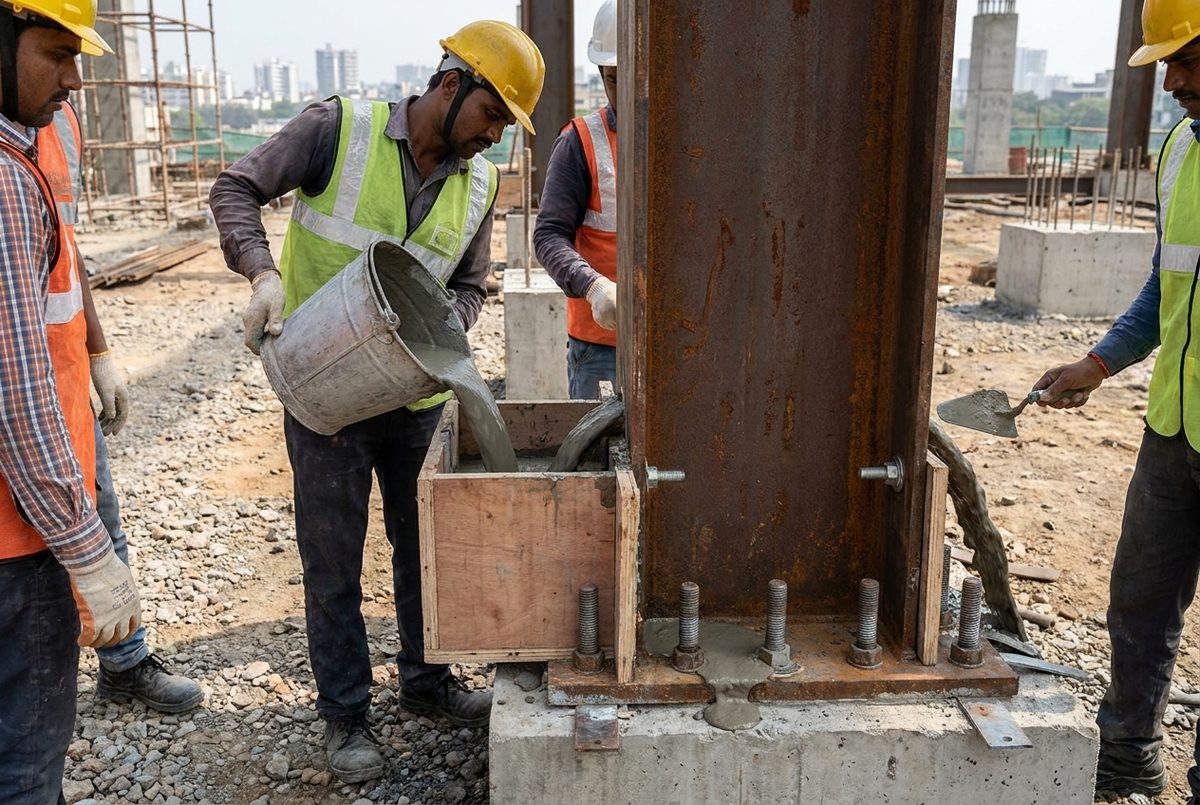
Cementitious non-shrink grouts
Pre-bagged blends of special cements, graded fillers and shrinkage-compensating additives, mixed on site to a flowable consistency and placed to a head so they fill completely under the plate.
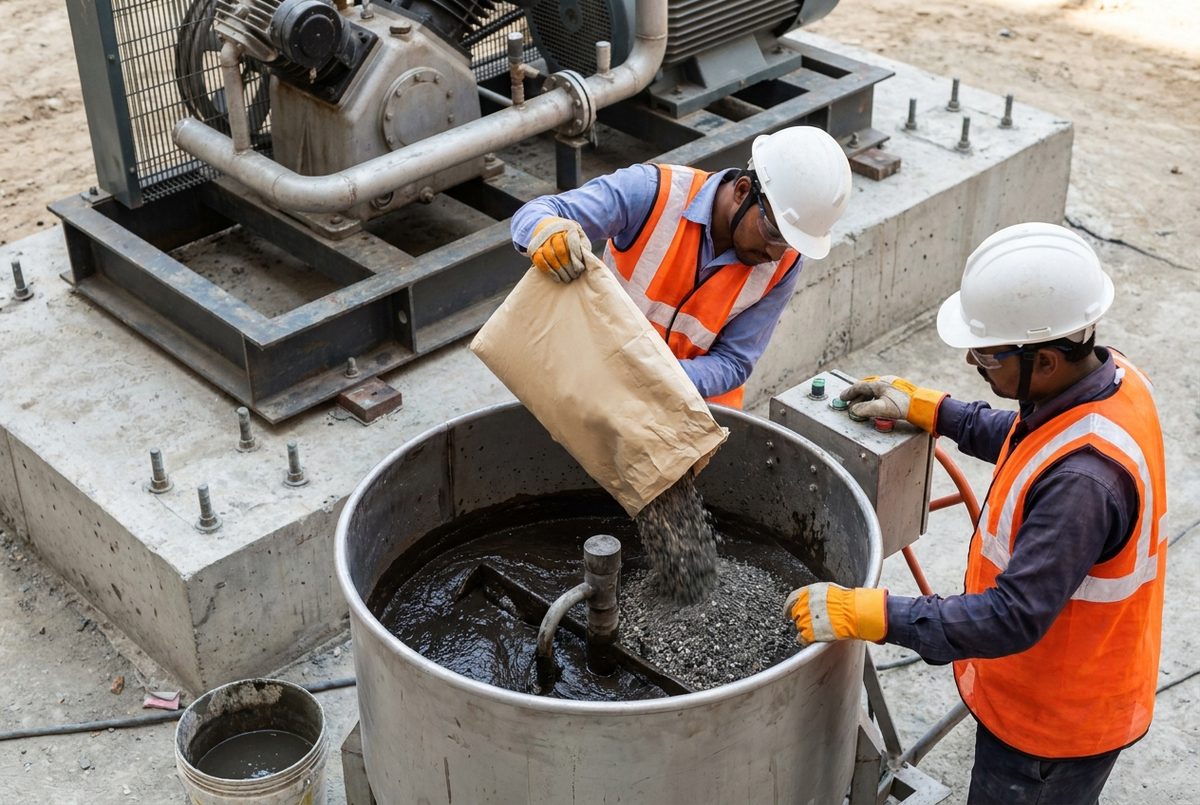
Epoxy precision grouts
Three-component resin systems — resin, hardener and graded filler — giving very high early and ultimate strength plus genuine fatigue, vibration and chemical resistance.
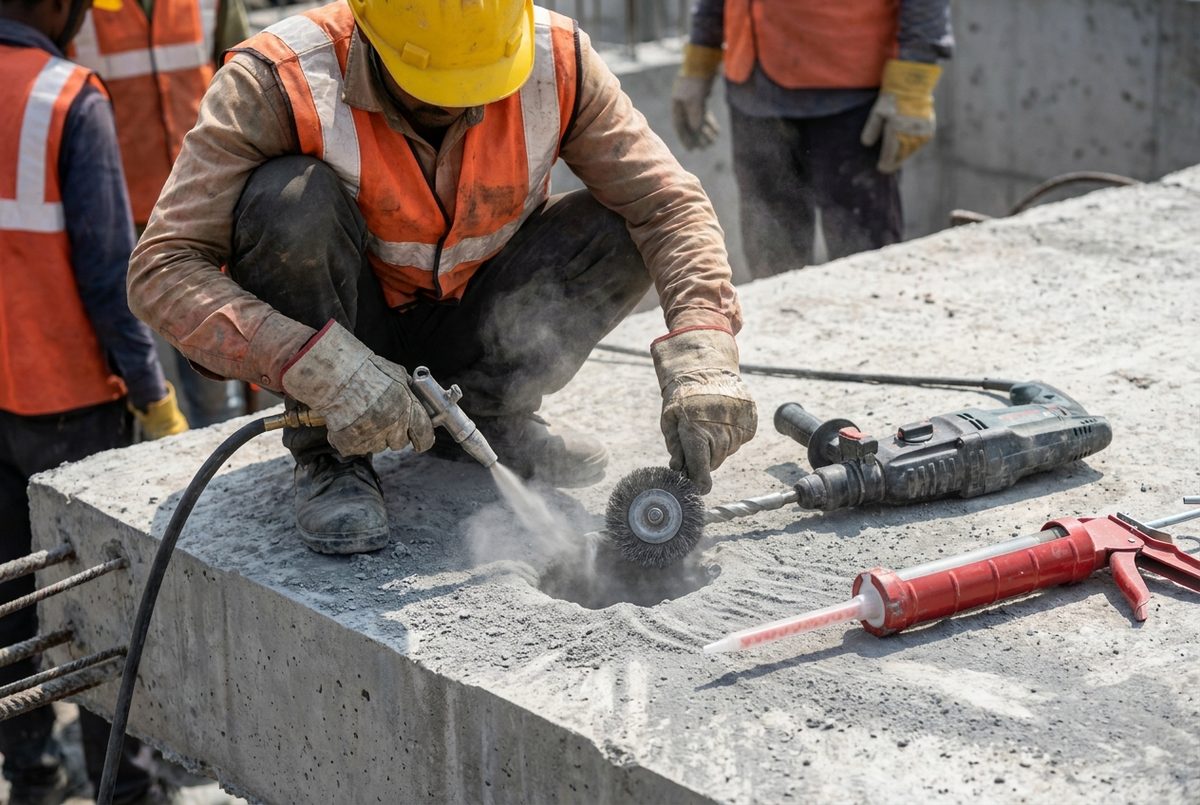
Resin anchoring systems
Polyester or epoxy resins that bond rebar starter bars, dowels, bolts and rails into holes drilled in hardened concrete. Supplied in pourable and thixotropic (non-sag) grades.
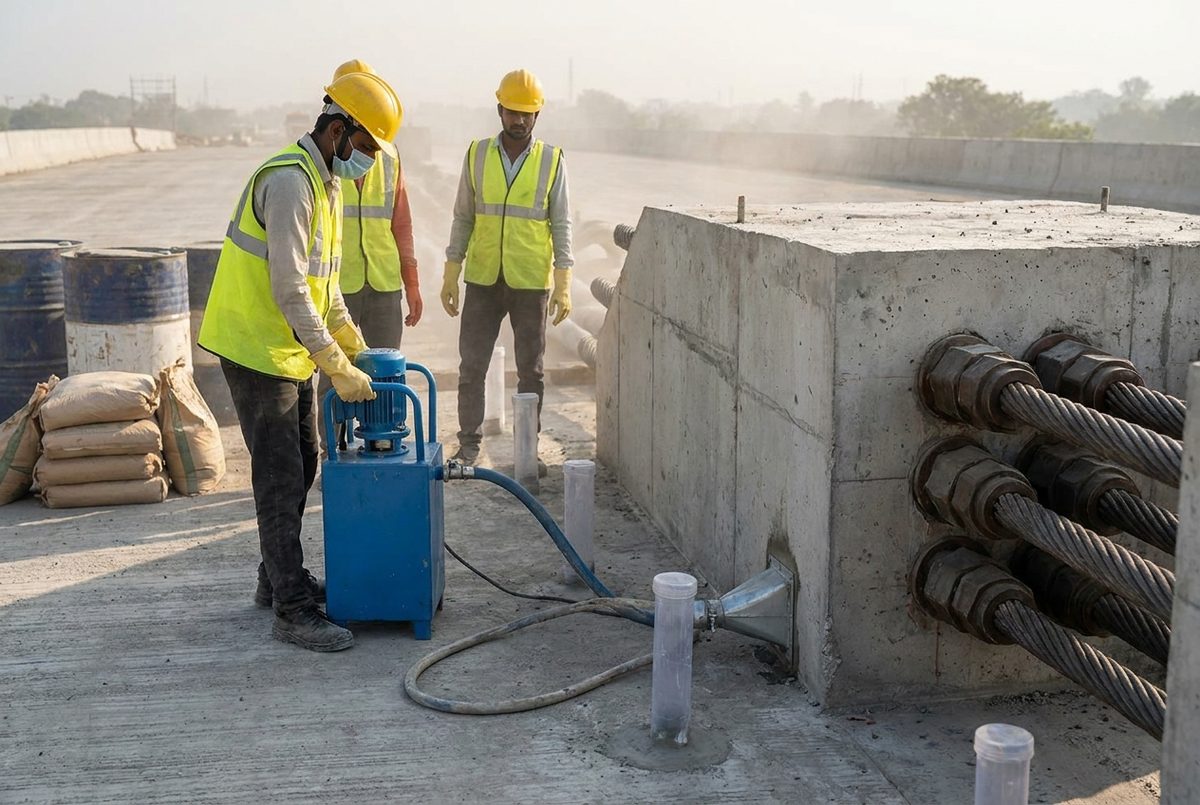
Post-tensioning / cable duct grouts
Specialist grouts formulated to fill and protect post-tensioning tendons inside ducts without bleeding or segregating over long runs, referencing EN 447.
Three constraints specifiers get wrong
Most grout complaints are not product failures. They are section, flow or water-ratio failures — decided long before the bag is opened.
Mind the gap, not just the grade
Every grout has a stated minimum and maximum section thickness. Too thin and it cannot develop strength or flow; too deep in one pour and it bleeds, segregates or generates heat. Deep pours need an approved aggregate extension at the stated dosage — never ad-hoc site aggregate.
Flow distance is a design input
A grout that flows beautifully in a bucket can still leave a void two metres under a large baseplate. Match consistency, pot life and placement method to the actual flow distance and placing temperature, and place from one side to a head so air is pushed out ahead of the grout.
Never add site water for flow
Adding unspecified water is the single most common cause of bleeding, segregation and lost strength. If the mix will not flow far enough, the answer is a different grade or an approved extension — not more water.
Six failures we are called out to fix
Drummy or hollow baseplates
Usual cause: grout shrinkage, or the plate was never fully filled
Fix: A genuine non-shrink grade placed to a correct head and flow distance, so grout stays in contact with the underside of the plate.
Premature cracking under dynamic load
Usual cause: a cementitious grade used where fatigue and vibration are severe
Fix: An epoxy precision grout matched to the machine’s forces — the Conbextra EP series or MasterFlow 9400.
Equipment held up waiting on strength
Usual cause: a standard grade specified and 28-day figures relied on
Fix: A rapid early-strength grade, specified against confirmed early-age data rather than 28-day values.
Anchor pull-out and rebar slippage
Usual cause: wrong resin grade, poor hole cleaning, or insufficient embedment
Fix: The correct resin grade with hole diameter, cleaning regime and embedment depth exactly per the data sheet.
Bleeding and segregation in deep pours
Usual cause: site water added to gain flow or volume
Fix: The manufacturer-approved aggregate extension at the stated dosage and section thickness — never unspecified water.
Resin sagging out of the hole
Usual cause: a pourable grade used overhead or horizontally
Fix: A thixotropic non-sag grade for overhead and horizontal fixings; keep pourable grades for vertical and horizontal-down holes.
One Fosroc grout per load condition
As an authorised Fosroc distributor and applicator we lead with Conbextra because it covers all four regimes on this page with a single, well-documented family — and we say so plainly where another brand is the better technical answer.
Conbextra GP2N
The workhorse non-shrink grout for baseplates, pockets and column bases.
Conbextra EP75
Epoxy precision grout for turbines, compressors and crusher bases under dynamic load.
Conbextra Cable Grout HS
High-strength cable duct grout that fills and passivates tendons without bleeding.
Conbextra HES
High early-strength grade where the plant cannot wait 28 days for the machine to run.
What the standards on the data sheet actually govern
Three references do most of the work in this category. Knowing what each one controls makes a data sheet comparable instead of decorative.
The reference for packaged dry hydraulic-cement non-shrink grout. It governs how a grout must behave dimensionally — that it does not shrink below its placed volume — which is exactly the property a baseplate depends on.
The specification for grout used in post-tensioning ducts. It sets the fluidity, bleed and volume-change limits that decide whether a tendon is fully encapsulated and passivated, or left sitting in a void.
The Indian test methods behind the compressive-strength figures on every data sheet. When you compare grades, compare numbers produced by the same method at the same age — especially early-age values.

Grout is a shelf-life product — ours is date-stamped
Space Arc Engineering is an Authorised Distributor and Applicator in India for Fosroc, Sika, Dr. Fixit, MC-Bauchemie, STP, UltraTech, Master Builders Solutions and Asian Paints SmartCare. Cementitious grout stiffens and resin cartridges lose reactivity with age, so every bag, pail and cartridge moves through our own warehousing with batch and date records intact — not repacked or grey-market stock that will not develop its stated strength.
All Grouts & Anchors products we supply
211 genuine grouts & anchors products from our authorised brands — supplied & applied across Delhi NCR and pan-India.
Fosroc · 100 Preferred
MC-Bauchemie · 30
Sika · 33
UltraTech · 6
STP · 12
Other · 27
Why specify grouts and anchors through us
We specify by load, not by brand quota
We ask what the force is doing first — static bearing, cyclic, tension, encapsulation — then name the family. That is why a cementitious grade gets recommended where it genuinely fits, and an epoxy where it does not.
Genuine, batch-traceable stock
Grout strength depends on fresh material. Every bag and cartridge arrives with batch and date records intact, so early-age figures on the data sheet are the figures you actually get.
Method statements, not just material
Head, flow distance, pot life, hole cleaning and embedment are what decide whether a grout works. We supply the placement method alongside the product, and trained crews where you want the risk carried.
Frequently asked questions
Cementitious or epoxy grout for a machine base?
It depends on what the machine does to the bed, not on how important the machine is. Static and moderately dynamic bases are well served by a cementitious non-shrink grade such as Conbextra GP2N. Once you are into severe vibration and fatigue — turbines, reciprocating compressors, crushers — an epoxy precision grout like the Conbextra EP series is the correct answer, because it resists cyclic breakdown that a cementitious bed will eventually suffer.
How thick can I pour a non-shrink grout in one go?
Every grade states a minimum and maximum section on its data sheet, and both matter. Below the minimum the grout cannot develop its stated strength; above the maximum you risk bleeding, segregation and heat. For deep pours use the manufacturer-approved aggregate extension at the stated dosage rather than pouring beyond the limit or thinning the mix.
Why do my anchors keep pulling out?
In our experience it is almost never the resin. It is dust. A drilled hole must be blown out and brushed to the regime on the data sheet before injection — residual dust acts as a bond breaker along the entire annulus. After that, check you are using the stated hole diameter and embedment depth, and that a pourable grade is not being used overhead where a thixotropic one is required.
Can I add water to make a grout flow further?
No. Added water is the most common cause of bleeding, segregation and lost strength we see on site. If the grout will not reach, change the approach — a more flowable grade, a shorter flow path, placing from a head on one side, or an approved aggregate extension. Water is never the fix.
What is different about post-tensioning duct grout?
In every other application on this page the grout carries load. In a PT duct it does not — the tendon does. The grout’s job is to completely fill the duct and passivate the steel, which is why EN 447 controls fluidity, bleed and volume change so tightly. A void in a duct is not a strength problem; it is a hidden corrosion cell.
How soon can we run the machine after grouting?
That is a grade decision, so make it at specification stage rather than on the day. Standard grades quote 28-day strengths; where commissioning cannot wait, a high early-strength grade such as Conbextra HES is specified against confirmed early-age data. Tell us your commissioning date and we will work backwards to the grade.
Do you supply application, or only material?
Both. For grouting and anchoring the placement method is most of the risk — head, flow, pot life, hole cleaning, embedment. We supply genuine material with method statements, and we can provide trained applicator crews across Delhi NCR and pan-India where you want that risk carried by us.
Are you an authorised distributor for these brands?
Yes. Space Arc Engineering is an Authorised Distributor and Applicator in India for Fosroc, Sika, Dr. Fixit, MC-Bauchemie, STP, UltraTech, Master Builders Solutions and Asian Paints SmartCare. Material moves through our own warehousing with batch and date records intact, which for a shelf-life-sensitive category like grout is the difference between the stated strength and a surprise.
Tell us what the load is doing — we will name the grout.
Send the equipment or fixing, the gap, the flow distance and your commissioning date. You get a system-wise quote with the grade, the placement method and the early-age figures that matter.