Sealants & joint treatment
PU, silicone, polysulphide, MS-polymer and acrylic sealants for facade, floor, glazing and water-retaining joints — chosen by the movement the joint will actually see and what the joint is exposed to.
What every chemistry buys — and what it charges
There is no best sealant — every chemistry buys you something and charges you something else. Pick the trade that matches the joint.
Polyurethane
Chosen by the movement the joint will actually see, and by what the joint is exposed to — not by price per cartridge.
Movement accommodation ±25%- Highest practical movement accommodation
- Paintable, and tough against abrasion
- The default for facade and floor joints
- Needs priming on many porous substrates
- Limited UV colour stability over long exposure
- Facade and floor movement joints
- Trafficked joints needing abrasion resistance
- Where the joint must later be painted
Silicone (neutral)
Chosen by the movement the joint will actually see, and by what the joint is exposed to — not by price per cartridge.
Movement accommodation ±25–50%- Outstanding UV and weather stability
- Best-in-class for glass and glazing
- Stays flexible at temperature extremes
- Not paintable — the colour you buy is final
- Silicone residue can contaminate adjacent repairs
- Glazing, curtain walling and glass-to-metal
- Sanitary and wet-area perimeters
- High UV exposure where colour must hold
Polysulphide
Chosen by the movement the joint will actually see, and by what the joint is exposed to — not by price per cartridge.
Movement accommodation ±25%- Excellent fuel and chemical resistance
- Long service record in water-retaining works
- Handles continuous immersion
- Slower cure than PU
- Usually two-part — needs correct site mixing
- Water-retaining structures and immersed joints
- Fuel-contact and chemical exposure
- Below-grade joints with long service demands
Acrylic
Chosen by the movement the joint will actually see, and by what the joint is exposed to — not by price per cartridge.
Movement accommodation ±7.5%- Lowest cost, easy to apply and paint
- Fine for internal, low-movement joints
- Low movement capability — fails in a real expansion joint
- Not for continuous wet or immersed exposure
- Internal, low-movement decorative joints
- Perimeter gaps that will be over-painted
- Dry areas only — never a real expansion joint
Movement figures are typical for the chemistry class; confirm against the product data sheet and design the joint width to the calculated movement.
The three we specify most
Movement capability, UV stability and whether it has to be painted decide almost every sealant choice on a real project.
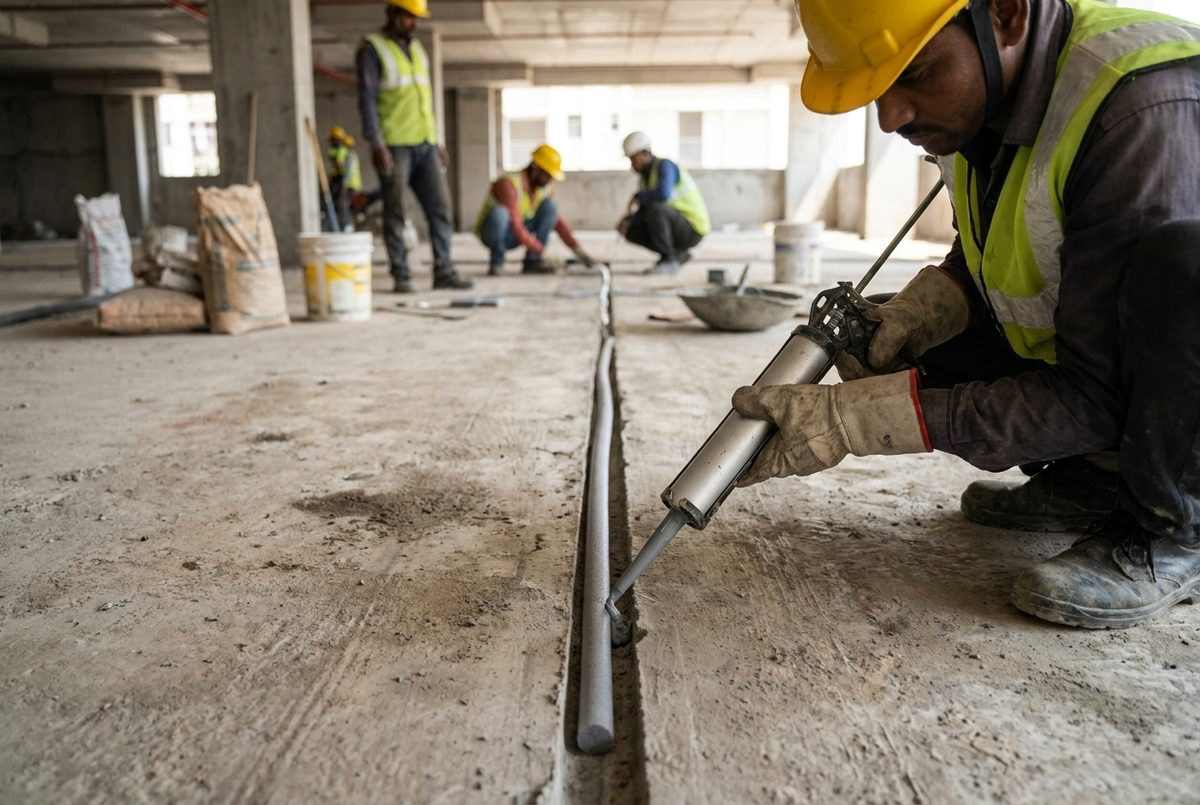
Polyurethane (PU) sealants
One- and two-part elastomeric sealants that cure to a tough, abrasion-resistant, paintable rubber. Described on the page as “the workhorse for expansion and connection joints in concrete, masonry and floors”. Generally require a primer on porous substrates. Available in non-sag (gun) and self-levelling/pouring grades.
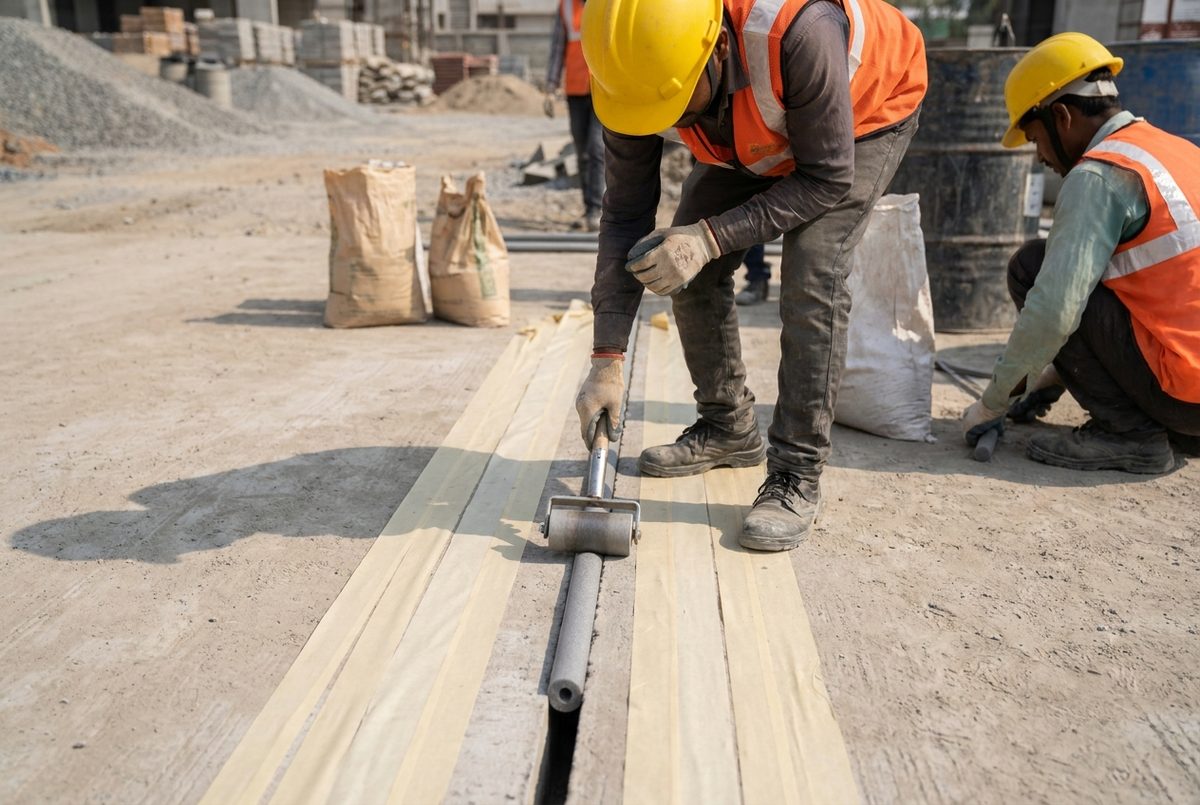
Silicone sealants (neutral-cure)
Silicone elastomers with outstanding UV stability and high movement capability. The page notes they are “generally not paintable or trafficable”, which rules them out of floor and traffic applications.
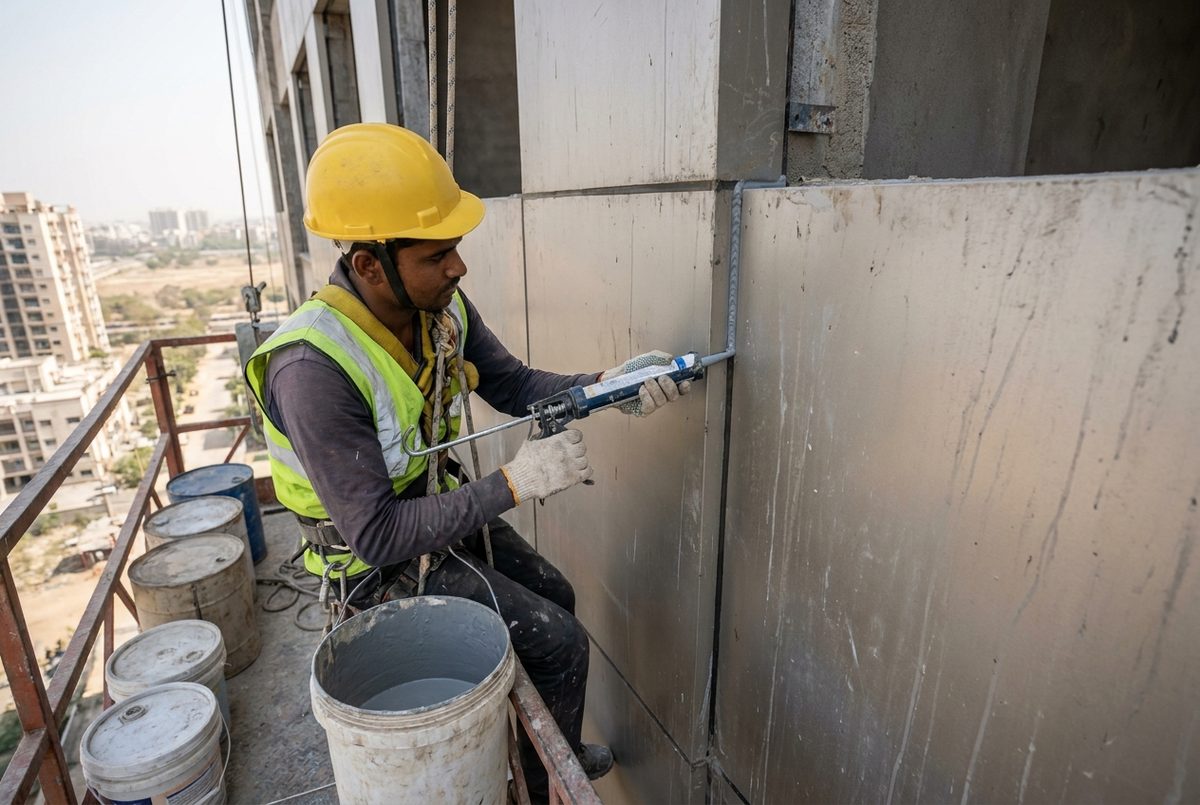
Polysulphide sealants
Two-part sealants that cure to a rubber-like seal with excellent chemical and fuel resistance. Traditionally specified for trafficked floor joints and civil structures. Supplied in gun grade (non-sag) and pouring grade (self-levelling).
Six joint failures and their real cause
Adhesion loss — the sealant peels cleanly away from one or both joint faces
Usual cause: Skipped or wrong primer. Porous substrates such as concrete and masonry generally need the manufacturer’s primer; contaminated, dusty or laitance-covered joint faces have the same effect.
Fix: Prepare the joint faces properly and apply the manufacturer’s matched primer for that sealant/substrate combination, or select an MS-polymer hybrid that bonds primerless to that substrate. Re-cut and re-seal the affected length rather than over-banding it.
Cohesive splitting — the sealant tears through its own body along the joint
Usual cause: Joint movement exceeds the sealant’s movement accommodation factor (MAF); the product was selected on width alone rather than on calculated thermal and structural movement.
Fix: Calculate the expected thermal and structural movement, then select a sealant whose MAF comfortably exceeds it — around +/-50% capability for high-movement and seismic joints, +/-25% for many standard joints — or move to a dedicated movement-joint system.
Three-sided adhesion — sealant bonded to the joint base as well as both faces, so it cannot extend and tears early
Usual cause: Missing backer rod or bond-breaker, so the sealant contacts the bottom of the joint.
Fix: Install a correctly sized closed-cell or open-cell polyethylene foam backer rod (or bond-breaker tape in shallow saw-cuts) to set the joint depth, give the correct width-to-depth ratio and leave the sealant free to move on two faces only.
Premature chalking, surface crazing or cracking of the sealant
Usual cause: Wrong chemistry for the exposure — most commonly a polyurethane used in a UV-exposed facade or glazing position, where the page notes PU chalks under sun.
Fix: Match chemistry to exposure: neutral-cure silicone for UV-exposed glazing and weatherseals, PU or polysulphide for immersed, below-grade and trafficked positions, MS-polymer hybrid for mixed weather-exposed substrates.
Water ingress at expansion and construction joints in tanks, basements and podiums
Usual cause: Unsealed or failed movement/construction joints, or a sealant selected without immersion resistance, and no waterstop in the construction joint.
Fix: Use PU or polysulphide sealants rated for immersion at the construction and movement joints and combine them with waterstops and the waterproofing membrane system as a complete detail; where the leak path is already active, seal it by PU/epoxy injection before re-detailing the surface joint.
Sealant slumps out of vertical joints, or fails to self-level in horizontal ones
Usual cause: Wrong rheological grade — a pourable/self-levelling grade used on a vertical or overhead joint, or a non-sag gun grade used where a pourable seal was needed.
Fix: Confirm sag vs self-levelling grade at specification: non-sag (gun) grades for vertical and overhead joints, pourable/self-levelling grades for horizontal floor and deck joints.
Fosroc sealants by joint type
As an authorised Fosroc distributor we lead with Nitoseal and Thioflex because the range covers facade, floor, immersed and fuel-contact joints with published movement capabilities — and the movement figure is the one that matters.
Nitoseal MS600
MS-polymer sealant: high movement, paintable, primerless on most substrates.
Nitoseal PU280
Traffic-grade polyurethane for floor and paving joints that take wheel loads.
Thioflex 600
Two-part polysulphide for water-retaining, fuel-contact and immersed joints.

A sealant past its date never reaches its movement rating
Space Arc Engineering is an Authorised Distributor and Applicator in India for Fosroc, Sika, Dr. Fixit, MC-Bauchemie, STP, UltraTech, Master Builders Solutions and Asian Paints SmartCare. Sealant cartridges and two-part packs cure by chemistry that degrades on the shelf — an out-of-date pack skins early, cures short of its stated elongation and tears at the first real movement cycle. Every carton moves through our own warehousing with batch and date records intact.
All Sealants & Joint Treatment products we supply
209 genuine sealants & joint treatment products from our authorised brands — supplied & applied across Delhi NCR and pan-India.
Fosroc · 91 Preferred
MC-Bauchemie · 18
Sika · 42
Dr. Fixit · 16
UltraTech · 3
STP · 32
Other · 7
Why specify joints through us
We size the joint before we pick the sealant
Movement capability is a percentage of joint width, so the width and the sealant are one decision. We work the movement first, then name a chemistry that can actually accommodate it.
Primer and backer specified with the sealant
Most sealant failures are adhesion failures, not cohesion failures. We quote the primer and the backer rod as part of the system rather than leaving them to the site to guess.
In-date stock with batch records
Cartridges and two-part packs arrive in date and batch-traceable, so the elongation and cure on site match the data sheet you specified from.
Frequently asked questions
Which joint sealant is best for exterior expansion joints in India?
For most exterior concrete and masonry expansion joints, a one-part polyurethane such as Sika Sikaflex-1A or the Fosroc Nitoseal PU range is the practical choice, it is durable, paintable and absorbs thermal movement well after priming. For UV-exposed glazing and curtain-wall weatherseals, a neutral-cure silicone (Sikasil WS) is better. Share the joint width, movement and exposure with Space Arc on +91 9999155255 and we will recommend the exact grade.
What is the difference between polyurethane, silicone and polysulphide sealants?
Polyurethane is tough, paintable and trafficable, ideal for floors and general movement joints. Silicone has the best UV resistance and movement capability for glazing and weatherseals but is not paintable or trafficable. Polysulphide cures to a chemical- and fuel-resistant rubber-like seal favoured for trafficked and fuel-exposed floor joints. MS-polymer hybrids combine low-VOC, primerless bonding with good weathering. The right choice depends on exposure, movement and whether the joint is walked or driven on.
Do I need a primer and backer rod with joint sealants?
Usually yes. Porous substrates like concrete and masonry generally need the manufacturer’s primer for reliable adhesion, while many MS hybrids bond primerless. A backer rod (closed- or open-cell polyethylene foam) sets the correct joint depth, prevents three-sided adhesion and lets the sealant move freely. Skipping either is one of the most common causes of premature sealant failure. Space Arc supplies compatible primers and backer rods alongside the sealant.
What does movement capability (e.g. +/-25% or +/-50%) mean for sealant selection?
It is the percentage of the joint’s designed width that the cured sealant can repeatedly stretch and compress without failing. You calculate the joint’s expected thermal and structural movement, then pick a sealant whose movement accommodation factor comfortably exceeds it. High-movement and seismic joints need around +/-50% capability, while many standard joints are fine with +/-25%. Correct joint width-to-depth geometry is essential to achieve the rated movement.
Which sealant should I use for water tanks, basements and STPs?
For water-retaining and below-grade structures, polyurethane and polysulphide sealants are typically specified for construction and movement joints because they tolerate immersion and resist water ingress. They are usually combined with waterstops and a waterproofing membrane system as part of the overall joint treatment. Space Arc can supply the matching Sika, Fosroc or Dr. Fixit products and advise on the full detail, contact [email protected].
Are Space Arc an authorized distributor for Sika, Fosroc and Dr. Fixit sealants in India?
Yes. Space Arc Engineering is an authorized project distributor and applicator supplying Sika (Sikaflex, Sikasil), Fosroc (Nitoseal, Thioflex) and Dr. Fixit sealants and joint-treatment products across India. Buying through an authorized distributor means genuine, batch-traceable material, correct storage, technical selection support and access to trained applicators. Reach us on +91 9999155255 or [email protected].
What is the price of joint sealants in India?
Sealant pricing depends on chemistry (silicone, PU, polysulphide or hybrid), pack size (cartridge, sausage or bulk), grade and project quantity, so it is quoted per project rather than fixed. Space Arc offers competitive, authorized-distributor pricing across Sika, Fosroc and Dr. Fixit. Send your joint details and quantities to +91 9999155255 or [email protected] for a current quotation.
Can Space Arc help with joint design and sealant application, not just supply?
Yes. As an authorized applicator, Space Arc provides technical support on joint design, sealant and primer selection, backer-rod sizing and substrate preparation, plus trained applicator services for facades, expansion joints, floor joints and waterproofing details. This ensures the specified system is installed correctly and performs as intended. Call +91 9999155255 to discuss your project.
Send the joint — width, movement and exposure.
Tell us how wide the joint is, how much it moves and what it is exposed to. You get a chemistry, a primer, a backer and a joint detail, material and application.