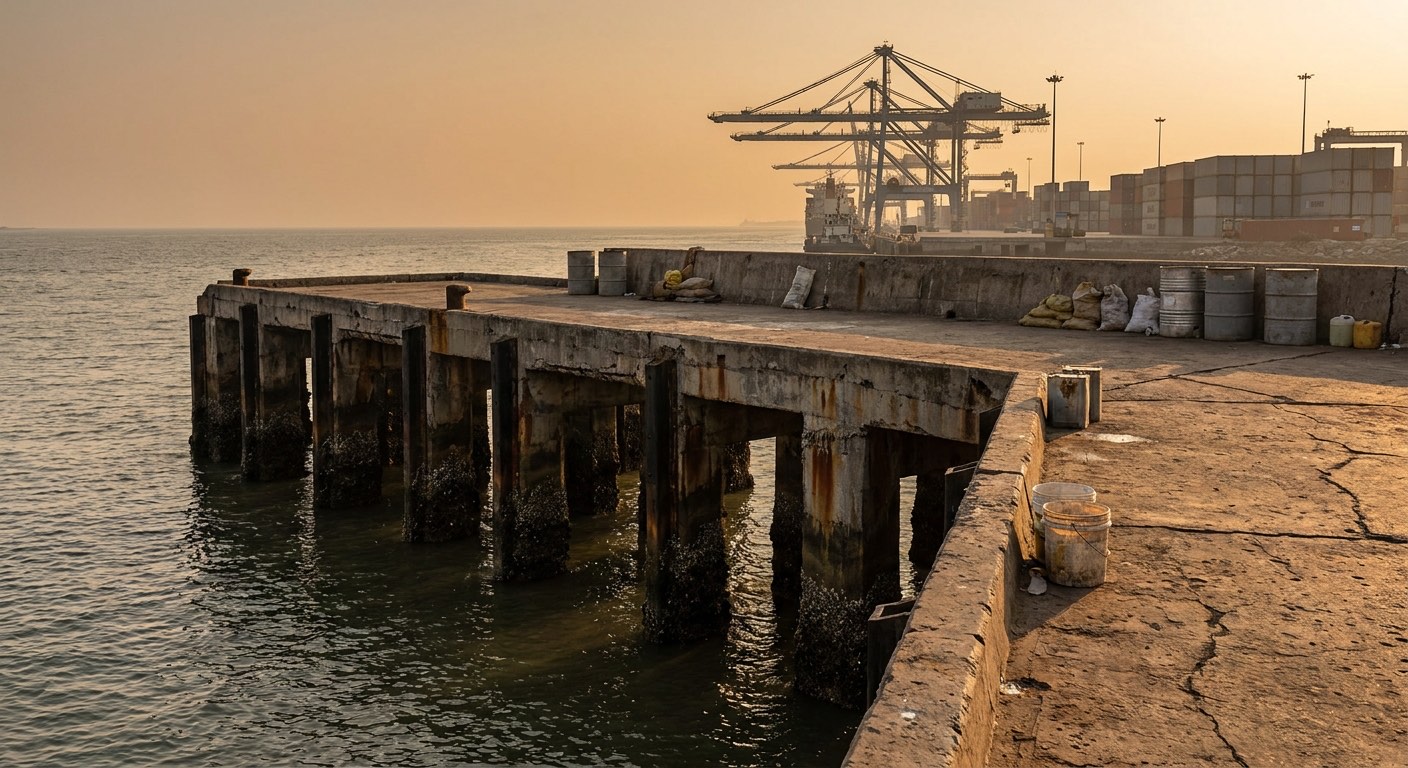
Protective Coatings and Corrosion Protection for Concrete and Steel
Written for specifying engineers, contractors and building owners in India who have to pick a coating system and defend it. It maps six degradation mechanisms to the correct build-up, DFT and product, and says where each system fails.
What this guide settles
Select the coating from the degradation mechanism, not the substrate. Carbonation on RCC needs a breathable acrylic anti-carbonation coating at not less than 150 microns total DFT. Chloride and marine exposure need a low-permeability barrier plus galvanic anodes at repair perimeters. Chemical, abrasion and sewage exposure need solvent-free or coal-tar-modified epoxy linings at 400 to 1000 microns on blast-prepared, blowhole-filled concrete. Structural steel follows ISO 12944: zinc-rich primer, epoxy build, aliphatic polyurethane topcoat, specified against the corrosivity class. Surface preparation and measured DFT decide the outcome more than brand choice.
What is actually attacking the structure?
Pick the condition that matches your project. The specification, the build-up and the products update as you choose.
Breathable acrylic anti-carbonation system over a penetrating primer, not less than 150 microns total DFT.
Carbonation is a diffusion problem, so the answer is diffusion resistance combined with vapour permeability, not waterproofing. A sealed impermeable film traps construction and monsoon moisture behind it and blisters. Repair spalls and treat exposed bar first, otherwise the coating simply hides an active corrosion cell that keeps growing underneath it.
- Break out delaminated cover, clean bar, apply rebar primer, reinstate with repair mortar
- Wash and dry substrate, fill blowholes and hairline cracks, allow 7 days minimum drying
- One coat penetrating primer, brush applied, allowed to soak in and dry
- Two coats acrylic anti-carbonation coating, not less than 150 microns total DFT
- Check wet film with a comb gauge each coat, record DFT per elevation
Galvanic anodes at every repair perimeter, plus a low chloride-diffusion acrylic barrier over the whole element.
A barrier coating cannot remove the chloride already inside the concrete. Patch repair on its own raises the potential difference between new alkaline mortar and old contaminated concrete, so corrosion restarts just outside the patch within one to three years. Anodes suppress that ring while the coating slows further ingress.
- Half-cell and chloride profile survey before pricing any repair area
- Break out to 25 mm behind bar, clean steel to bright, verify electrical continuity
- Tie sacrificial anodes around the repair perimeter before reinstating mortar
- Allow repair mortar to cure 7 to 14 days before coating over it
- Reinstate, cure, then apply primer plus two coats chloride-resistant acrylic coating
Solvent-free epoxy lining at 400 to 600 microns over a filled, blast-prepared surface.
Chemical resistance is per chemical, per concentration and per temperature. Ask for the resistance chart and match it against the actual spill list, not a generic claim. Most failures here are not chemical at all, they are pinholes from unfilled blowholes and edges that were never coved or terminated into a chase.
- Confirm chemical list, concentration and service temperature before selecting resin
- Abrasive blast or scarify to expose fine aggregate, remove all laitance
- Check substrate moisture and apply epoxy primer within the same shift
- Fill blowholes and defects with epoxy filler, cove all wall to floor junctions
- Two coats solvent-free epoxy to 400 to 600 microns, holiday test before commissioning
High-build solvent-free epoxy at 500 to 1000 microns, aggregate filled where the flow carries sand.
Abrasion resistance tracks film hardness and thickness together, and thin coats always fail at the leading edge first. Where flow carries sand, a filled or broadcast system outlasts a smooth one even though the smooth one tests better in the laboratory. Detail the upstream edge into a chase so flow cannot lift the film.
- Cut a 10 mm chase at all upstream edges and terminations
- Blast to expose aggregate, repair honeycombing and erosion scour first
- Prime, then fill and level with epoxy filler to remove flow-side turbulence
- Two or three coats high-build epoxy to 500 to 1000 microns total
- Broadcast graded quartz into the intermediate coat where flow carries sand
Coal-tar-modified or high-build solvent-free epoxy, 600 microns minimum in the crown and splash zone.
The crown, not the invert, is the aggressive zone. Hydrogen sulphide gases off, oxidises biologically on damp concrete above the water line and forms sulphuric acid, so concrete above the flow degrades faster than concrete under it. Coat the full internal surface and specify the crown thicker than the submerged zone.
- Ventilate, gas test and confirm confined-space permit before surface preparation
- High-pressure wash off biogenic sludge, then blast back to sound concrete
- Cut back acid-softened concrete, reinstate with sulphate-resistant repair mortar
- Two coats coal-tar-modified or solvent-free epoxy, 600 microns minimum at crown
- Spark test the full internal surface for holidays before returning flow
Aliphatic polyurethane topcoat over the epoxy build. Never leave epoxy as the exposed exterior finish.
Aromatic epoxy binders break down under UV and chalk. The chalk is not only cosmetic, it becomes a weak boundary layer that the next coat bonds to instead of bonding to the film below, which is why so many recoats peel off in sheets. Aliphatic polyurethane and acrylic hold colour and gloss.
- For steel: Sa 2.5 blast, then zinc-rich primer at 60 to 80 microns DFT
- Epoxy intermediate coat 100 to 150 microns within the stated overcoat window
- Aliphatic polyurethane topcoat 50 to 75 microns, two coats where colour matters
- For concrete: acrylic or PU topcoat over the anti-carbonation system
- Wash, abrade and wipe test any chalked surface before applying a new coat
Selections are indicative. Send us the substrate, exposure and area and Space Arc Engineering will confirm the specification.
Systems compared, including where each one fails
Every system here is one Space Arc Engineering both supplies and applies, so the limitations listed are the ones we see on site rather than the ones in a brochure.
Acrylic anti-carbonation coatings
Pigmented acrylic resin films, solvent or water borne, that carry a high resistance to carbon dioxide diffusion while staying open to water vapour. They are built in two coats to a total of not less than 150 microns dry film over a penetrating primer, and work as a diffusion barrier, not a waterproofing membrane.
Urban RCC frames, soffits and facades where the carbonation front is approaching the reinforcement but cover is still sound. Breathability lets trapped construction and monsoon moisture escape rather than blister the film.
It bridges nothing. Over live cracks wider than hairline it splits along the same line within a season. It also does little about chloride already inside the concrete, and nothing about standing water on a terrace.
Typical spec. One coat penetrating primer plus two coats acrylic, not less than 150 microns total DFT, roughly 5 to 6 m2 per litre per coat on fair-faced concrete, overcoat after 4 to 6 hours, full cure 7 days.
Elastomeric crack-bridging coatings
Higher-elongation acrylic and acrylic hybrid films applied thicker than a standard anti-carbonation coat, formulated to stretch over moving hairline cracks. Elongation is strongly temperature dependent, so any crack-bridging class is only meaningful at the test temperature quoted with it.
Terraces, parapets and long facade panels that thermally cycle 25 degrees or more between a May afternoon and a January night, where shrinkage cracks reopen every year and a rigid film keeps splitting.
The film softens and holds dirt in peak summer. It is rated against a declared crack-accommodation figure, not against unlimited movement. Dekguard E2000 declares 2 mm static crack spanning and 1 mm cyclic movement at 200 microns DFT and 23 degrees; both fall away sharply as temperature drops, and neither covers a live structural crack or an unsealed movement joint. It will not take foot traffic.
Typical spec. Primer plus two coats at not less than 200 microns total DFT, brush or medium-nap roller, no thinning to ease spraying, second coat applied at 90 degrees to the first and only when the first is firm to the touch, typically about 12 hours in dry weather at 35 degrees.
Solvent-free epoxy linings
Two-pack amine-cured epoxies with no solvent, laid at high build in one or two coats. They cure to a hard, low-permeability, chemically resistant film that keys into an opened concrete surface and can be filled or reinforced for immersion service.
Bunds, plant floors, process areas, water tanks and reservoirs where resistance to a defined chemical list, immersion and repeated cleaning matters far more than flexibility or long-term appearance.
Rigid. It telegraphs and cracks over moving substrates, chalks badly in direct sun, and is unforgiving of damp concrete. Amine blush in high humidity destroys intercoat adhesion unless the surface is washed before overcoating.
Typical spec. Blast or scarify to expose fine aggregate, epoxy primer, fill blowholes, then two coats at 400 to 600 microns total DFT. Overcoat window typically 16 to 48 hours at 30 degrees, full chemical cure 7 days.
Coal-tar-modified and bituminous epoxies
Solvent-free epoxy resins extended with coal tar or bitumen. The extender lowers water permeability and cost and produces a very hard, dark, biologically inert film that is normally applied primerless in two coats over sound concrete or blast-cleaned steel.
Buried concrete, wet wells, effluent channels, sea-water intakes and the submerged and splash zones of sewage works, where water and biological attack dominate and appearance is irrelevant.
Black only, and it degrades and chalks under UV. It softens at high surface temperature, is difficult to overcoat once weathered, and coal-tar grades attract growing scrutiny on health and disposal grounds.
Typical spec. Two coats at roughly 200 microns wet film per coat, more where exposure is severe, primerless on sound concrete, brush, roller or spray, overcoat 16 to 24 hours. These grades tolerate green and damp concrete better than conventional epoxies, but do not apply over standing water or on cold substrates.
Zinc-rich primers and duplex systems for steel
Epoxy or silicate binders loaded with zinc dust above the percolation threshold, so the zinc stays electrically continuous with the steel and corrodes sacrificially. They are the first layer of a three-coat system, never the finish coat.
Coastal and industrial steelwork in ISO 12944 C4 and C5 categories, and specifically at cut edges, welds and mechanical damage, where a pure barrier coating undercuts and creeps back from the defect.
It needs Sa 2.5 blast cleaning and a real anchor profile. Over hand-tooled or mill-scaled steel the zinc is wasted. Zinc settles fast in the pot, and overthick application causes mud cracking and poor intercoat adhesion.
Typical spec. Sa 2.5 blast to 40 to 75 micron profile, zinc-rich primer 60 to 80 microns DFT, epoxy intermediate 100 to 150 microns, aliphatic polyurethane topcoat 50 to 75 microns, giving 210 to 305 microns total. Around 240 to 280 microns for C4 high durability and 320 microns for C5.
Cementitious barrier coatings
Polymer-modified cementitious slurries, one or two component, brush, trowel or spray applied at 1 to 2 mm. They bond into damp concrete, resist positive and negative hydrostatic pressure and reduce chloride and sulfate ingress without relying on an organic film.
Damp, green or negative-side substrates where no organic coating will bond. Water tanks, basements, lift pits, canals and culverts, and as a sacrificial protective layer over freshly repaired concrete.
Not resistant to acids or to a broad chemical list. Rigid grades crack over movement, thin application is easy to get away with because 1 mm is hard to judge by eye, and the finish is never decorative on its own.
Typical spec. Saturated surface dry substrate, two coats applied at right angles to each other, 1 mm per coat for 2 mm total, roughly 1.8 kg per m2 for each 1 mm coat, so a minimum of about 3.6 kg per m2 for a full two-coat 2 mm system, second coat when the first is thumb-print hard, cure 3 days.
Galvanic anodes and rebar primers
Not coatings in the barrier sense. Zinc anode units tied to the reinforcement corrode preferentially and pass current into the surrounding steel, while cementitious or zinc-rich rebar primers restore an alkaline or sacrificial environment directly at exposed bar.
Chloride-contaminated concrete where patch repair on its own would start incipient anode corrosion around the new patch. Also useful in new coastal construction, where no surface coating can reach the steel.
It does nothing for the concrete surface, depends entirely on verified electrical continuity, and anode life is finite. Cementitious rebar primers are routinely over-applied, leaving a thick layer that debonds under the repair mortar.
Typical spec. Anodes tied to cleaned steel around the repair perimeter at the spacing given by the anode data sheet, continuity verified before encapsulation. Rebar primer, where used, two thin coats, second coat before the repair mortar goes on.
What this looks like in practice
The work Space Arc Engineering supplies and applies, matched to the systems and steps described above.
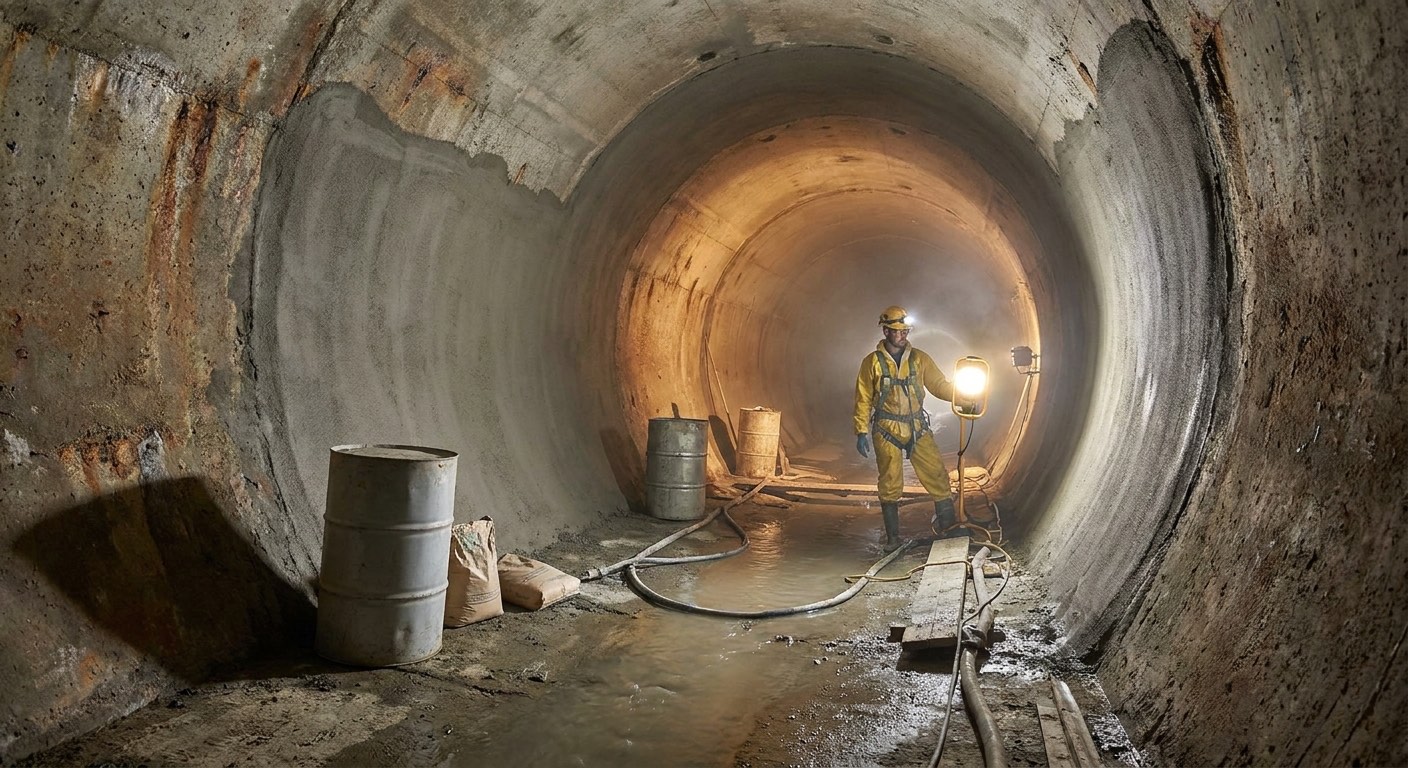
Solvent-free epoxy linings
Two-pack amine-cured epoxies with no solvent, laid at high build in one or two coats. They cure to a hard, low-permeability, chemically resistant film that keys into an opened concrete surface and can be filled or reinforced for immersion service. Bunds, plant floors, process areas, water tanks and reservoirs where resistance to a defined chemical list, immersion and repeated cleaning matters far more than flexibility or long-term appearance.
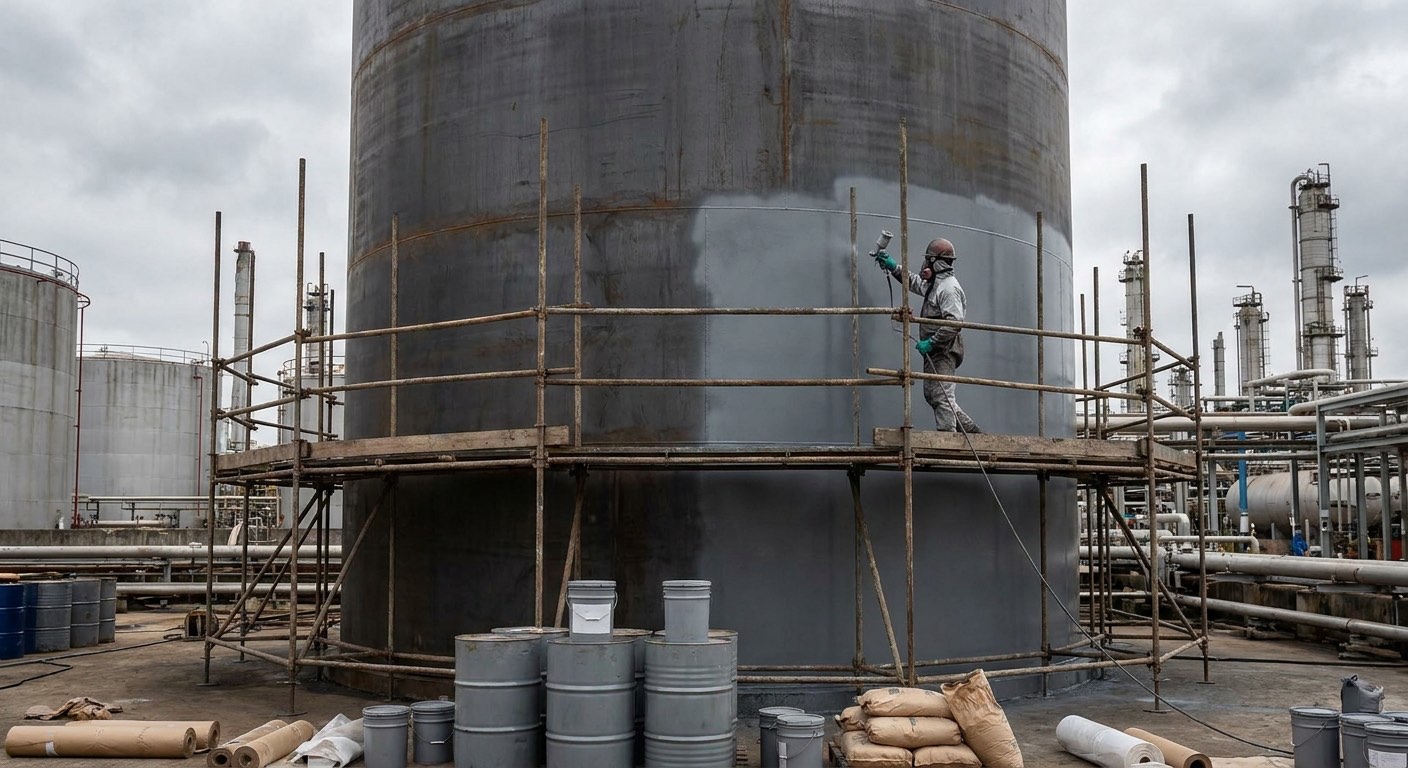
The coating trapped monsoon moisture
Concrete was coated before it dried out after monsoon or after high-pressure washing. Vapour pressure builds behind a low-permeability film in afternoon sun and pushes it off. Sealer-type and epoxy coatings do this on external RCC far more often than breathable acrylics do. Check substrate moisture with an instrument or a taped plastic sheet left overnight, not by eye, and enforce a minimum drying period after washing. On external RCC choose a vapour-permeable system rather than the most impermeable one on the shelf.
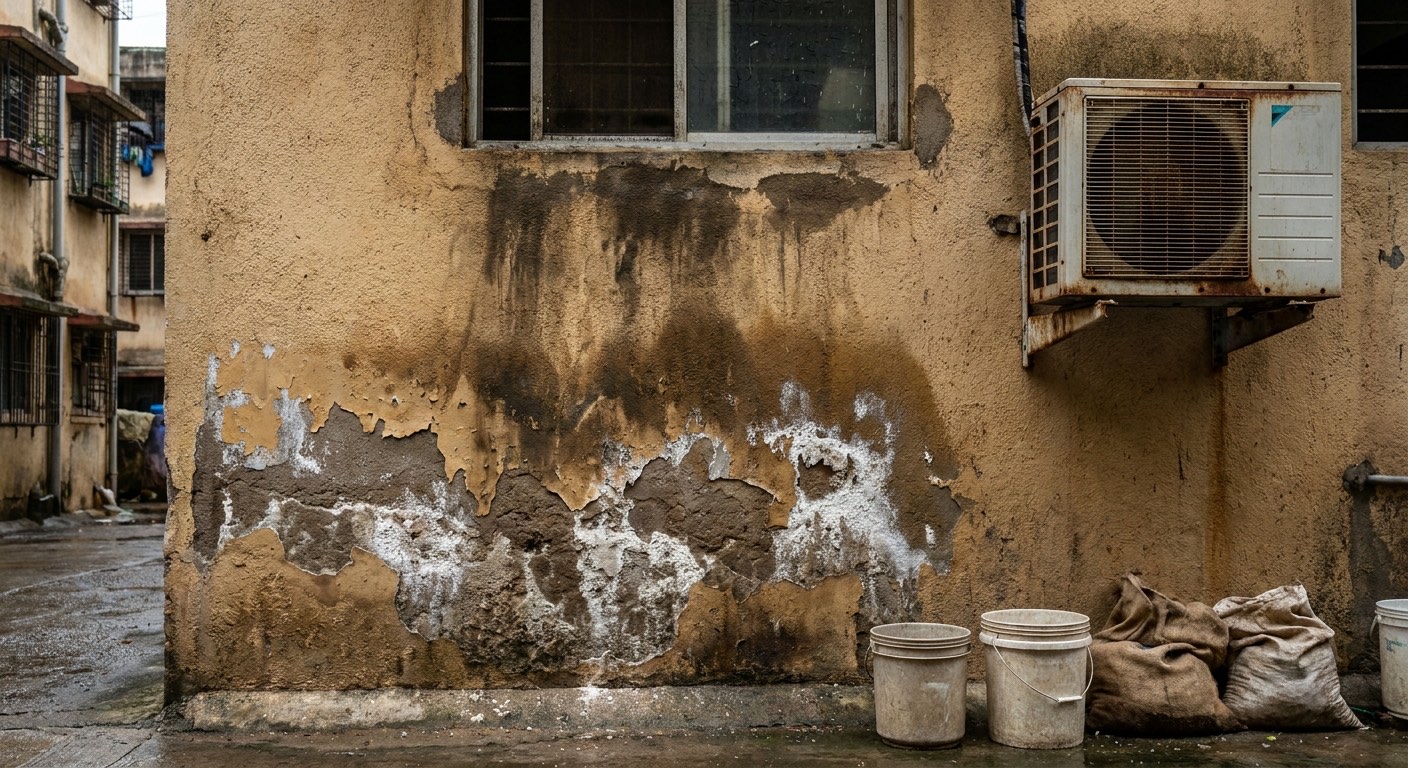
The correct sequence, in order
Skipping a step here is what turns a specified system into a warranty claim. Space Arc supervises these hold points on the projects it applies.
- 1
Diagnose the mechanism, do not guess it
Measure carbonation depth with phenolphthalein on a freshly broken face, cover with a cover meter, chloride by drilled dust profile at depth increments, and corrosion activity by half-cell where chloride is suspected. The result decides whether you need a barrier, an electrochemical system or both.
Hold point: Written survey giving carbonation depth, measured cover and chloride results signed off before any product is specified. - 2
Repair the concrete and protect the steel
Break out to 25 mm behind exposed bar, clean the steel to bright metal, then apply a rebar primer or install sacrificial anodes according to what the survey found. Reinstate with a compatible repair mortar and cure it properly before anything else happens.
Hold point: Inspection of cleaned reinforcement, and of anode continuity where anodes are used, before any mortar is placed. - 3
Prepare the surface to a stated standard
On concrete, abrasive blast, needle gun or high-pressure water to remove laitance and expose fine aggregate, to a profile matched to coating thickness. On steel, Sa 2.5 to ISO 8501-1 with a 40 to 75 micron profile. Grinding alone rarely produces a coating profile.
Hold point: Prepared area compared against the written standard and a surface comparator, and formally accepted before priming. - 4
Check moisture, salts and ambient conditions
Confirm substrate moisture is inside the data sheet limit, surface temperature is at least 3 degrees above dew point, and, on steel exposed to coastal or industrial atmospheres, soluble salts are below the stated limit by Bresle patch. Record air and surface temperature at the start of every shift.
Hold point: Dew point, surface temperature and substrate moisture readings recorded and within limits immediately before priming. - 5
Prime within the overcoat window
Use the primer stated for that coating rather than a generic one, and apply the next coat inside the window given on the data sheet. A primer left too long oxidises or gathers dust, and the topcoat then bonds to that contaminated layer instead of to the substrate.
Hold point: Time-stamped record of primer application per area so the overcoat window can be audited later. - 6
Fill blowholes and detail the edges
Fill blowholes, tie-holes and surface defects with a filler suited to the system, cove all wall to floor junctions in tanks and bunds, and terminate the coating into a cut chase at every edge rather than feathering it out to nothing.
Hold point: Filled and detailed area inspected under raking light before the first full coat is applied. - 7
Apply the coating and control wet film
Work elevation by elevation or panel by panel, check wet film thickness with a comb gauge while each coat is still wet, and reconcile material consumed against area covered at the end of each area. Wet film control is the only chance to correct a thin coat.
Hold point: Wet film readings and material reconciliation recorded per area before the next coat is started. - 8
Verify, cure and hand over with records
Measure dry film thickness by gauge on steel and by destructive check on concrete where specified, pull-off test adhesion at an agreed frequency, spark or sponge test linings for holidays, and allow full chemical cure before immersion or commissioning.
Hold point: DFT log, adhesion results and holiday test report accepted before the structure is returned to service.
Comparison table
| System | Typical total DFT | Primer | Resists | Realistic maintenance interval |
|---|---|---|---|---|
| Acrylic anti-carbonation | Not less than 150 microns | Penetrating silane or acrylic primer | CO2 diffusion, driving rain, UV; stays vapour permeable | Inspect at 5 years, recoat 8 to 12 years |
| Elastomeric acrylic | Not less than 200 microns | Penetrating primer | Hairline crack movement, CO2, driving rain | Recoat 7 to 10 years, sooner on exposed terraces |
| Solvent-free epoxy lining | 400 to 600 microns | Epoxy primer plus blowhole filler | Chemicals, immersion, abrasion; chalks badly under UV | 10 to 15 years internal, unsuitable as an exposed exterior finish |
| Coal-tar-modified epoxy | 350 to 500 microns | Primerless on sound concrete | Water, sewage, biological attack; degrades under UV | 10 to 15 years buried or submerged |
| Zinc-rich duplex system on steel | 240 to 280 microns for C4, 320 microns for C5 | Zinc-rich epoxy is itself the primer | ISO 12944 C4 and C5 atmospheres, cut edges and welds | First major maintenance 15 to 25 years in C4 |
| Cementitious barrier coating | 1 to 2 mm | None, damp substrate tolerated | Water under positive and negative pressure, chloride and sulfate ingress | 15 years plus if not cracked or abraded |
| Galvanic anodes with patch repair | Not a film system | Not applicable | Incipient anode corrosion around repair perimeters | Anode life typically 10 to 20 years |
Why this fails on Indian sites
Most failures are not product failures. These are the ones Space Arc Engineering’s applicators get called in to put right, usually years after the original job.
The coating trapped monsoon moisture
- What you see
- Blisters 10 to 50 mm across appear within weeks, concentrated on south and west elevations and on soffits. Cut one open and the substrate underneath is damp and the film lifts cleanly with no cohesive failure.
- Root cause
- Concrete was coated before it dried out after monsoon or after high-pressure washing. Vapour pressure builds behind a low-permeability film in afternoon sun and pushes it off. Sealer-type and epoxy coatings do this on external RCC far more often than breathable acrylics do.
- How to prevent it
- Check substrate moisture with an instrument or a taped plastic sheet left overnight, not by eye, and enforce a minimum drying period after washing. On external RCC choose a vapour-permeable system rather than the most impermeable one on the shelf.
Blowholes were never filled before lining
- What you see
- A new epoxy lining passes visual inspection, then fails a holiday test at hundreds of discrete points, or seeps and undermines within months of the tank or bund being commissioned.
- Root cause
- Formed concrete carries blowholes 1 to 5 mm deep. A coating bridges the air pocket, the bridge collapses or the trapped air expands as the surface warms, and every blowhole becomes a pinhole straight through to the substrate. Nobody prices the filling coat, so nobody applies it.
- How to prevent it
- Make blowhole filling with an epoxy filler a separately priced line item and a formal hold point. Blast, prime, fill, then coat. Spark or wet-sponge test the entire lined surface before handover rather than a nominated sample area.
DFT stretched to make the coverage work
- What you see
- The coating looks correct at handover, then carbonation depth and rust staining return within five to seven years instead of the specified design life, with no visible defect to point at.
- Root cause
- Coverage figures are quoted on smooth surfaces. Real fair-faced or plastered concrete absorbs 20 to 40 percent more material. When the drum count is fixed in the contract, applicators thin the material or stretch the roller, and delivered DFT lands near half the specification.
- How to prevent it
- Specify total material consumption per square metre alongside DFT, not just a number of coats. Reconcile drums used against area covered at the end of every elevation, and check wet film with a comb gauge while each coat is still wet.
Corrosion restarts in a ring around the patch
- What you see
- New spalls appear 100 to 300 mm outside patch repairs completed one to three years earlier, in concrete that looked entirely sound at the time of repair and was coated over.
- Root cause
- Incipient anode effect. New alkaline repair mortar repassivates the steel inside the patch, which increases the potential difference against the surrounding chloride-contaminated concrete and accelerates corrosion just beyond the patch edge. A coating over the top delays the symptom, not the mechanism.
- How to prevent it
- On any chloride-contaminated element, survey by half-cell potential and chloride profile before repair, and install sacrificial anodes around the repair perimeter with verified electrical continuity. Treat repair and protection as one system rather than two separate contracts.
Blast-cleaned steel left overnight
- What you see
- Flash rust or a light bloom on blasted steel by the next morning, and blistering or under-film creep along welds, edges and bolt heads within the first monsoon after commissioning.
- Root cause
- In NCR humidity blasted steel starts to rust within hours. Soluble salts left from coastal transit or an industrial atmosphere are not removed by blasting alone and pull moisture through the film osmotically. Both faults become invisible the moment the primer goes on.
- How to prevent it
- Blast and prime within the same shift, never across a night or a rain break. Test for soluble salts with a Bresle patch on steel from coastal or industrial exposure, and wash down to a stated conductivity limit before blasting begins.
Applied at 45 degrees surface temperature
- What you see
- Dry spray, orange peel, pinholing and dramatically short pot life. The film finishes rough and DFT is inconsistent across the area even though the material and the applicator are both competent.
- Root cause
- Epoxy pot life roughly halves for every 10 degree rise in temperature. On an Indian terrace or a west elevation the surface sits 15 to 20 degrees above air temperature, so a 40 minute pot life becomes 15 minutes and solvent flashes off before the film has levelled.
- How to prevent it
- Measure surface temperature, not air temperature, and follow the shade around the building. Start early, mix smaller batches, keep material stored cool, and stop when the substrate exceeds the data sheet maximum or falls within 3 degrees of dew point.
The standards this work is specified against
Quote these in your tender documents. They are what a third-party inspector will check against, and Space Arc Engineering can supply the batch and compliance paperwork to match.
Defines the atmospheric corrosivity categories C1 to C5 plus CX for extreme offshore and aggressive industrial exposure, and the immersion categories Im1 to Im4. Fixing the category is the first decision in any structural steel coating specification, and it drives both the system and the total DFT.
Gives worked paint system examples against each corrosivity category and surface preparation grade, including primer type, number of coats and nominal DFT. Use it to sanity check a supplier proposal that looks thin for the exposure.
The reference framework for concrete surface protection, covering hydrophobic impregnation, impregnation and coatings, with the performance characteristics and test methods a coating must declare. Ask for the declared values, not marketing claims.
Defines rust grades A to D and preparation grades such as Sa 2.5 with photographic comparators. This is the standard an inspector should be holding against the blasted steel before any zinc-rich primer is opened.
The test behind any genuine anti-carbonation claim. A supplier should be able to quote a CO2 diffusion-equivalent air layer thickness measured to this method, which is what separates an anti-carbonation coating from a decorative exterior emulsion.
The Indian standard for factory-applied fusion bonded epoxy coating on reinforcement, including coating thickness, holiday limits and bend test requirements. Relevant when comparing factory-coated bar against site-applied rebar primers on a coastal project.
Products we recommend and stock
Every product below is one Space Arc Engineering stocks as an authorised distributor. Fosroc is strongest here on the concrete side. The Dekguard range covers anti-carbonation and elastomeric acrylics with published diffusion data, and Nitocote runs from cementitious barriers through solvent-free epoxy to coal-tar-modified linings for sewage and buried work. The genuine differentiator is Galvashield: sacrificial anodes that address incipient anode corrosion after patch repair, which no coating alone can do. On heavy structural steelwork in C5, dedicated marine paint houses often offer a deeper certified range.
Distributor and applicator, not just a supplier
Protective coatings fail in the gap between what was specified and what was applied. Because Space Arc stocks these systems in Ghaziabad, the same team that helps set the build-up can supply primer, intermediate and topcoat together, so overcoat windows are not missed waiting on delivery, and can hand the applicator the current data sheets the inspection regime is written against. That matters here more than in most disciplines: a 150 micron film cannot be verified after the fact without destructive testing, so the application record is the only evidence a client gets.
- Authorised distributor for Fosroc, Sika, Dr. Fixit, MC-Bauchemie, UltraTech, Master Builders Solutions, STP and D-Seal
- In-house application crews across Delhi NCR, with pan-India project supply
- Specification support before you tender, and site supervision during execution
- Genuine, batch-traceable material direct from authorised channels
Protective coatings – frequently asked questions
What is an anti-carbonation coating and does my building actually need one?
What DFT should an anti-carbonation coating be applied at?
Epoxy or polyurethane for an exposed terrace or external steelwork?
Can protective coatings be applied during the monsoon?
How should exposed reinforcement be protected during repair, cement slurry or zinc-rich primer?
Which coating survives H2S in a sewage treatment plant?
Is grinding enough before an epoxy lining, or does the concrete need blasting?
How long does a protective coating last in Delhi NCR?
Related guides
Concrete repair
Repair the concrete before you protect it.
How to Repair Spalled & Damaged Concrete
A practical, cross-brand guide to diagnosing and repairing spalled, delaminated and damaged concrete — from rebar…
Integral vs Surface Waterproofing for Concrete
A practical, cross-brand comparison of integral (in-the-mix) versus surface-applied waterproofing for concrete,…
Not sure which specification your project needs?
Send us the substrate, the exposure and the area. Space Arc Engineering will come back with a specification, a bill of quantities and the datasheets to support it.