Concrete repair & rehabilitation systems
Repair mortars, micro-concrete, bonding agents, rebar primers and protective coatings for spalled beams, corroded columns and honeycombed slabs — specified as a sequence, because that is how repairs succeed or fail.
Six gates you cannot skip
Repair is the one category here that is strictly sequential. Six gates in three phases — each with a condition that must be true before the next may start. Every repair we are called back to inspect failed at a gate somebody skipped.
What actually goes into the repair
Three material decisions carry most of the risk: what you trowel in, what you pour when the section is too deep to trowel, and what protects the steel underneath.
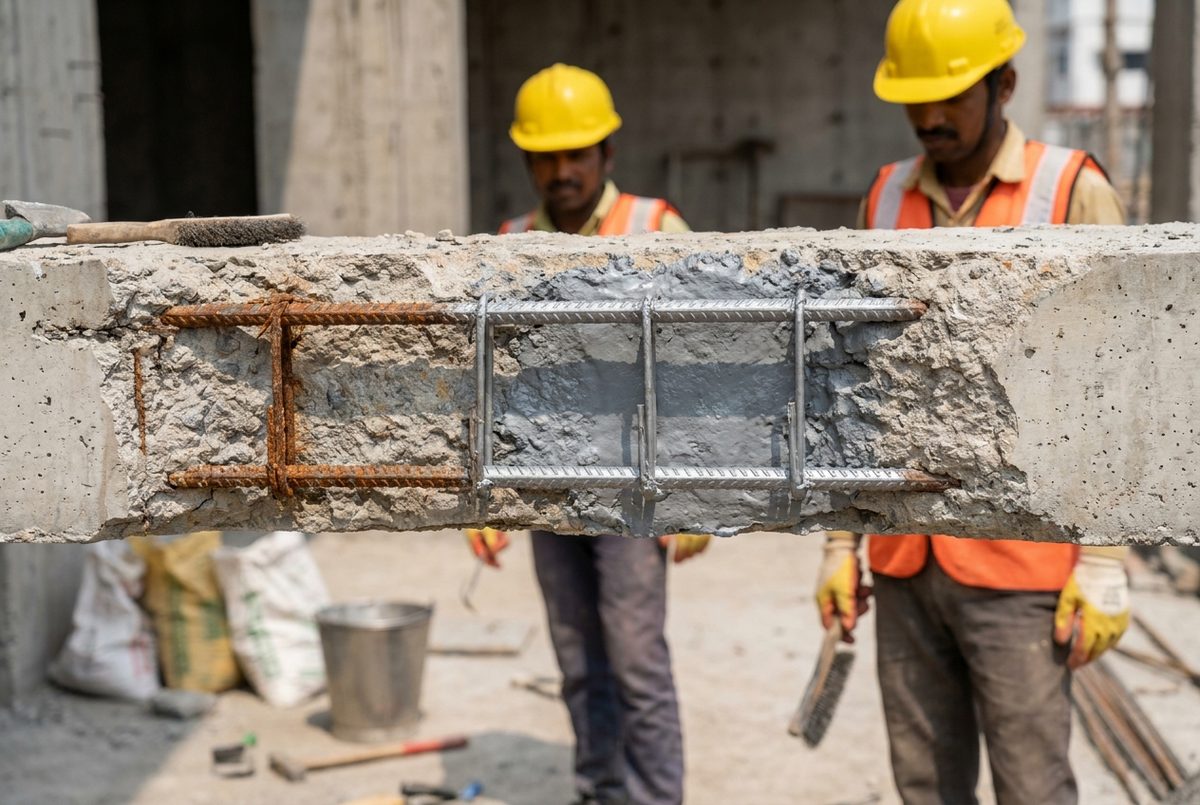
Polymer-modified cementitious repair mortars
The workhorse of the category — hand-trowelled or spray-applied cementitious mortars modified with polymer for adhesion, low permeability and shrinkage control. Used for patch repair, reprofiling and structural section restoration, and graded from non-structural to structural. Thixotropic / low-slump grades hold on vertical and overhead work without formwork. Ranges include Fosroc Renderoc, Sika MonoTop and SikaTop, Master Builders MasterEmaco and MC-Bauchemie Nafufill.
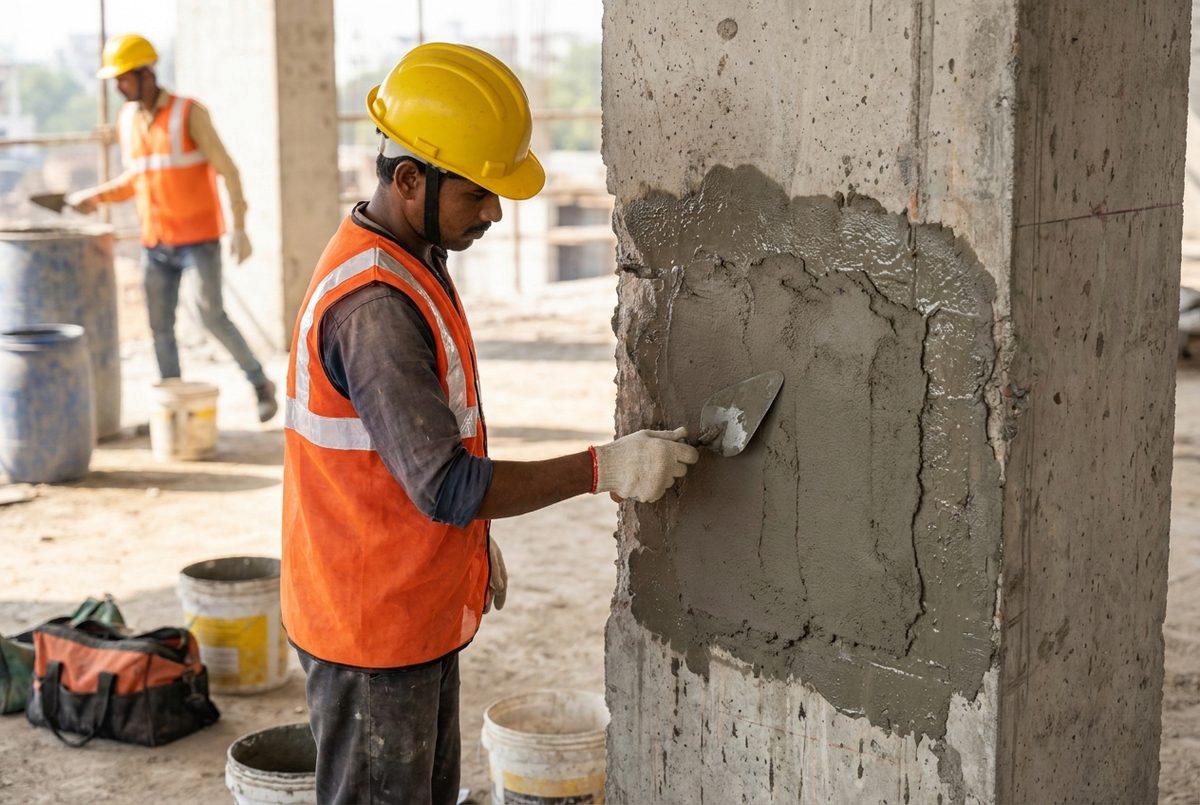
Free-flow micro-concrete
Flowable, non-shrink, often self-compacting cementitious concrete poured into fitted formwork where vibration is impractical. Typically supplied in strength grades matched to the design (for example UltraTech Microkrete HS1/HS2/HS3). Ranges include Fosroc Renderoc micro-concrete and UltraTech Microkrete.
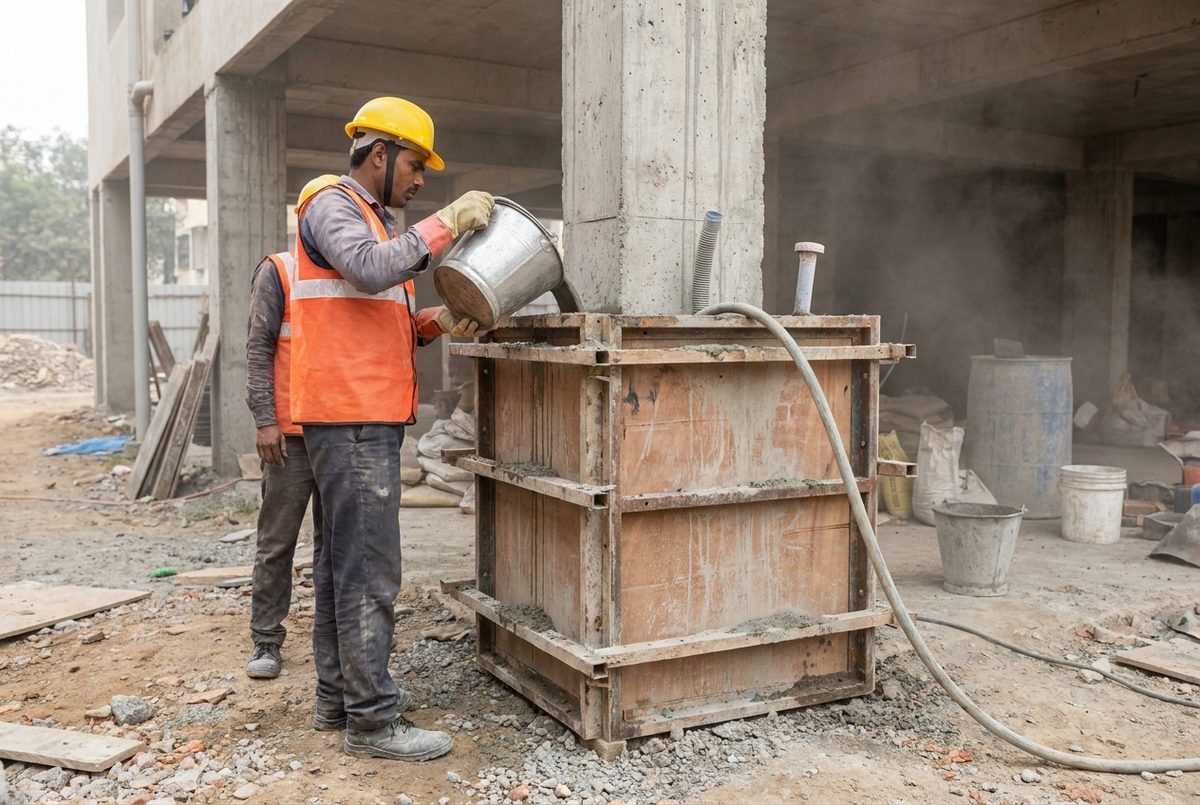
Rebar corrosion-protection primers
Cementitious or epoxy zinc-rich coatings applied to reinforcement that has been cleaned of rust and scale, to passivate the steel before mortar is reinstated. Examples: Fosroc Nitoprime Zincrich, Sika MonoTop / SikaTop Armatec steel-protection grades, Dr. Fixit Zinc Rich Primer.
Six distress patterns and what they really need
Spalling and delamination of cover concrete
Usual cause: Reinforcement corrosion — expanding corrosion products burst the cover off from within.
Fix: Break out all unsound concrete to a sound substrate, clean the steel of rust and scale, prime it with a rebar corrosion-protection primer, apply a bonding agent, reinstate the section with a structural polymer-modified repair mortar (or free-flow micro-concrete if deep or formed), then fairing coat and protective coating.
Cracking and loss of cover
Usual cause: Corrosion and deterioration reducing effective cover to the reinforcement, leaving the steel unprotected.
Fix: Restore the section and cover with a compatible repair mortar; where chloride or carbonation testing shows the remaining cover is contaminated, use a migrating corrosion inhibitor or full cover replacement rather than patching over the problem.
Honeycombing and cold joints
Usual cause: Poor placement — inadequate compaction, segregation or interrupted pours.
Fix: Cut back to sound concrete, apply a bonding agent, and fill: repair mortar for shallow voids, free-flow non-shrink micro-concrete where the void is deep, congested or can be formed.
Carbonation of the concrete
Usual cause: Atmospheric CO2 ingress lowering concrete alkalinity, depassivating the embedded steel.
Fix: Repair the affected section, protect the reinforcement, and finish the system with an anti-carbonation coating; carbonation testing determines whether an inhibitor or full cover replacement is warranted.
Chloride ingress
Usual cause: Marine exposure or de-icing salts driving chlorides to the reinforcement.
Fix: Chloride testing to map contamination, removal of contaminated concrete, rebar cleaning and priming, migrating corrosion inhibitor or full cover replacement as indicated, and a low-permeability repair and protective system.
Abrasion and chemical attack on floors and water-retaining surfaces
Usual cause: Traffic, mechanical wear and aggressive industrial or wastewater chemistry.
Fix: Specify abrasion-resistant and low-permeability mortars and dedicated floor repair systems, selected for the actual exposure (immersion, marine, industrial chemicals, traffic).
One Fosroc product per gate
As an authorised Fosroc distributor we lead with Renderoc and Nitobond because the family covers the whole protocol — primer, bond coat, mortar and flowable — from one manufacturer with one set of compatible data sheets.
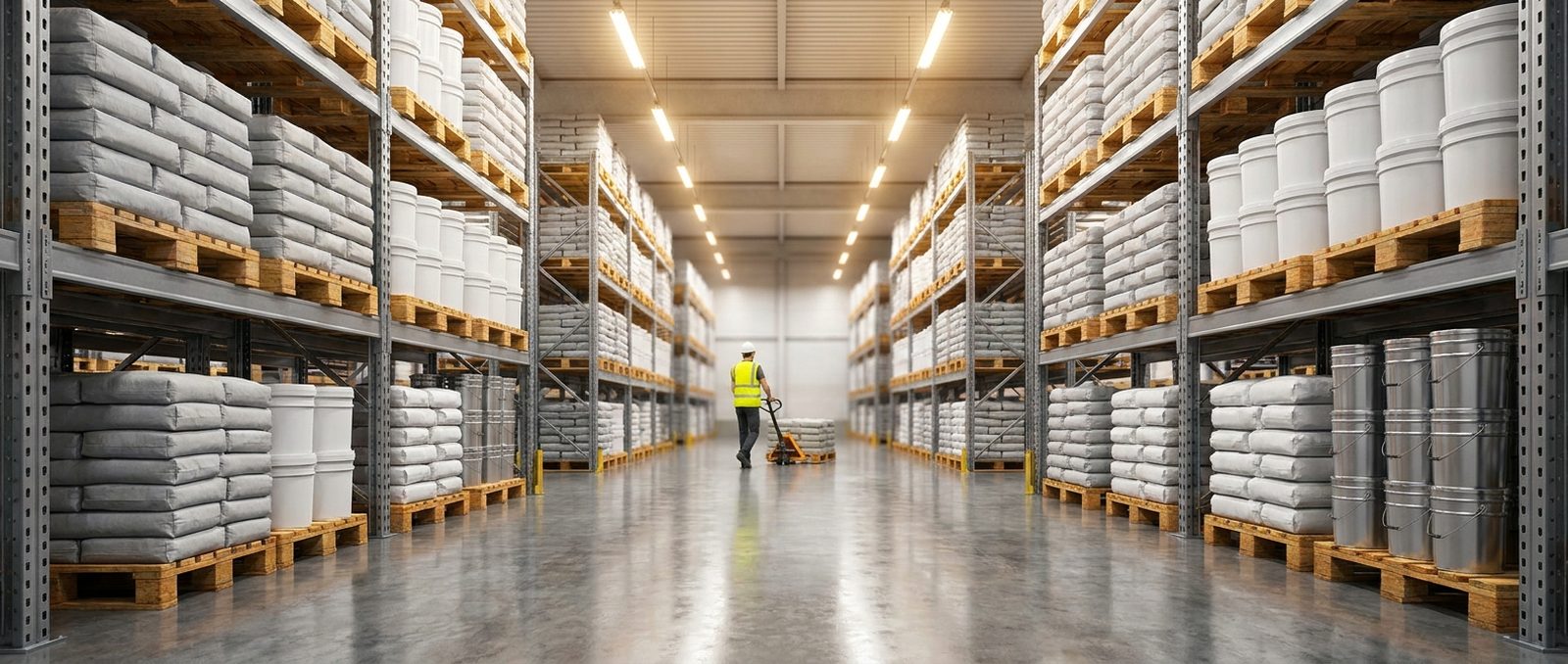
A repair is only as good as the bag it came from
Space Arc Engineering is an Authorised Distributor and Applicator in India for Fosroc, Sika, Dr. Fixit, MC-Bauchemie, STP, UltraTech, Master Builders Solutions and Asian Paints SmartCare. Polymer-modified mortars are shelf-life products — the polymer content is what buys you bond and flexural strength, and it degrades in stale or badly stored stock. Every bag and pail moves through our own warehousing with batch and date records intact, so the repair you specify is the repair that actually cures on the beam.
All Concrete Repair & Rehabilitation products we supply
428 genuine concrete repair & rehabilitation products from our authorised brands — supplied & applied across Delhi NCR and pan-India.
Fosroc · 195 Preferred
MC-Bauchemie · 109
Sika · 53
Dr. Fixit · 19
UltraTech · 14
STP · 25
Other · 13
Why specify repair systems through us
We specify the sequence, not just the mortar
A repair mortar quoted on its own is half an answer. We give you the whole protocol — break-out, steel prep, primer, bond coat, mortar and protective coating — from one compatible family.
Compatible products, one manufacturer
Primer, bond coat and mortar have to work together. Mixing families across brands is where bond failures come from, so we keep the system coherent unless there is a technical reason not to.
Trained applicators for gated work
Most of the risk in repair sits in workmanship at gates 1 to 4, where nobody is watching. We supply method statements and trained crews across Delhi NCR and pan-India where you want that carried by us.
Frequently asked questions
Which concrete repair product is best for spalled, corroding columns and beams?
For corrosion-related spalling, clean and prime the exposed steel with a rebar corrosion-protection primer, apply a bonding agent, then reprofile with a structural polymer-modified repair mortar (Fosroc Renderoc, Sika MonoTop/SikaTop or Master Builders MasterEmaco). For deeper or formed sections, free-flow micro-concrete such as Fosroc Renderoc or UltraTech Microkrete is more suitable. Space Arc can recommend the exact grade after reviewing your defect details, call +91 9999155255.
What is the difference between a repair mortar and micro-concrete?
Repair mortars are trowel- or spray-applied for patching and reprofiling shallow to medium defects, including overhead and vertical work. Micro-concrete is a flowable, non-shrink, often self-compacting material poured into formwork for deep, congested or large-volume repairs such as column and beam jacketing. The choice depends on repair depth, geometry and whether formwork can be fitted.
Should I use an SBR or an epoxy bonding agent?
Use an SBR/acrylic bonding agent (e.g. Fosroc Nitobond AR or SBR) for most general cementitious repairs — it is economical and easy to apply as a slurry bond coat. Use an epoxy bonding agent (e.g. Fosroc Nitobond EP) where you need a higher-strength, structural old-to-new bond. Always follow the open time and overlay window stated on the product data sheet.
Do I always need to prime exposed reinforcement before repair?
Yes. If reinforcement is exposed or showing corrosion, it should be cleaned to remove rust and scale and then coated with a corrosion-protection primer before the repair mortar is applied. Skipping this step is a leading cause of repairs failing prematurely, as ongoing corrosion will spall the new mortar from within.
Are Fosroc, Sika, Master Builders, UltraTech and MC-Bauchemie repair products interchangeable?
They address the same problems and follow similar repair principles, but products differ in strength grade, modulus, application thickness, set time and approvals. They should not be mixed within a single repair system. The best practice is to select one compatible system per repair. Space Arc stocks all these brands and helps you standardise on the right system for each element.
Where can I buy concrete repair products in India, and what about price?
Space Arc Engineering is an Authorized Project Distributor and Applicator across India for Fosroc, Sika, Master Builders Solutions, UltraTech and MC-Bauchemie concrete repair ranges. Pricing depends on the product, grade and project quantity. For genuine, batch-traceable material and a project quote, contact Space Arc at +91 9999155255 or [email protected].
Why buy from an authorized distributor instead of a local trader?
An authorized distributor supplies genuine, in-warranty material with correct batch traceability and current shelf life, plus access to manufacturer technical support and method statements. Space Arc adds trained applicator crews and on-site guidance, which reduces the risk of system failure and protects any manufacturer warranty on the repair.
Does Space Arc provide application services or only supply material?
Both. As an Authorized Applicator, Space Arc can supply the complete repair system and carry out or supervise the application — surface preparation, steel priming, bonding, reprofiling, fairing and protective coating — so the system performs as the manufacturer intended. Contact +91 9999155255 to discuss site support.
Send us the distress — we will send back the protocol.
Photographs of the spall or crack, the element and the exposure, and you get a gate-by-gate specification with compatible products at each stage, material and application.