Protective coatings & corrosion protection
Anti-carbonation coatings, chemical-resistant epoxies, zinc-rich primers and migrating corrosion inhibitors — specified by the exposure the structure actually sees, and by how long you need before the first repaint.
Exposure class decides the service life
A protective coating is not bought by the litre — it is bought by the year. Pick the exposure your structure actually sees and read the interval it buys you.
Sheltered / rural · C2
Dry inland, low pollution. A single high-build epoxy or an acrylic on primed steel lasts a long time.
- Dry inland sites with low pollution
- Sheltered elevations and internal structures
- Where repaint access is easy and cheap
Urban & coastal-adjacent · C3
Urban humidity and sulphur. Epoxy primer plus PU topcoat — the topcoat is what holds the colour.
- Urban and suburban exposure
- Coastal-adjacent but not splash zone
- Facades where colour retention matters
Industrial / chemical · C4
Process fallout and spillage. High-build epoxy, often with a chemical-resistant novolac topcoat.
- Process areas, bunds and chemical storage
- Industrial fallout and spillage
- Anywhere cleaning is aggressive and frequent
Marine & splash zone · C5
Chlorides plus wet/dry cycling. Zinc-rich primer, high-build epoxy and a PU or polysiloxane finish.
- Marine, splash and tidal zones
- Chloride-laden coastal atmospheres
- Structural steel needing galvanic protection
Intervals are typical first-maintenance ranges under ISO 12944 exposure classes. Under-thickness is the single most common reason a coating reaches maintenance early.
Three jobs a coating is asked to do
Protect the concrete from carbonation, protect the steel from chlorides, or protect the surface from what gets spilled on it. They are different chemistries and they are not interchangeable.
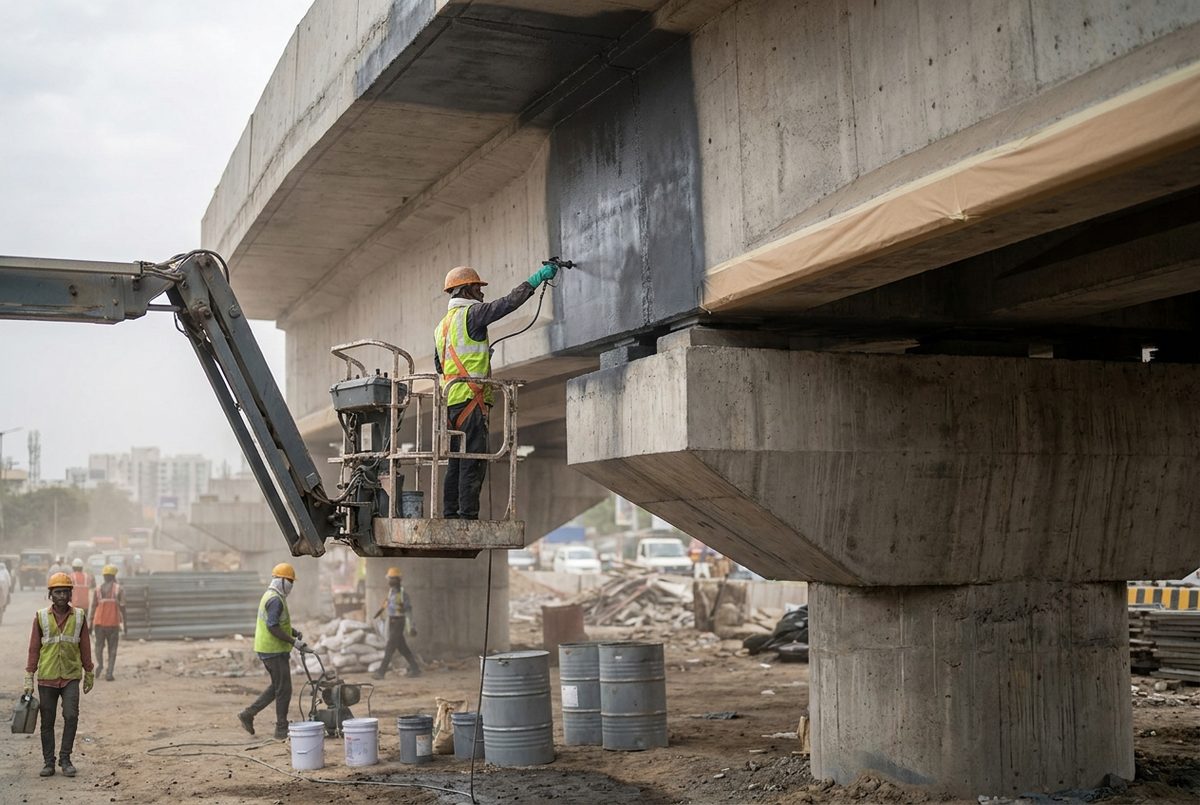
Anti-carbonation & decorative protective coatings (acrylic / pure-acrylic elastomeric)
Thin-film acrylic or pure-acrylic elastomeric coatings applied over atmospherically exposed concrete. They form a high CO2-diffusion-resistant, water-shedding barrier while remaining water-vapour permeable so trapped moisture can escape; many grades bridge fine cracks and carry UV-stable decorative pigmentation. The page names Sika’s Sikagard range, Fosroc Dekguard (S, AC, E2000, WB) and MC-Bauchemie MC-Color Flex.
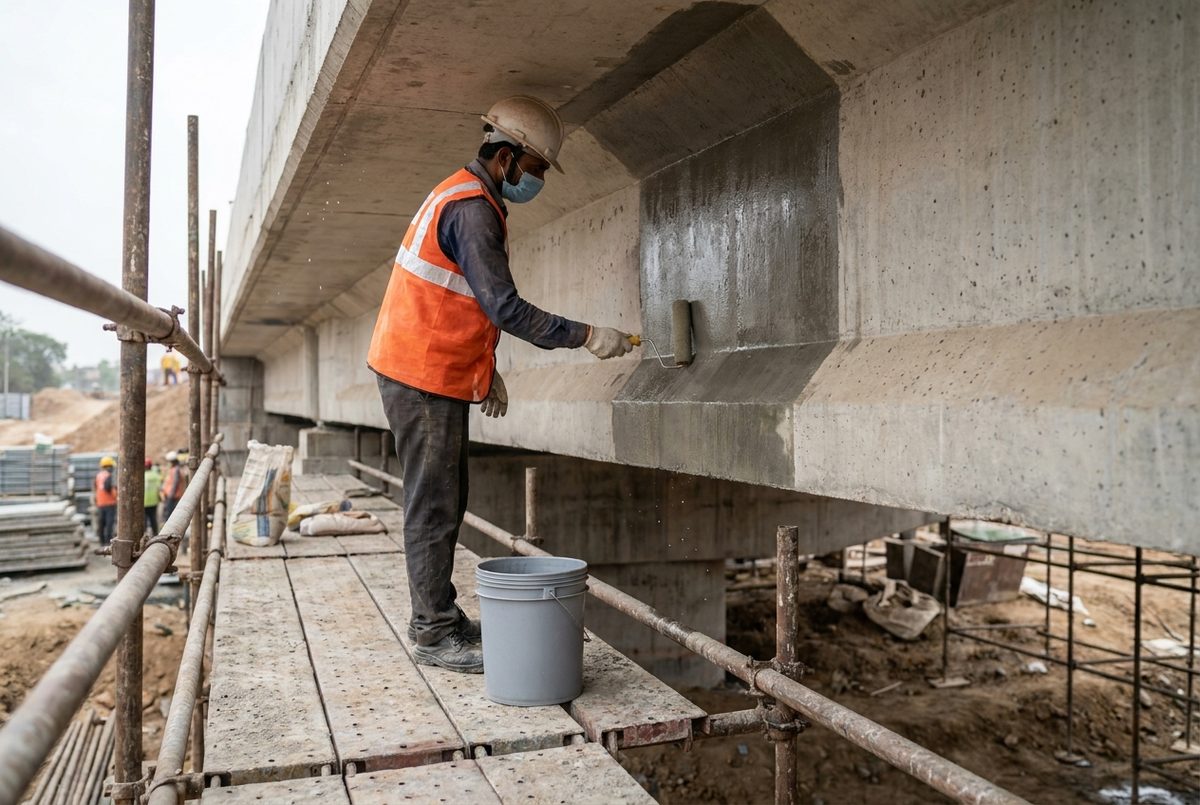
Chemical-resistant protective coatings (epoxy & polyurethane)
High-build epoxy and polyurethane barrier systems for structural steel and aggressive-exposure concrete. The page names Fosroc Nitocote (EM, CM and BCS series) and MC-DUR epoxies. Epoxies give strong chemical and abrasion resistance but are less UV-stable; polyurethane adds UV durability and flexibility and is often used as a topcoat over epoxy.
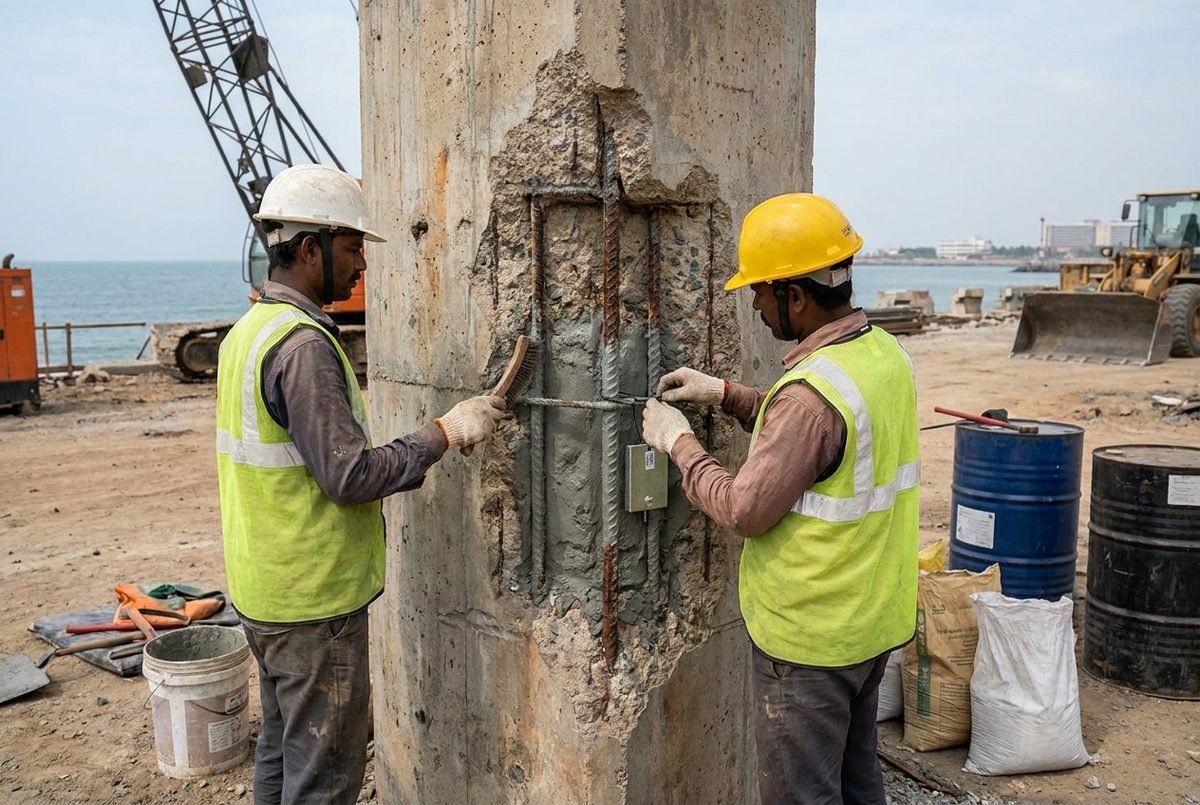
Zinc-rich primers & structural-steel protective systems
Zinc-rich primers applied after correct blast preparation to the specified surface standard, overcoated with epoxy or polyurethane build coats. The catalogue carries Fosroc Nitozinc Primer, Fosroc Nitoprime Zincrich and the STP ShaliPrime Zn range (Zn PE, Zn Ph 60, Zn R, ZnSl, PU MIO Zn).
Six coating failures and what actually caused them
Carbonation-induced corrosion — cracking, rust staining and spalling, typically on older atmospherically exposed structures
Usual cause: Atmospheric CO2 diffuses into the concrete cover and carbonates it, lowering pH and depassivating the embedded steel. Once rebar begins to corrode it expands, cracks the cover and accelerates further deterioration.
Fix: Anti-carbonation coating to block further CO2 ingress, often combined with a migrating corrosion inhibitor to passivate steel already at risk. Where cover has already spalled, repair first, then coat.
Chloride-induced corrosion in coastal, marine-splash and salt-exposed concrete
Usual cause: Chlorides from marine environments, coastal air or de-icing salts penetrate the cover and break down the passive film on the reinforcement.
Fix: Low-permeability protective coating plus a penetrating (migrating) corrosion inhibitor; combine with cementitious repair where spalling has begun.
Chemical and abrasion attack on plant concrete and steel
Usual cause: Effluent, process chemicals, spillage and traffic/abrasion in immersion, splash and spillage zones attack unprotected concrete and steel.
Fix: Epoxy or polyurethane barrier coatings selected for the specific exposure — e.g. Fosroc Nitocote or MC-DUR systems.
Water ingress, freeze-thaw damage and efflorescence
Usual cause: Water absorption into porous, unprotected concrete surfaces.
Fix: Water-shedding, vapour-permeable protective films that keep liquid water out while still allowing the structure to breathe.
Aesthetic degradation — surface cracking, colour fading and algae growth
Usual cause: Fine surface movement and cracking, UV degradation of pigment, and biological growth on persistently damp surfaces.
Fix: Elastomeric decorative coatings with crack-bridging capability and durable, UV-stable pigmentation.
Coating failure shortly after application over a structure that already showed rust stains and cracks
Usual cause: Overcoating active corrosion treats the symptom, not the mechanism — corrosion continues under the film, expands and lifts the coating. The page calls this the most costly mistake in the category.
Fix: Correct sequence: break out spalled/contaminated concrete, treat or replace corroding steel, reinstate with a repair mortar (often with galvanic anodes at the margins), apply a migrating inhibitor where appropriate, and only then apply the anti-carbonation or protective coating.
Fosroc systems by exposure, not by colour chart
As an authorised Fosroc distributor we lead with Dekguard and Nitocote because between them they cover the full exposure range with published film thicknesses — and we quote the DFT, because that is the number that decides service life.
Nitocote EP405
Solvent-free epoxy for chemically aggressive and immersed exposure.
Nitozinc Primer
Zinc-rich galvanic primer for cleaned structural steel and reinforcement.
Dekguard W
Water-based anti-carbonation coating where solvent odour or VOC is a constraint.
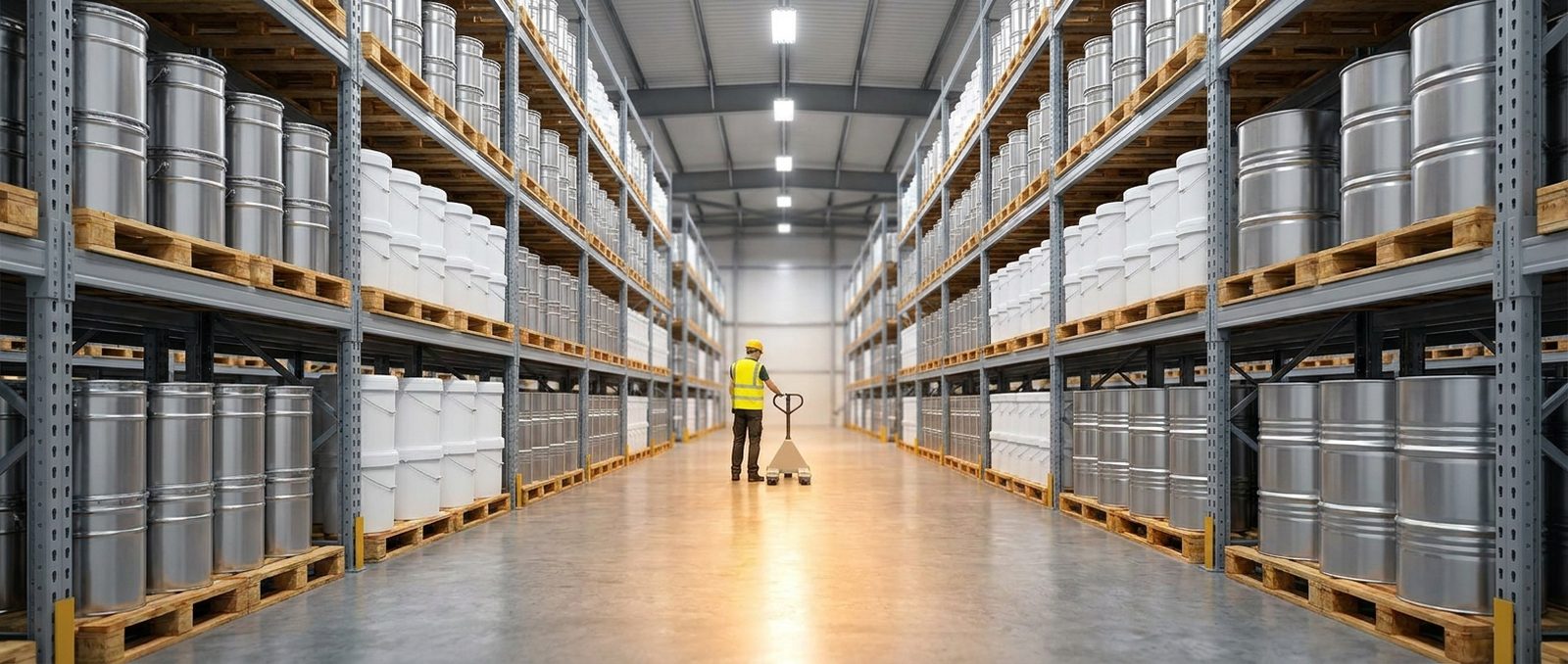
Coatings are dated goods — and ours are in date
Space Arc Engineering is an Authorised Distributor and Applicator in India for Fosroc, Sika, Dr. Fixit, MC-Bauchemie, STP, UltraTech, Master Builders Solutions and Asian Paints SmartCare. Two-pack coatings have a defined shelf life and a defined pot life; stale resin or hardener will not cure to the film properties the data sheet promises, however carefully it is applied. Every pail and drum moves through our own warehousing with batch and date records intact.
All Protective Coatings products we supply
324 genuine protective coatings products from our authorised brands — supplied & applied across Delhi NCR and pan-India.
Fosroc · 128 Preferred
MC-Bauchemie · 33
Sika · 27
Dr. Fixit · 4
STP · 125
Why specify coatings through us
We quote the DFT, not just the litre rate
Service life comes from dry film thickness and the number of coats. We quote coverage against the specified DFT so the tender comparison is honest, rather than the cheapest litre price.
Exposure-matched, not colour-matched
We ask what the structure is exposed to before we ask what colour it should be — because the exposure class decides the chemistry and the maintenance interval.
In-date, batch-traceable two-pack material
Resin and hardener are supplied as matched, in-date sets with batch records, so the mix ratio on site produces the cure the data sheet describes.
Frequently asked questions
Which protective coating is best for anti-carbonation protection of a concrete facade or bridge?
For atmospherically exposed, sound concrete, an acrylic anti-carbonation coating is the standard choice — Sika Sikagard, Fosroc Dekguard (S, AC or E2000) or MC-Bauchemie MC-Color Flex where crack-bridging is needed. Select for high CO2-diffusion resistance, water-vapour permeability and UV-stable colour. If the reinforcement is already at risk, pair the coating with a migrating corrosion inhibitor. Space Arc can recommend the exact product and finish for your exposure on +91 9999155255.
What is a migrating corrosion inhibitor and when should I use one?
A migrating (penetrating) corrosion inhibitor such as Sika FerroGard-903/908 is a surface-applied liquid that diffuses through hardened concrete to the embedded steel, forming a protective film that slows chloride- and carbonation-induced corrosion. Use it on existing structures where reinforcement is at risk but the cover is largely intact — typically before applying an anti-carbonation topcoat — as part of a corrosion-management strategy rather than as a standalone cure for active spalling.
What is the difference between an anti-carbonation coating and an anti-corrosion coating?
An anti-carbonation coating is applied to the concrete surface to block CO2, chlorides and water from reaching the rebar, preventing depassivation. An anti-corrosion coating usually refers to a protective film applied directly to steel (or steel reinforcement / harsh-exposure concrete), such as epoxy or zinc-rich systems, to protect the metal itself. Many durable solutions combine both — plus a corrosion inhibitor — into one specification, which Space Arc can assemble across brands.
Can I apply a protective coating over concrete that is already showing rust stains and cracks?
Not directly. Overcoating active corrosion traps the problem and the coating will fail. The correct sequence is to break out spalled/contaminated concrete, treat or replace corroding steel, reinstate with a repair mortar (often with galvanic anodes at the margins), apply a migrating inhibitor where appropriate, and only then apply the anti-carbonation or protective coating. Space Arc’s applicator team can carry out this full concrete-repair-and-protection sequence.
Which Fosroc and Sika protective coating products do you supply for industrial and marine projects?
We supply the full Fosroc Dekguard range (S, AC, E2000, WB) and Nitocote chemical-resistant coatings (EM, CM, BCS series), the Sika Sikagard protective coatings and FerroGard corrosion inhibitors, plus MC-Bauchemie MC-Color Flex, Zentrifix and MC-DUR systems. For marine/chloride and industrial chemical exposure we typically combine a chemical-resistant coating with a penetrating inhibitor. Email [email protected] with your exposure details for a product-specific recommendation.
Who is an authorized distributor for protective and corrosion-protection coatings in India, and how is pricing handled?
Space Arc Engineering is an authorized project distributor and applicator in India for Sika, Fosroc and MC-Bauchemie (and Master Builders Solutions, STP, UltraTech, Dr. Fixit). We supply genuine, batch-traceable material nationwide with technical support. Pricing depends on the product family, pack size, project quantity and site location, so we quote per project — contact +91 9999155255 or [email protected] for a current quotation.
Do you provide application services or only supply the material?
Both. As an authorized applicator, Space Arc can supply the coating system only, or supply and apply it with trained crews — including surface preparation, priming, inhibitor application and topcoats — backed by manufacturer-aligned technical guidance. This is particularly valuable for warranty-sensitive infrastructure, marine and industrial projects where correct surface prep and film build are critical.
How do I choose between an acrylic, epoxy and polyurethane protective coating?
Match the chemistry to the exposure. Acrylic anti-carbonation coatings suit weather-exposed atmospheric concrete (facades, bridges) where breathability and UV stability matter. Epoxy coatings (e.g. Nitocote, MC-DUR) offer strong chemical and abrasion resistance for immersion, plant floors and tanks but are less UV-stable. Polyurethane systems add UV durability and flexibility, often as a topcoat over epoxy. Space Arc can specify the right single-brand system for your substrate and service conditions.
Tell us the exposure — we will tell you the interval.
Send the structure, the environment and how long you need before first maintenance. You get a system, a film thickness and a realistic repaint interval, material and application.