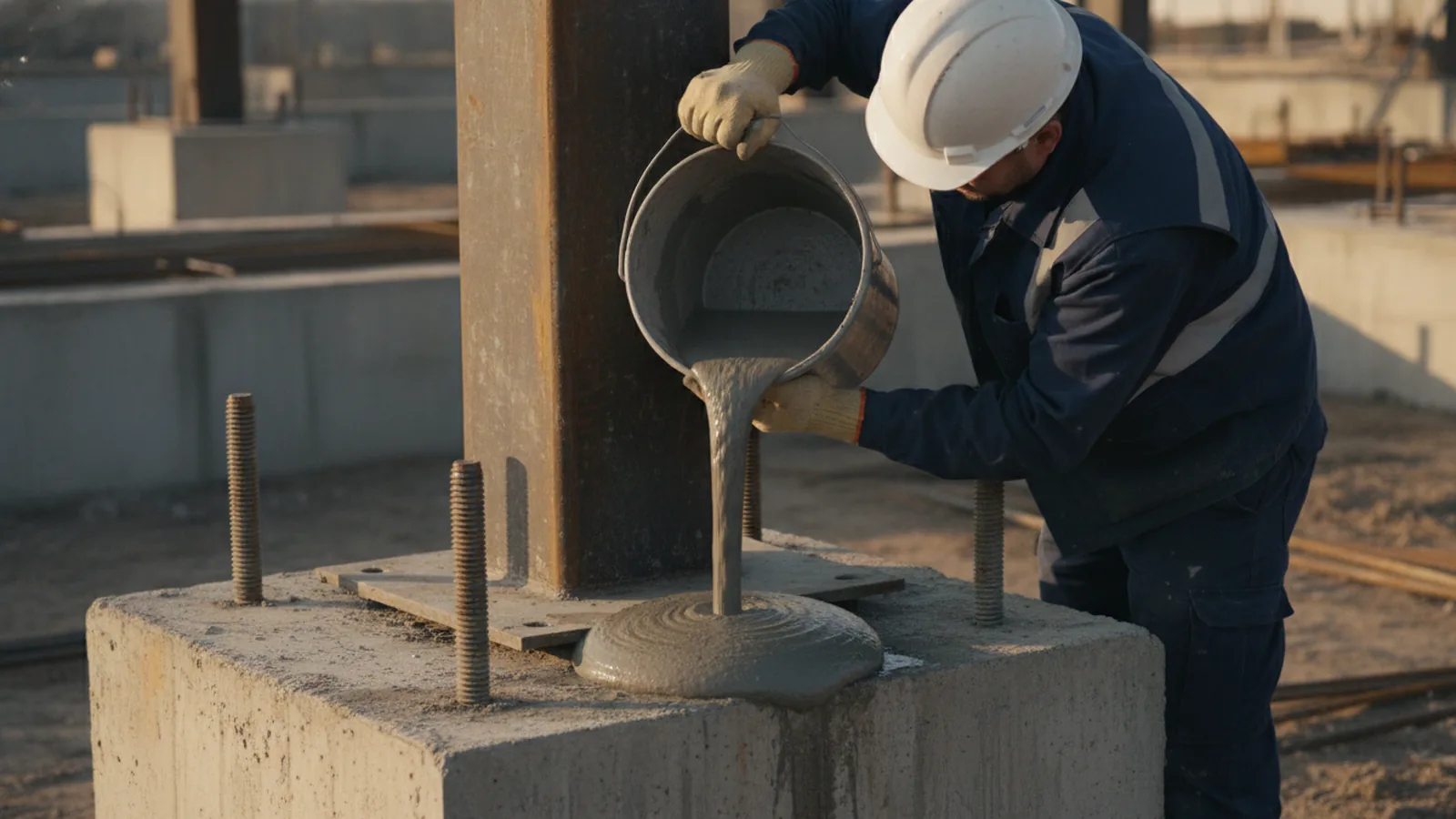
Fosroc Conbextra Grout Range: GP1, GP2, GP3 and EP Grades Compared
Settles cementitious GP1/GP2/GP3 versus epoxy EP first, then gives a gap-flow-strength sequence for choosing a grade. No published figures.
Key takeaways
- Conbextra is a family of Fosroc non-shrink grouts, not a single product — the GP grades are cementitious and the EP grades are epoxy.
- Settle cementitious vs epoxy first: GP grades for static/normal applications, EP epoxy for chemical exposure, high vibration/impact, or thin high-load bedding.
- GP1 is the general-purpose grade, GP2 is positioned for free-flow placement under larger plates, and GP3 offers higher flow and strength for heavier machinery.
- Select by gap, flow and strength in that order — then confirm the exact grade, consistency and water ratio against the current Fosroc TDS.
- Never over-water cementitious grout to chase flow; pour continuously from one side to avoid hollow baseplates, and water-cure immediately after initial set.
- Space Arc is an authorized Fosroc distributor and applicator supplying the full Conbextra range pan-India — call +91 9999155255 for grade selection help.
The short version
On almost every Indian project that involves structural steel, rotating equipment or post-installed anchors, the word “Conbextra” gets used as shorthand for “non-shrink grout.” It is one of the most recognised names in the Fosroc range, and for good reason — it covers everything from a simple column baseplate to a high-vibration compressor foundation. The catch is that “Conbextra” is not one product. It is a family of cementitious and epoxy grouts, and the difference between a GP1, a GP3 and a Conbextra EP grade decides whether your grout flows into the gap, develops the strength the consultant specified, and survives the load and chemical environment it sits in. Pick the wrong grade and you either struggle to place it, leave voids under a baseplate, or over-spend on an epoxy where a cementitious grout would have done the job. This Space Arc spotlight, written for engineers and contractors who actually place this material on site, walks through the cementitious-versus-epoxy decision, the flow grades, the common grouting situations, and a clear way to select by gap, flow and strength. We deliberately avoid quoting specific strength or flow figures — always confirm those against the current Fosroc Technical Data Sheet for the grade and batch you are using — and focus instead on how to think about the choice.
What “Conbextra” actually is — a family, not a product
Conbextra is Fosroc’s brand for ready-to-use, pre-bagged non-shrink precision grouts. The shared idea across the range is the same: you get a factory-blended powder (or a multi-part epoxy kit) that, once mixed and placed, fills a confined gap completely, develops controlled expansion rather than the drying shrinkage of an ordinary sand-cement mix, and transfers load reliably from a baseplate or bearing into the foundation below. What changes from grade to grade is the binder system, the consistency you can mix it to, and the strength and durability it ultimately delivers.
Broadly, the family splits into two camps. The cementitious grouts — the GP (general purpose) series such as Conbextra GP1, GP2 and GP3 — are Portland-cement based, mixed with water on site, and suit the large majority of structural and equipment grouting. The epoxy grouts — Conbextra EP grades — are resin-based, mixed from separate base, hardener and graded-filler components, and are reserved for the demanding situations where cementitious grout is not enough: high dynamic load, chemical attack, or very thin sections under heavy machinery. Knowing which camp your application falls into is the first and most important decision.
Cementitious vs epoxy grout — the decision that matters most
Before you argue about flow grades, settle whether the job needs a cementitious or an epoxy grout. Getting this right saves both money and rework. Cementitious Conbextra grades cover most everyday structural and equipment grouting and are far more economical per litre placed. Epoxy grades cost considerably more and demand cleaner surfaces and tighter mixing discipline, but they earn their place where chemistry and dynamic loading would defeat a cement-based grout.
A simple rule of thumb for Indian sites: reach for cementitious when the load is largely static or moderately dynamic, the environment is normal, and the grout section is not extremely thin. Reach for epoxy when you have aggressive chemical exposure (effluent plants, chemical and fertiliser units, battery and plating areas), high-frequency vibration or impact (reciprocating compressors, presses, crushers, rail and crane components), or where the consultant has specified a thin, high-strength bedding. Both families belong to the wider grouts and anchors portfolio Space Arc supplies and applies across India.
- Choose cementitious (GP series) for: column baseplates, structural steel, pump and motor bases, general machine foundations, bridge bearings, and bulk void filling.
- Choose epoxy (EP series) for: chemical exposure, high-vibration or impact machinery, thin high-load bedding, and areas needing fast, durable reinstatement.
- Cementitious grouts need damp (saturated, surface-dry) concrete and full water curing; epoxy grouts need a dry, clean, oil-free substrate.
- Cost order, lowest to highest: GP cementitious grades, then epoxy EP grades — don’t pay for epoxy unless the application genuinely needs it.
The GP series explained: GP1, GP2 and GP3
Within the cementitious camp, the GP grades are best understood as a progression in consistency and intended use, rather than as “better” or “worse” versions of one another. Always read the current TDS for the exact grade, but here is how Indian engineers typically use them:
Conbextra GP1 is the general-purpose workhorse for everyday non-shrink grouting — column baseplates, structural steel stanchions, holding-down bolt pockets and routine equipment bases. It is the grade most often called up on a standard structural drawing simply as “non-shrink grout.” Conbextra GP2 is positioned for free-flow grouting where you need the material to travel under a baseplate or into a confined gap with good flowability, making it suited to larger plates and equipment bases where placement by pour and gravity flow matters. Conbextra GP3 is the higher-performance cementitious grade, used where greater flow and higher early and ultimate strength are needed — heavier machinery, larger pour volumes, and situations where the structural consultant has called for a higher grout strength. As you move from GP1 to GP3, think “more flow, more strength, more demanding applications.”
Because the exact flowability and strength class differ by grade and can be revised by the manufacturer, the safe practice is to match the grade name on the drawing or specification, then confirm the placement consistency (flowable vs free-flow) and strength against the live data sheet before ordering.
Flow grades and placement consistency
One of the most useful features of the Conbextra cementitious range is that several grades can be mixed to different consistencies — typically flowable (a thick, pourable consistency for moderate gaps) and free-flow (a thinner, self-levelling consistency that travels easily under large plates). The consistency is governed mainly by the water content, within the narrow band the TDS allows. This matters because over-watering to “make it flow” is one of the most common site mistakes — it reduces strength, increases bleed, and can compromise the non-shrink behaviour the grout was chosen for.
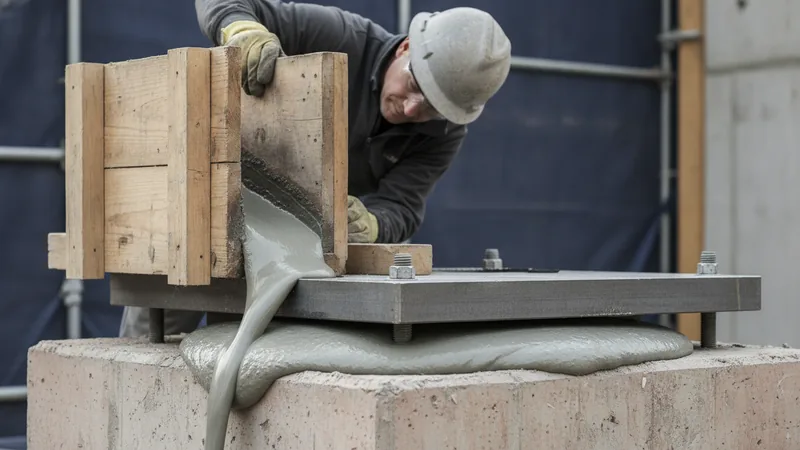
The practical guidance: decide the consistency you need from the geometry of the gap and the placement method, then mix to the corresponding water figure in the TDS — not by eye, and never beyond the maximum permitted. For large baseplates and machine bases, free-flow placement from one side (so the grout pushes air ahead of it and out the far side) avoids the trapped voids that cause hollow, drumming baseplates later. Build a small head box or hopper on the pour side to maintain hydraulic pressure and keep the grout moving.
- Flowable consistency: thicker, for moderate gaps and where some pumping or trowelling head is available.
- Free-flow consistency: self-levelling, for large plates, thin sections and long flow paths.
- Mix to the TDS water figure for the chosen consistency — do not add water to chase flow.
- Always pour from one side and let the grout displace air across to the far side; keep a continuous pour to avoid cold joints.
Baseplate, anchor and machine grouting in practice
The three most common grouting jobs on an Indian site each have their own quirks. Baseplate grouting (structural steel columns, portal frames, PEB stanchions) is usually a cementitious GP grade. The keys are full contact under the plate, adequate vent and pour holes for larger plates, and saturating the concrete beforehand so the dry substrate doesn’t pull water out of the grout. Anchor and holding-down bolt grouting — fixing bolts into pockets or anchoring rebar and dowels into drilled holes — can use a cementitious grout for larger pockets, while small-diameter, high-load or post-installed anchors are often better served by a resin anchoring system from the broader grouts and anchors range. Confinement and clean, dust-free holes are everything here.
Machine and equipment grouting is where the cementitious-versus-epoxy decision sharpens. A water pump, fan or motor on a static base is comfortably a cementitious GP grade. A reciprocating compressor, crusher, press or any high-impact, high-vibration machine in a chemically exposed bay is a candidate for Conbextra EP epoxy grout, which resists the dynamic fatigue and chemical attack that would micro-crack a cementitious grout over time. For rotating equipment the grout must be placed without voids directly under the load-bearing area, because any gap there becomes a stress concentration under vibration.
Selecting by gap, flow and strength — a working method
Here is a repeatable way to land on the right Conbextra grade without guesswork. Work through three questions in order, then confirm against the TDS:
1) Gap and section thickness. Very thin sections under heavy load push you toward epoxy (which develops high strength in thin films) or a high-grade cementitious grout; thick pours favour cementitious grades, sometimes extended with the manufacturer-approved aggregate for deep sections to control heat and economy. 2) Flow path and placement. A large plate or long travel under the bearing means you need free-flow consistency and a grade that supports it; a small, accessible pocket can take a flowable mix. 3) Load and environment. Static or mild dynamic load in a normal environment stays cementitious; heavy dynamic, impact or chemical exposure moves you to epoxy. Strength is the final filter — match or exceed the strength class the structural consultant specified, then pick the grade that also satisfies the gap and flow requirements.
- Step 1 — Gap: thin + heavy load leans epoxy; thick pours stay cementitious (use approved extension aggregate for deep sections).
- Step 2 — Flow: large plate / long path needs free-flow; small accessible pocket can take flowable.
- Step 3 — Load + environment: static/normal stays cementitious; dynamic/impact/chemical moves to epoxy.
- Final check: meet the specified strength class, then confirm the exact grade and water ratio on the current Fosroc TDS.
Site practice: mixing, placing and curing that protects the result
Even the right grade fails if it is mixed or cured badly, and India’s climate makes this unforgiving. For cementitious grouts: pre-soak the concrete to a saturated, surface-dry condition; mix mechanically with a slow-speed drill and paddle to the TDS water figure; place continuously from one side; and — critically — start water curing immediately after the grout takes its initial set, keeping exposed edges damp under wet hessian. In peak summer, mix with chilled water and grout in the cooler parts of the day to slow flash setting; during the monsoon, protect fresh grout and bolt pockets from rain ingress that would dilute the surface. For epoxy grouts: the substrate must be dry and oil-free, components must be mixed in full kit proportions (never split a kit by eye), and you have a limited working time that shortens sharply as temperature rises — plan the pour and have enough hands ready before you mix.
Two failures we see repeatedly on Indian sites: over-watered cementitious grout that bleeds and under-performs, and baseplates grouted without venting so air is trapped and the plate drums hollow when tapped. Both are fully avoidable with a one-side continuous pour, correct water, and proper curing.
Where Conbextra fits in the wider Fosroc and Space Arc range
Grouting rarely happens in isolation. A baseplate grout is often paired with a Fosroc epoxy bonding agent at a construction joint, a protective coating where the grout edge is chemically exposed, or a repair mortar where the surrounding concrete needs reinstatement first. Treating the grout as one part of a compatible system — primer, grout, sealant and coating all from a coordinated range — avoids the incompatibility problems that arise when materials from mismatched systems meet at an interface.
As an authorized Fosroc distributor and applicator, Space Arc supplies the full Conbextra range alongside the rest of the grouts and anchors category, and can advise on grade selection against your drawings and the latest data sheets. If you are unsure whether a job is a GP cementitious or a Conbextra EP epoxy application, that single phone call usually saves a costly wrong order.
- Grouts & Anchors
- Concrete Repair & Rehabilitation
- Structural Strengthening
- Protective Coatings & Corrosion
Frequently asked questions
What is the difference between Conbextra GP1, GP2 and GP3?
When should I use an epoxy grout instead of a cementitious Conbextra grade?
Can I add extra water to make Conbextra grout flow more easily?
How do I stop a grouted baseplate from sounding hollow when tapped?
Do cementitious Conbextra grouts need curing?
Which Conbextra grade is right for anchoring holding-down bolts?
Where can I buy genuine Fosroc Conbextra grout in India?
Related products & ranges
Related articles
Three more from the same corner of the catalogue.
Non-Shrink Grout: Which Type, What Gap, How to Place
Six-step grouting method plus a table matching gap thickness and load type to GP1, GP2, GP3 or epoxy grout.

Concrete Repair: Diagnose First, Then Pick the System
How to tell carbonation from chloride attack, when to switch from repair mortar to micro-concrete, and the five surface-preparation steps.

Choosing a Construction Chemical: A 3-Step Framework
A three-step method – category, brand and grade, site conditions – with named product picks across waterproofing, repair, grouting, admixtures and flooring.
Related products & solutions
The systems this article is about, with the published data behind them.
Downloadable resources
Current-revision documents, sent straight over.
Specifying this on a live project?
Send the substrate, the exposure and the area. We are an authorised distributor and applicator for nine manufacturer ranges, so the recommendation follows the condition rather than the stock.