Tile Fixing Done Right: Adhesives, Grouts and the Failures to Design Out
Decodes C1/C2/S1 adhesive classes, sets out the wet-area build-up order, and traces debonding and efflorescence back to their causes.
Key takeaways
- Neat cement slurry no longer works on dense vitrified and porcelain tiles; use a polymer-modified C2 cementitious adhesive that bonds chemically.
- Read the EN 12004 code: C is cementitious, the number is the bond class (C1 normal, C2 improved), and suffixes T, E and S1/S2 add non-slip, extended open time and flexibility.
- Match the adhesive to the tile and exposure: C1 for dry ceramic, C2 for vitrified, large-format, wet and external areas, and flexible S1/S2 for substrates that move or tile-on-tile.
- Large-format tiles demand full, void-free coverage with back-buttering, the right notch trowel and respect for open time, which shrinks fast in Indian heat.
- Wet areas are a system: waterproof first with a flexible membrane and detailed corners, then tile with C2 adhesive and a water-resistant or epoxy grout.
- Use epoxy grout wherever it gets wet, dirty or chemically attacked; cementitious grout is fine for dry internal residential surfaces.
- Debonding is preventable with the right adhesive, clean substrate, full coverage, cured screeds and properly placed flexible movement joints.
- Efflorescence is a moisture-path symptom, not a surface stain; fix the waterproofing and drainage, do not just scrub the white bloom away.
The short version
Walk through any newly handed-over project in India and the tiling tells a story. Hollow-sounding floors, hairline cracks tracking the grout lines, a white salty bloom creeping across a balcony, a row of skirting tiles quietly lifting off the wall. None of these are the fault of the tile itself. They are almost always the result of a decision made earlier and cheaper: a site-mixed sand-cement slurry used to stick a vitrified tile it was never meant to hold, a wet area waterproofed as an afterthought, or a grout selected by colour and price rather than performance. As tiles have moved from small porous ceramic to dense vitrified, porcelain and now huge slab formats, the old “dot-and-dab with neat cement” habit has stopped working, but it has not stopped being used. This guide lays out how tile fixing should actually be done on Indian sites: how to read adhesive classifications, when to step up from a basic adhesive to a high-performance one, how to handle large-format tiles and wet areas, where epoxy grout earns its cost, and how to design out the two failures site engineers see most often, debonding and efflorescence.
Why neat cement no longer holds your tiles
For decades, tiles in India were bedded on a thick mortar screed and stuck down with a thin slurry of neat cement. It worked because the tiles were porous ceramic that drank in moisture and gripped the cement as it set. That physics has changed. Vitrified and full-body porcelain tiles have water absorption below half a percent, so there is almost nothing for a cement slurry to bond into. The slurry sets, shrinks, and lets go, which is exactly why so many vitrified floors sound hollow underfoot within a year.
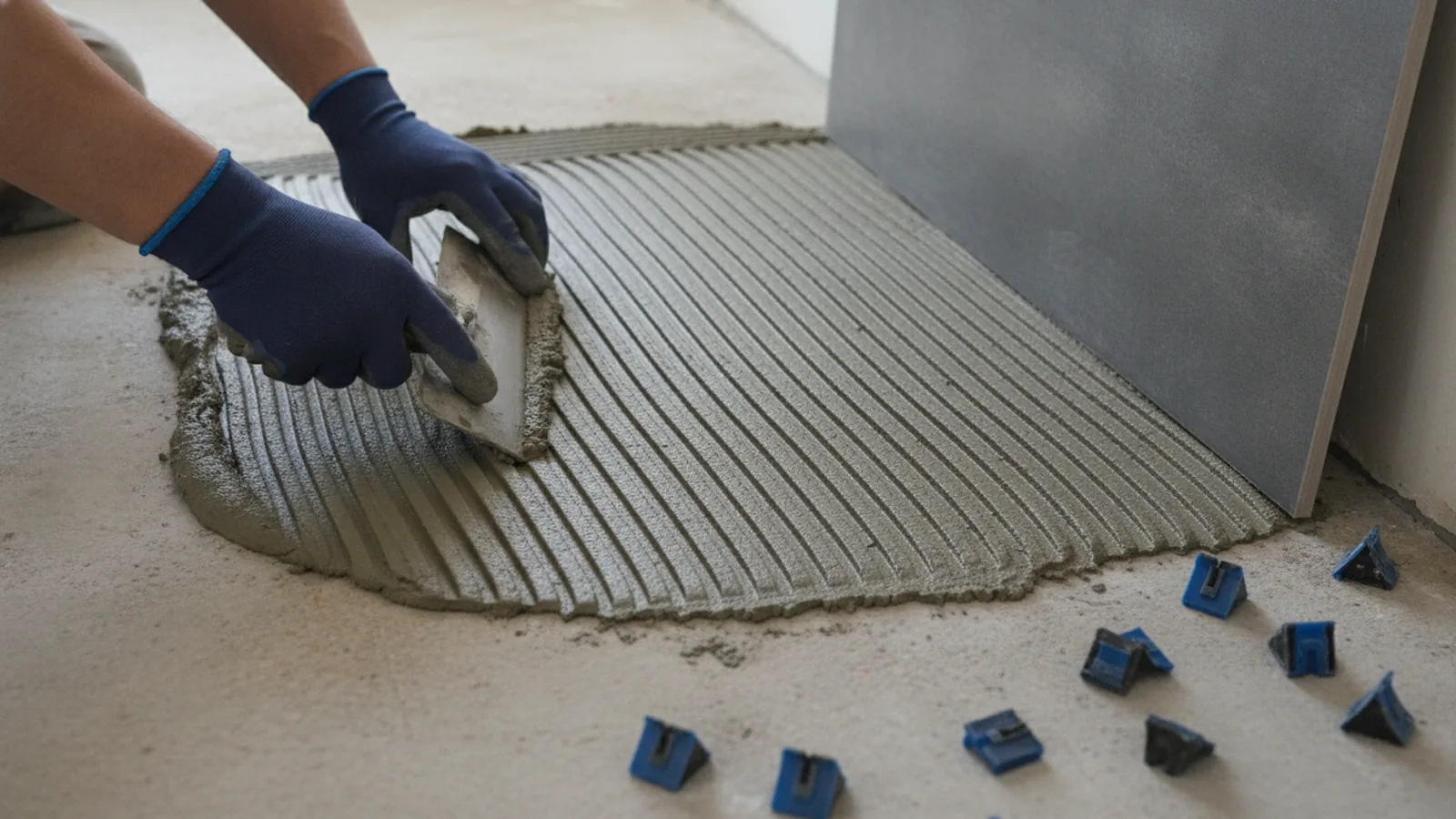
Modern polymer-modified cementitious tile adhesives solve this by bonding to the back of the tile chemically, not just mechanically. They are factory-blended cement, graded sand and polymers, mixed with clean water on site to a consistent, creamy, notch-holding paste. Applied with a notched trowel, they form ribs that collapse under the tile to give full, void-free contact. The result is a thin-bed system, typically 3 to 6 mm, that is stronger, faster, and far more forgiving than the thick-bed slurry method it replaces. Space Arc supplies the full range of these systems through our tile-fixing portfolio, drawn from manufacturers like Sika, Fosroc, MC-Bauchemie and others.
Reading the adhesive code: C1, C2 and the letters that follow
Cementitious tile adhesives are graded under the EN 12004 system, and you will see the same shorthand on bags from Sika, Fosroc and others sold in India. The letter C means cementitious. The number is the bond-strength class: C1 is a normal-grade adhesive, C2 is an improved adhesive meeting a higher bond strength after curing and water immersion. The suffixes matter just as much. T means non-slip (the tile stays put on a wall without sliding), E means extended open time (you get longer before the adhesive skins over), and S1 or S2 denote deformability, the adhesive’s ability to flex with movement without cracking.
Put plainly: a C1 adhesive is fine for small-to-medium ceramic tiles on a sound internal wall or floor. The moment you move to dense vitrified or porcelain, large formats, wet areas, external facades, or substrates that move, you should be specifying C2, and often C2 with an S1 or S2 flexibility rating. Choosing the class is not about buying the most expensive bag; it is about matching the adhesive to the tile and the exposure.
- C1 (normal): standard ceramic wall and floor tiles, dry internal areas, sound substrate
- C2 (improved): vitrified, porcelain, glass mosaic, external and wet areas, high bond demand
- C2TE: improved adhesive with non-slip and extended open time, ideal for walls and slower workmanship
- C2S1 / C2S2: flexible adhesives for substrates that move, decks, podiums, tile-on-tile and heated floors
Matching the adhesive to the job
The cleanest way to avoid failures is to choose the adhesive by use-case, not by habit. For ordinary ceramic wall tiles in a bedroom or a dry lobby, a good C1 or basic C2 adhesive is appropriate and economical. For full-body vitrified flooring across a hall, step up to a C2 adhesive rated for low-absorption tiles. For bathrooms, balconies, terraces, swimming pools and kitchens, specify a C2 adhesive used over a sound waterproofing layer, because these areas combine low-absorption tiles with constant or repeated wetting.
Two situations deserve special care. Tile-on-tile overlays, common in renovations where the old floor is left in place, demand a flexible C2S1 adhesive because you are bonding to a smooth, non-absorbent surface with no key. Substrates that move, such as podium decks, plywood backing, or anything over a structure that deflects or sees thermal cycling, need a deformable S1 or S2 adhesive that can absorb that movement instead of transferring it into the tile as a crack. When in doubt, the safe direction is always toward more flexibility and a higher class, never less.
Large-format tiles and slabs: where method matters most
Large-format tiles, anything from 600×1200 mm up to full slabs of 1600 mm and beyond, are now standard in lobbies, showrooms and premium homes. They are also where bad technique shows up fastest, because a big rigid tile concentrates any void or movement into a single dramatic crack or a drummy, rocking panel. The non-negotiable rule for large formats is full bed coverage with zero voids, and that means the back-buttering technique: comb the adhesive onto the substrate with a large-notch trowel, then skim a thin layer onto the back of the tile as well, so the two faces knit together with no air pockets.
Coverage should approach total contact, especially in wet and external areas where a void becomes a water trap. Use the right notch size, large square or U-notch trowels for big tiles, and beat the tile in with a rubber mallet and a beating block to collapse the ribs. Tile levelling clips and wedges are worth using on big formats to control lippage. And respect the adhesive’s open time, because a skinned-over ribbed bed gives almost no bond. In India’s summer heat the open time shrinks dramatically, so work in smaller sections and use an extended-open-time (E-class) adhesive when conditions are hot or windy.
Wet areas: the system, not just the tile
The single most expensive tiling failure on Indian sites is a leaking wet area, and it is almost never the tile or the adhesive that failed first. It is the missing or poorly detailed waterproofing underneath. Tiles and grout are not a waterproofing layer. Water passes through grout joints and through micro-cracks, so a bathroom, balcony or terrace must be waterproofed as a system before a single tile is laid. In a monsoon climate, where terraces and balconies see standing water for weeks, that layer is what stands between the slab and a leak into the floor below.
The correct sequence is: prepare and cure the screed with the right slope to drains, apply a flexible cementitious or polymer waterproofing membrane carrying it up the walls to above the splash line, treat the corners and pipe penetrations with a reinforcing tape or fillet, then fix tiles with a C2 adhesive and finish with a water-resistant or epoxy grout. The corners, drains and pipe collars are where leaks start, so they deserve the most attention, not the least. Space Arc handles wet areas as an integrated build-up, pairing our waterproofing systems with the matched tile adhesive and grout, because a tile system is only as watertight as the layer beneath it.
Grout choice: cementitious versus epoxy
Grout is the part of a tiling job that gets the least thought and causes a surprising share of the complaints. There are two broad families. Cementitious grout, usually polymer-modified, is cost-effective, easy to apply, available in many shades, and perfectly adequate for dry residential walls and floors. Its weakness is that it is porous: it absorbs water, stains, and over time can shrink, crack and harbour mould, which is why bathroom grout lines go grey and patchy.
Epoxy grout, made from epoxy resin and hardener, is non-porous, chemically resistant, and effectively impervious to water and stains. It costs more and demands disciplined application, because it sets hard and is unforgiving if not cleaned off the tile face promptly. But in the places that punish ordinary grout, it is the right answer. Specify epoxy grout for kitchens, bathrooms, swimming pools, food-processing and pharma floors, chemical-exposed areas, and any joint where hygiene, staining or constant wetting is a concern. A useful rule of thumb: if the area gets wet, dirty, or chemically attacked, the grout should be epoxy.
- Cementitious grout: dry internal walls and floors, residential, budget-conscious, wide colour range
- Epoxy grout: wet areas, pools, kitchens, hygiene-critical and chemical-exposed floors, stain resistance
- Joint width: follow the grout’s rated range, and never grout flush over movement or expansion joints
- Always provide flexible sealant-filled movement joints at perimeters, internal corners and large field areas
Debonding: why tiles come loose and how to prevent it
Debonding, the tile letting go of the substrate, shows up as hollow-sounding floors, drummy panels, tented tiles that pop up, and lifting wall tiles. The causes are predictable, which means they are preventable. The big ones are using neat cement or the wrong adhesive class under a low-absorption tile, poor coverage that leaves voids, a dirty, dusty, oily or unprimed substrate, fixing onto a green screed that is still shrinking, and the absence of movement joints so that thermal and structural movement has nowhere to go except into the bond line.
Preventing debonding is a checklist, not a secret. Choose the correct C-class adhesive for the tile and exposure. Prepare the substrate so it is sound, clean, free of laitance and primed where needed. Achieve full bed coverage, back-buttering large formats. Let screeds cure before tiling. And build in movement joints at the perimeter of every floor, at internal corners, around columns, and dividing large tiled fields, filling them with a flexible sealant rather than rigid grout. Movement has to be accommodated somewhere; the only choice is whether you design that somewhere or let the tiles decide it for you.
Efflorescence: reading the white bloom
Efflorescence is the white, salty, powdery deposit that appears on grout lines and tile edges, most visibly on balconies, terraces, external cladding and around pools. It is not a stain on the surface so much as a symptom of what is happening underneath. Water moving through the bedding mortar, screed or substrate dissolves soluble salts, carries them to the surface through grout joints, and evaporates, leaving the salts behind as that telltale crust. Wherever you see persistent efflorescence, you are really seeing a moisture path that should not exist.
The cure is to control the water, not just to scrub the surface. That means proper waterproofing beneath wet and external tiling, good falls so water drains rather than ponds, low water-cement ratios and quality materials in the bedding layers, dense void-free adhesive coverage that does not act as a reservoir, and dense grout, epoxy in the worst-exposed areas, that does not let salts migrate through. Surface efflorescence can be cleaned off with a proprietary efflorescence remover, but if the underlying moisture movement is not fixed, it will simply return. Treat the bloom as a diagnostic flag pointing at a waterproofing or drainage gap, and fix that.
- Waterproofing Systems
- Sealants & Joint Treatment
- Sika Construction Chemicals
- Grouts & Anchors
Frequently asked questions
What is the difference between C1 and C2 tile adhesive?
Can I still use neat cement slurry to fix vitrified tiles?
When should I choose epoxy grout instead of cementitious grout?
How do I stop my tiles from sounding hollow or coming loose?
What causes the white powder on my balcony and grout lines?
Do I really need waterproofing if I am using a good tile adhesive and grout?
What is back-buttering and when is it necessary?
How does India’s heat affect tile fixing?
Related products & ranges
Related articles
Three more from the same corner of the catalogue.
Choosing a Waterproofing System: Four Questions First
Four questions – substrate, exposure, water side, movement – then a matrix pairing seven site situations with acrylic, PU, cementitious, crystalline or bituminous.
Epoxy vs PU Flooring: Which One Fits Your Facility?
Compares epoxy, PU-cement and PMMA on heat, chemicals and cure time, with thickness bands from 0.1 mm to 9 mm.
Basement Waterproofing: Positive vs Negative Side Systems
Maps five situations – new build, retrofit, water tank, terrace, penetrations – to sheet, cementitious, liquid or crystalline systems.
Related products & solutions
The systems this article is about, with the published data behind them.
Downloadable resources
Current-revision documents, sent straight over.
Specifying this on a live project?
Send the substrate, the exposure and the area. We are an authorised distributor and applicator for nine manufacturer ranges, so the recommendation follows the condition rather than the stock.