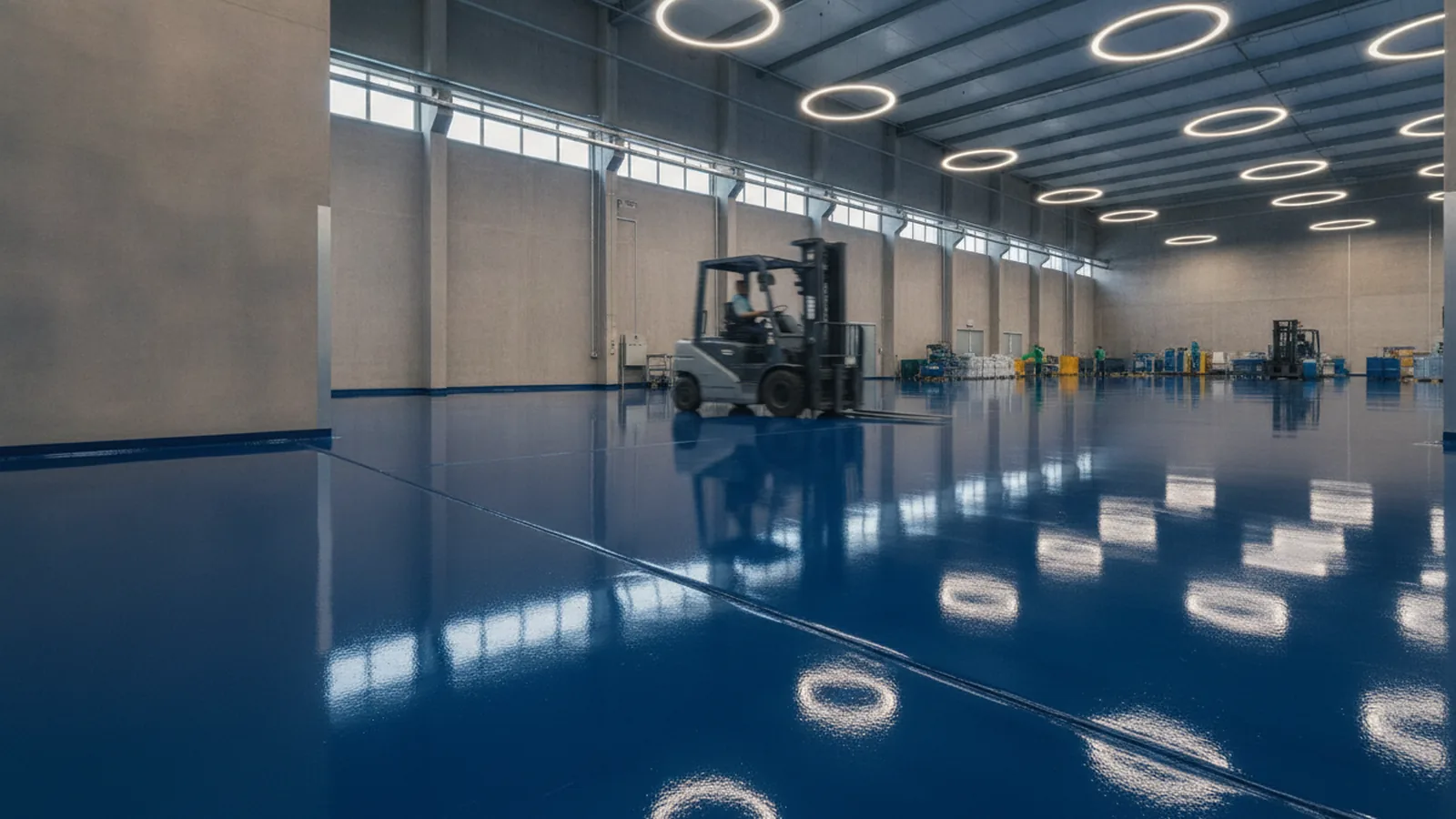
Epoxy vs PU Industrial Flooring: How to Choose for Your Facility
Compares epoxy, PU-cement and PMMA on heat, chemicals and cure time, with thickness bands from 0.1 mm to 9 mm.
Key takeaways
- Epoxy is rigid, hard and economical — ideal for clean, dry, general-purpose and chemical-storage floors, but it fails under sustained heat and thermal shock.
- PU-cement (e.g. Ucrete-type) is the heavy-duty answer for heat, steam wash-down, organic acids and hygiene — the default for food, beverage and pharma.
- PMMA cures in about an hour and works in cold conditions, making it the choice when downtime must be near-zero.
- Choose by exposure: thermal shock and food chemistry point to PU; mineral acids, solvents and containment point to epoxy; both are strong on abrasion.
- Match thickness to duty — from 0.1 mm coatings to 6–9 mm PU screeds — and never lay over a damp or green slab, especially during the monsoon.
- Specify the full build-up (primer, body, topcoat, coving, joints) on a sound, prepared substrate, and involve an experienced applicator like Space Arc early.
The short version
Few decisions affect a working facility as directly as its floor. It takes every forklift wheel, every drum of acid, every steam wash-down and every monsoon-season spill, day after day. Specify the wrong system and you are looking at premature failure, recurring shutdowns and repair bills that dwarf the original cost. Specify the right one and the floor quietly does its job for years. The two workhorses of industrial flooring are epoxy and polyurethane (PU), with PMMA (methyl methacrylate) filling a third niche where speed is everything. They look similar once cured, but they behave very differently under heat, chemicals and impact. This guide explains how each resin system performs, where it belongs and how to match the build-up to your operation — written for Indian architects, project engineers, contractors and facility owners who have to live with the result.
The three resin families: epoxy, PU and PMMA
Epoxy is a two-component thermoset that cures hard and rigid, bonds tenaciously to prepared concrete and gives a dense, glossy, easy-to-clean surface. It is the default for general industrial and commercial floors because it offers an excellent balance of strength, chemical resistance and cost. Polyurethane systems — and specifically the polyurethane-cement (PU concrete) screeds used in heavy industry — cure tougher and more flexible than epoxy. That flexibility lets them absorb impact and, critically, accommodate thermal movement, which is why they dominate in kitchens, dairies and process areas that see hot water, steam and rapid temperature swings. PMMA cures chemically in roughly an hour even in cold conditions, so it is chosen when a line, cold store or retail area cannot be shut for more than a day. Each family is offered by the manufacturers Space Arc distributes — across the industrial flooring range you will find epoxy and PU systems from Fosroc, Master Builders Solutions and others, so the choice is about matching chemistry to the application rather than brand availability.
- Epoxy: rigid, hard, glossy, economical — general-purpose industrial and commercial floors
- PU / PU-cement: tough, flexible, thermal-shock and chemical resistant — food, pharma, wet and hot process areas
- PMMA: very fast curing, cures in cold conditions — fast-track and cold-store work where downtime is the constraint
Self-levelling epoxy: where it earns its place
A self-levelling (self-smoothing) epoxy is the floor most people picture when they think ‘epoxy’ — a seamless, mirror-finish surface typically laid at 2 to 3 mm over a primed and repaired substrate. It is ideal where you want a clean, dust-free, chemically resistant floor without heavy thermal or impact demands: pharmaceutical clean-room support areas, electronics and assembly, packaging halls, showrooms, laboratories and general manufacturing. Thinner epoxy systems also exist — roller-applied coatings at a few hundred microns for light-traffic areas, and broadcast or screed systems where slip resistance or extra build is needed. The catch is heat and movement. Standard epoxy softens and can discolour under sustained high temperature, and being rigid it does not tolerate thermal cycling well. Pour boiling water or run a steam hose over an epoxy floor day after day and it will eventually craze, blister or debond. That single limitation is what pushes many process facilities toward PU.
- Best for: clean, dry-to-moderately-wet areas with foot and light-to-medium wheeled traffic
- Typical build: 2–3 mm self-levelling; thinner coatings for light duty, screeds for heavy duty
- Watch-outs: limited thermal tolerance, rigid (poor with thermal shock), can yellow under UV unless a PU/aliphatic topcoat is added
Polyurethane and PU-cement: the heavy-duty, high-temperature answer
When a floor has to survive heat, thermal shock, aggressive chemicals and constant wet cleaning, PU-cement (polyurethane-modified cementitious screed) is the system that delivers. Laid as a trowel or screed at roughly 6 to 9 mm, a well-known example is the Ucrete range from Master Builders Solutions — a benchmark for food, beverage and pharmaceutical floors worldwide. PU-cement tolerates thermal shock from steam cleaning and from spillage of hot liquids that would destroy an epoxy floor, resists a broad spectrum of organic and inorganic acids, lactic acids, fats and sugars, and because it has a thermal expansion close to that of concrete it stays bonded through temperature cycles. It is also dense and effectively impervious, so it does not harbour bacteria — a decisive factor in any hygiene-critical environment. PU systems are generally tougher and more abrasion- and impact-resistant than standard epoxy too, which is why heavy engineering and warehouse loading areas often specify them. The trade-offs are cost and finish: PU-cement is more expensive than epoxy and usually has a matt or lightly textured, less glassy appearance.
- Best for: food and beverage processing, dairies, breweries, commercial kitchens, pharma wet areas, cold stores, chemical and heavy engineering plants
- Why PU wins here: thermal-shock resistance (steam and hot-water wash-down), broad chemical resistance, flexibility and impact toughness, hygienic and impervious
- Reference system: Ucrete-type PU-cement from Master Builders Solutions; PU screeds and coatings also available across the industrial-flooring range
Head-to-head: chemical, thermal and abrasion resistance
On chemical resistance, both perform well, but they trade strengths. Epoxy handles a wide range of acids, alkalis, solvents and oils and is excellent for secondary containment and chemical storage, where rigidity and a fully sealed surface are assets. PU-cement edges ahead against organic acids — lactic, citric, acetic — and against the fats, sugars and aggressive cleaning agents found in food and dairy plants, where epoxy can be attacked over time. On thermal resistance there is no contest: standard epoxy is comfortable up to moderate warmth but struggles with sustained heat and fails under thermal shock, whereas PU-cement screeds can withstand steam cleaning and hot-liquid spillage and tolerate rapid hot-cold cycling. On abrasion and impact, both are strong; epoxy is very hard and abrasion resistant, while PU is tougher and more impact- and gouge-resistant because it flexes rather than fractures. The honest summary: choose epoxy for clean, dry, chemical-storage and general areas; choose PU wherever heat, thermal shock, food chemistry or heavy impact is in play. For containment bunds and corrosive-process areas, pair either system with the right protective coatings on walls and steelwork for a complete barrier.
- Chemical: epoxy strong on mineral acids, solvents, containment; PU stronger on organic acids, fats, sugars, food chemistry
- Thermal: PU-cement clearly superior — handles steam wash-down and thermal shock that crack epoxy
- Abrasion/impact: epoxy very hard; PU tougher and more impact-resistant due to flexibility
Application-by-application: food and pharma, warehouse, car park
Food, beverage and pharma: default to PU-cement (Ucrete-type). Wash-down, steam cleaning, organic acids and hygiene rules all point to PU; specify integral coving at wall and plinth junctions and falls to drains so the floor cleans easily and holds no standing water. Warehouses and distribution centres: the loads are wheeled traffic and point loads from racking and forklifts, not heat or chemicals, so a high-build epoxy screed or self-levelling epoxy is usually the economical choice; abrasion-resistant aggregate broadcast extends life in the busiest aisles, and line-marking can be integrated. Where heavy steel-wheeled or very high-impact traffic runs, a PU screed is the more durable specification. Car parks: these are a special case — they are exposed decks subject to UV, thermal movement, rainwater, chlorides from vehicles and dynamic flexing of the structure. A car-park deck coating is typically a flexible PU-based crack-bridging system on the exposed roof deck, with a tougher epoxy or PU build in the heavily trafficked ramps and intermediate floors. Crucially, the deck coating works hand in hand with the waterproofing strategy and with movement detailing through expansion joints, so the floor finish and the watertightness of the structure are designed together.
- Food/pharma: PU-cement with coving and falls to drains; hygiene and wash-down driven
- Warehouse: epoxy (self-levelling or screed) for cost and abrasion; PU screed for heavy/steel-wheeled traffic
- Car park: flexible crack-bridging PU deck coating on exposed decks; integrate with waterproofing and expansion joints
Thickness systems: from thin-film coatings to heavy-duty screeds
Thickness is a specification decision, not an afterthought — it should follow from the traffic, the chemical and thermal exposure and the condition of the substrate. As a working framework: thin-film coatings at roughly 0.1–0.5 mm (roller or sealer-grade epoxy/PU) suit light foot traffic, dust-proofing and aesthetics; self-levelling systems at 2–3 mm give a seamless, durable surface for medium-duty industrial and commercial floors; broadcast or mortar systems at 3–6 mm add slip resistance and impact capacity through aggregate; and heavy-duty screeds at 6–9 mm (and occasionally more) — almost always PU-cement in process plants — take the worst combination of impact, abrasion, heat and chemical attack. Thicker is not automatically better: an over-thick rigid epoxy can be more prone to stress cracking, while a flexible PU screed at the right build outperforms it. Whatever the system, the substrate must be sound — laitance removed, surface mechanically prepared, moisture under control, and any defects made good with the appropriate concrete repair mortars before priming. The bond is only ever as good as the concrete beneath it.
- 0.1–0.5 mm: thin-film coatings — light traffic, dust-proofing, aesthetics
- 2–3 mm: self-levelling — seamless medium-duty industrial/commercial floors
- 3–6 mm: broadcast/mortar — slip resistance and added impact capacity
- 6–9 mm+: heavy-duty PU-cement screeds — maximum impact, abrasion, heat and chemical resistance
Downtime, curing and the Indian climate
Downtime is often the deciding factor in a live facility, and it splits the three families cleanly. Epoxy is the slowest to return to service — typically allow around a day for light foot traffic and up to roughly a week before full chemical and load service, and epoxy is sensitive to low temperature, curing sluggishly below about 10°C. PU systems generally turn around faster than epoxy and cope better with a wider temperature window. PMMA is in a class of its own: it cures in about an hour and can be laid in cold conditions and cold stores, so a floor can go down overnight and be back in use the next morning — at a premium price and with a strong odour during installation. India’s climate adds two practical constraints. First, humidity and the monsoon: resin floors are unforgiving of moisture in the slab, and laying over green or damp concrete — common when programmes are rushed in the rainy season — is the single most frequent cause of blistering and debonding. Always test substrate moisture and use a moisture-tolerant primer or damp-proof membrane where readings are high. Second, summer heat: high ambient temperatures shorten pot life and working time, so plan to lay in cooler parts of the day and adjust quantities to the conditions. Good site discipline on substrate preparation, moisture and temperature matters more to the final result than the choice of resin itself.
- Return to service: PMMA ~1 hour; PU faster than epoxy; epoxy slowest (light traffic ~24 h, full service up to ~7 days)
- Temperature: epoxy cures poorly in the cold; PMMA cures even in cold stores
- Monsoon risk: never lay over green/damp slabs — test moisture, use moisture-tolerant primers or a DPM
- Summer heat: reduced pot life — lay in cooler hours and adjust batch sizes
How to specify: a quick decision framework
Work through five questions in order and the right system usually selects itself. 1. Temperature and thermal shock — any steam cleaning, hot spillage or hot-cold cycling? If yes, specify PU-cement; epoxy will fail. 2. Chemicals — what is actually spilled, and how often? Organic acids, fats and sugars favour PU; mineral acids, solvents and containment favour epoxy. 3. Loads and impact — foot traffic, pallet trucks, forklifts or steel-wheeled loads? Heavier impact pushes toward thicker builds and PU. 4. Hygiene — food, beverage or pharma? PU-cement with coving and falls to drains. 5. Downtime — how long can the area be closed? If almost none, consider PMMA; otherwise epoxy or PU on a normal programme. Then size the thickness to the duty and confirm the substrate is sound and dry before anything is laid. Because the answer is rarely one product but a build-up — primer, body coat, topcoat, coving and joint detailing — it pays to involve an experienced applicator early. Space Arc supplies and applies epoxy, PU and PMMA systems from the leading manufacturers across India; our team can survey the substrate, recommend the system and stand behind the installation.
- Ask in order: thermal shock, chemicals, loads/impact, hygiene, downtime
- Specify the full build-up — primer, body, topcoat, coving, joints — not just a single product
- Confirm a sound, dry, prepared substrate before laying — it governs the result more than the resin
- Involve the applicator early; Space Arc surveys, specifies and installs pan-India
- Master Builders Solutions
- Fosroc
- Protective Coatings & Corrosion
- Waterproofing
Frequently asked questions
Is epoxy or PU flooring better for an Indian food processing plant?
How thick should an industrial epoxy or PU floor be?
Why does epoxy flooring fail under heat or steam cleaning?
Which flooring system gives the least downtime?
Can resin flooring be laid during the monsoon?
What flooring is best for a multi-level car park?
Does Space Arc supply and install both epoxy and PU flooring across India?
Related products & ranges
Related articles
Three more from the same corner of the catalogue.

D-Seal Expansion Joints: Floor, Wall, Roof and Seismic
Sorts D-Seal into four families by joint location, then four questions — location, movement, traffic, exposure — that narrow to one profile.
Expansion Joints Explained: Types, Selection and Installation
Explains the four joint types, how to size a gap from calculated movement, and when to use metal-and-insert versus compression seals.
Tile Fixing: Adhesive Classes, Grouts and Why Tiles Debond
Decodes C1/C2/S1 adhesive classes, sets out the wet-area build-up order, and traces debonding and efflorescence back to their causes.
Related products & solutions
The systems this article is about, with the published data behind them.
Downloadable resources
Current-revision documents, sent straight over.
Specifying this on a live project?
Send the substrate, the exposure and the area. We are an authorised distributor and applicator for nine manufacturer ranges, so the recommendation follows the condition rather than the stock.